
Urinary System
Overview
The urinary system influences the organism’s homeostasis by osmoregulation. It’s functions are:
1. filtration of the blood — in the kidneys' cortex, blood plasma is filtered from the glomeruli into the glomerular capsule and flows down the tubular system in the medulla portion of the kidney.
2. reabsorption — a major part of the primary urine is returned to blood vessels that surround the tubules of the medullary region.
3. secretion — the remaining liquid becomes urine, which travels down collecting ducts to the renal pelvis.
4. excretion — the urine is stored in the urinary bladder and is expelled via the urethra, controlled by sphincter muscles.
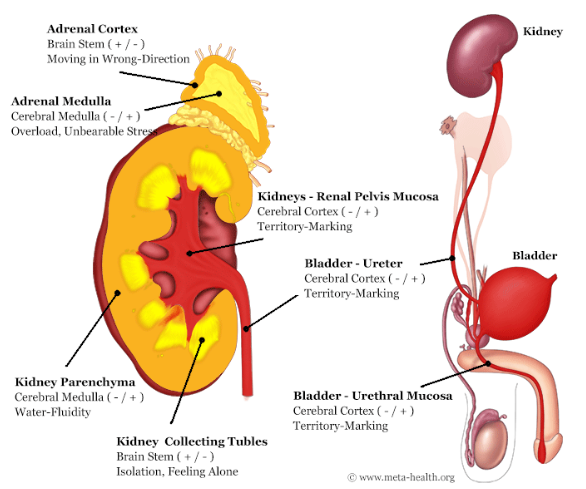
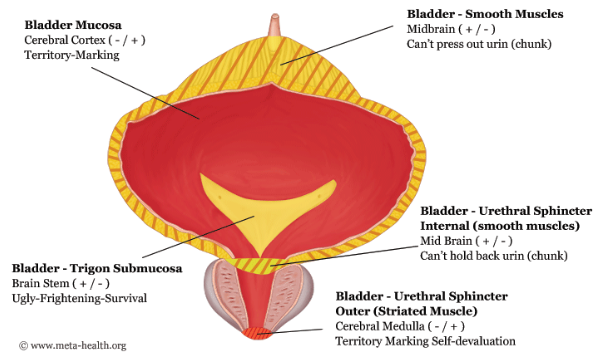
META-Organ tissues & Brain Relays:
Kidneys
- Kidneys – Parenchyma/Glomeruli (Cerebral Medulla -/+): Drowning, managing liquids
- Kidneys – Collecting Tubules (Brain Stem +/-): Abandonment, survival in hostile environment
Urothelium - Kidneys – Renal Pelvis Mucosa (Cerebral Cortex -/+): Excretion, boundaries
- Ureter, Urethral Mucosa (Cerebral Cortex -/+): Excretion, boundaries
- Bladder – Mucosa (Cerebral Cortex -/+): Excretion, boundaries
Excretion - Bladder – Trigon Mucosa (Brain Stem +/-): Excretion, expelling ugly waste
- Bladder – Urethral Sphincters (Cerebral Medulla -/+, Midbrain +/-): boundaries, self-control
- Bladder – Mucle Layer (Midbrain +/-): expelling ugly waste
- Bladder – Submucosa Layer (Cerebral Medulla -/+): self-worth concerning boundaries and self-control
