
Kidneys – Parenchyma
Anatomy
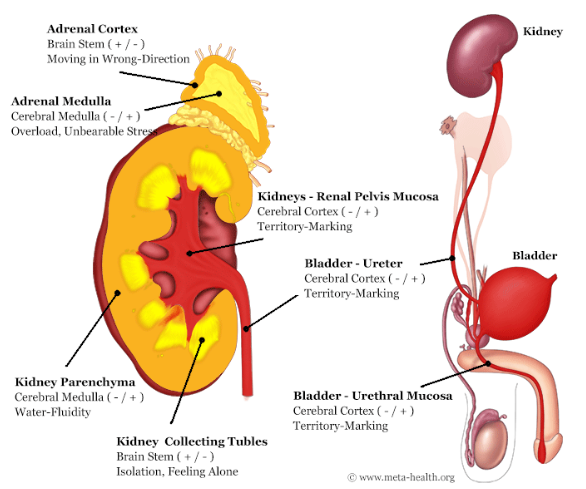
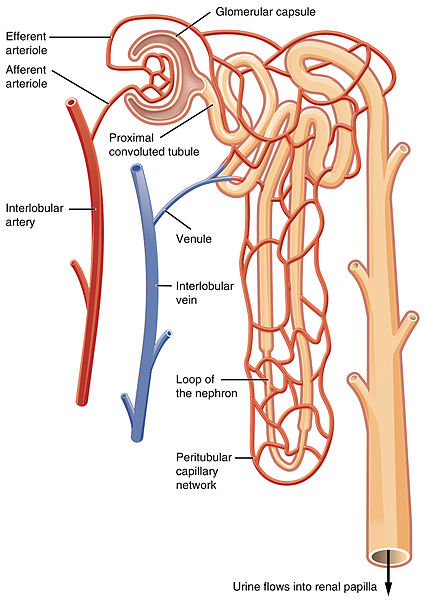
Parenchyma refers to the kidney cortex and medulla which consist of the blood supply and the nephrons as functional basic units. The nephron consists of renal corpuscles and a tubular system leading to the collecting ducts. 2 processes are carried out in the kidney parenchyma:
1. In the renal corpuscles (glomeruli made out of balled-up capillaries surrounded by Bowman’s-capsule) the primary urine is filtered from the blood. Blood cells and bigger molecules are filtered out, so that only low-molecular components remain, which are to be excreted.
2. In the tubular system, glucose, amino acids and electrolytes as well as water are reabsorbed back into the bloodstream, by which the urine is concentrated and is passed on to the collecting ducts and renal pelvis.
The distal tubules are counted to the collecting tubule system.
Brain
Relay:
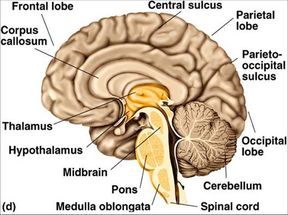
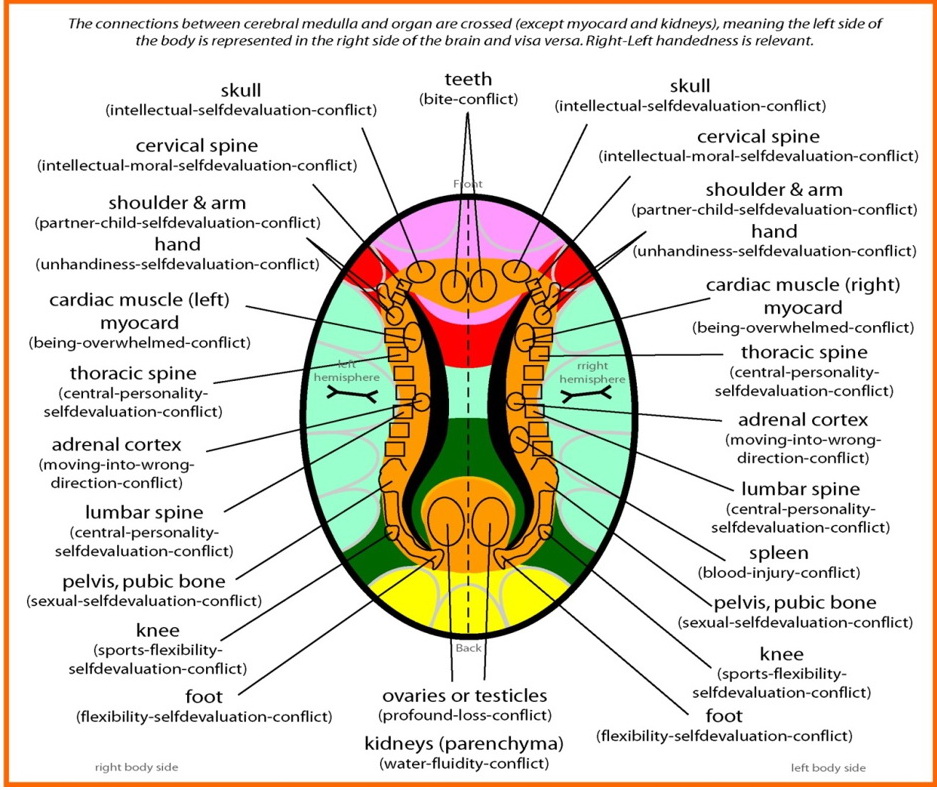
Cerebral Medulla/upper Midbrain ( – / + ), dorso-central, caudal (below) of the ovary/testes relays
The brain-organ connection is not crossed because of vicinity to the midbrain
Mind
Theme:
Overwhelm or trauma concerning water or fluids, also associated: feelings of drowning in something
Also information overwhelm which cannot be filtered sufficiently
Emotions, Thoughts:
Panic, hopelessness
- I’m drowning!
- This is just too much!
- Where does all the water/blood/fluid come from?
- I won’t ever get this mess cleaned up!
- That’s dangerous!
META-Meaning:
- I am safe and able to handle the circumstances.
- I am floating!
Organ
Stress Phase Symptoms:
Decrease in glomerular and tubular function and the blood-urine barrier. Renal artery stenosis and possibly necroses leading to uremia (concentration of urea, creatinin and uric acids in the blood), compensatory renovascular hypertension (Goldblatt-mechanism), as well as proteinuria. Possible diagnosis: renal insufficiency, nephrotic syndrome
Uremia can make the body attempt to excrete the toxins via the digestive tract by nausea and vomiting, or via the skin by producing a generalized itch. In longer periods, it can affect the heart and the nerves (polyneuropathy).
Regeneration Phase Symptoms:
Inflammatory swelling, first impaired filtering function (proteinuria) then slow restoration, normalization of blood pressure, growth of cysts or tumors possible. Possible diagnoses: glomerulonephritis, renal artery stenosis, nephritic syndrome, nephroblastoma, kidney cell carcinoma
Biological Meaning:
The increase of blood pressure in stress phase in order to maintain or to increase renal excretion. After regeneration phase, Cerebral Medulla-related tissues are stronger than before, thus indurated cysts are meant to contribute to the improvement of excretory renal function.
Social
Flood disasters, almost drowning, but also other traumatic life experiences in connection with alcohol, blood or other liquids
Overload of information, like by news & social media, can trigger this programme.
Examples:
- A client with hypertension recalls playing in the leaves as a child, slipping and falling into the lake, and almost drowning because she cannot swim. She couldn’t tell anybody about that incident. When she renegotiates the memory, she feels better grounded and supported which helps her to manage. (Klapp)
- A sailor is diagnosed with bouts of hypertension. It is winter time, and the steel deck and ladderway (which are under his responsibility) are slippery and dangerous. He needs to have physical and emotional balance. (Klapp)
Additional Information
Kidney Cysts
According to Dr Hamer's concept, a full process of the kidney parenchyma from the stress trigger to full repair (which is the encapsulation of the tumor) lasts for 9 months regardless of the length of the stress phase. At the end of the regeneration phase, the remaining (solidified) cysts showing an increased filtering capacity. By now, at the latest, the blood pressure becomes ‘fully normalized’.
The cysts may show an exophytic (pushing the kidney capsule outwards) or an endophytic (within the kidney capsule) form.
During the regeneration phase about 4-6 months after the regeneration trigger part of the cyst has already solidified and at this point may be diagnosed as nephroblastoma. At this point the cyst has yet an independent blood supply and commonly infiltrates the surrounding tissues. Solidified renal cysts become part of the kidney parenchyma and are able to produce urine. Now, they estabilish an independent blood supply and encapsulate themselves. A functional organ emerges.
Constellations:
Adaptation-Megalomania: Kidney parenchyma relays of both hemispheres affected: the person “always stays afloat” or seeks extreme challenges in water, like deep sea diving, free diving or sailing.
Differential Diagnosis:
Kidney Collecting Tubules (Brain Stem, +/-): stress phase (abandonment): enhanced reabsorption and water retention, oliguria, kidney stones formation; Regeneration phase: nephritis, enhanced urination, proteinuria
Renal Pelvis Mucosa – Urothelium (Cerebral Cortex, -/+) stress phase (boundaries): dilation, inconspicious tissue reduction enhanced excretion; Regeneration phase: painful pyelonephritis, hematuria
Other causes for hypertension: - Every stress phase because of vasoconstriction – mechanic
- Kidney tubules in stress phase – blood volume
- Right myocardium in stress phase (diastolic pressure elevated)
- Pericardium in stress phase and regeneration phase A – compensatory
- Pituitary posterior lobe in stress phase – hormonal (elevated cortisol)
- Adrenal cortex in regeneration phase – hormonal (elevated cortisol)
- Adrenal medulla in stress phase – hormonal (elevated adrenalin, noradrenalin)
- Thyroid in stress phase – hormonal (elevated thyroxin)
