Eyes – Retina
Anatomy
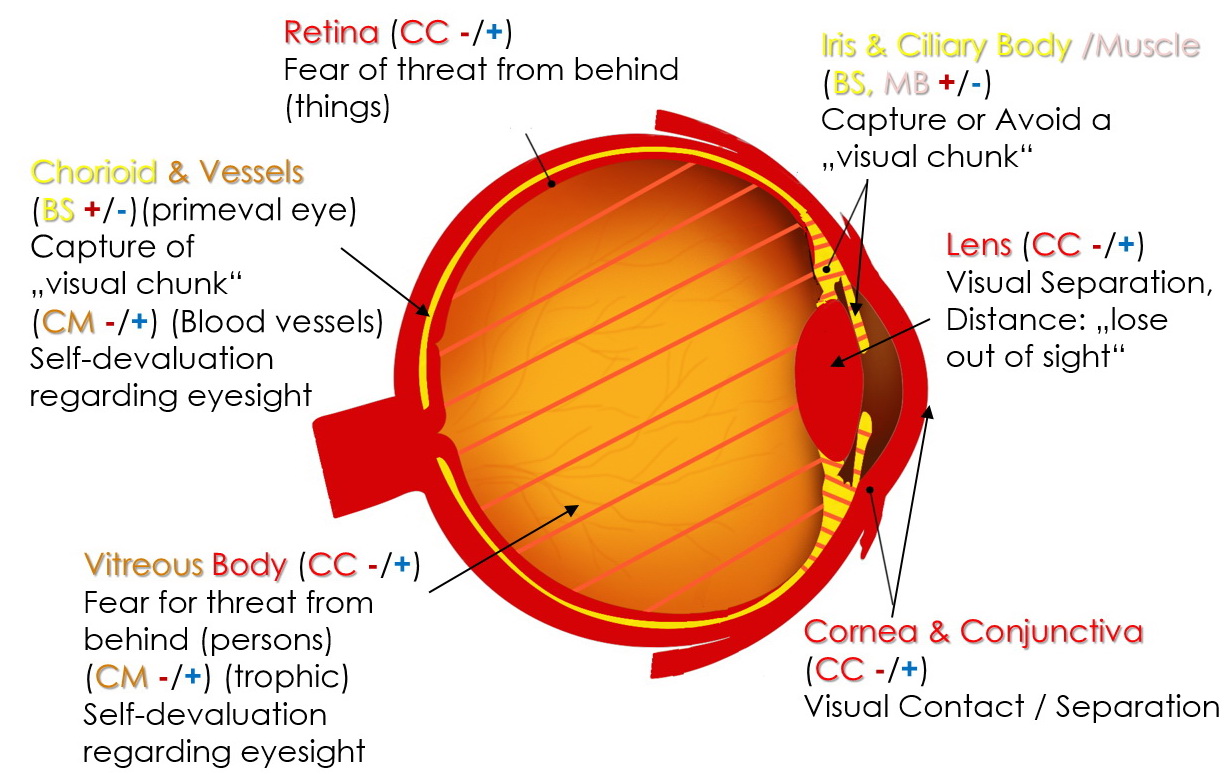
The retina is a thin layer of neural cells that lines the back of the eyeball. The retina and the optic nerve originate as outgrowths of the developing brain. Hence the retina is part of the central nervous system (CNS). The retina contains photoreceptor cells (rods and cones) that respond to light: The cones enable colour vision, the rods make vision with little light possible . the resulting neural signals then undergo complex processing by other neurons of the retina and are transmitted to the visual cortex by the optic nerve.
Brain
Relay
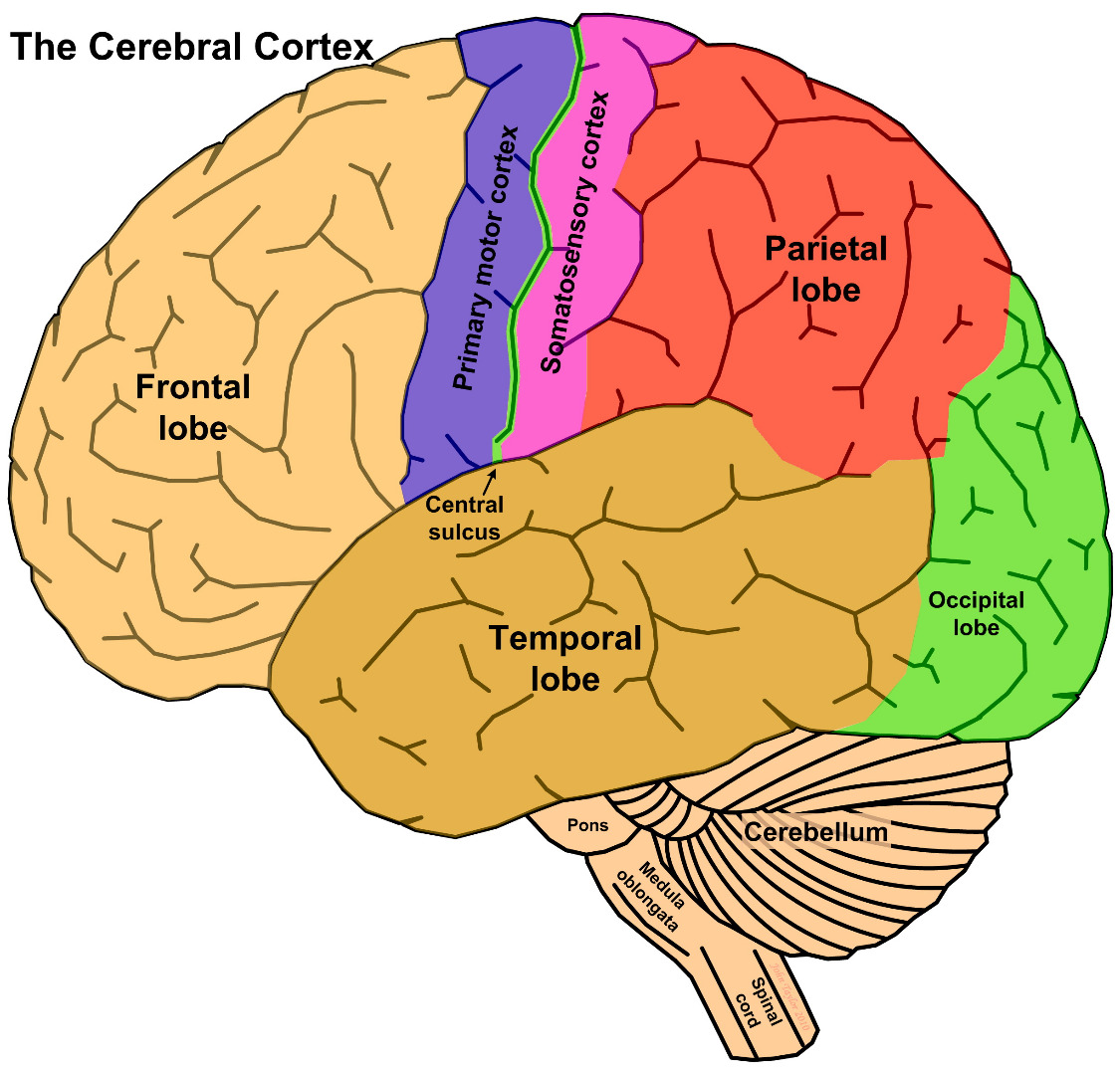
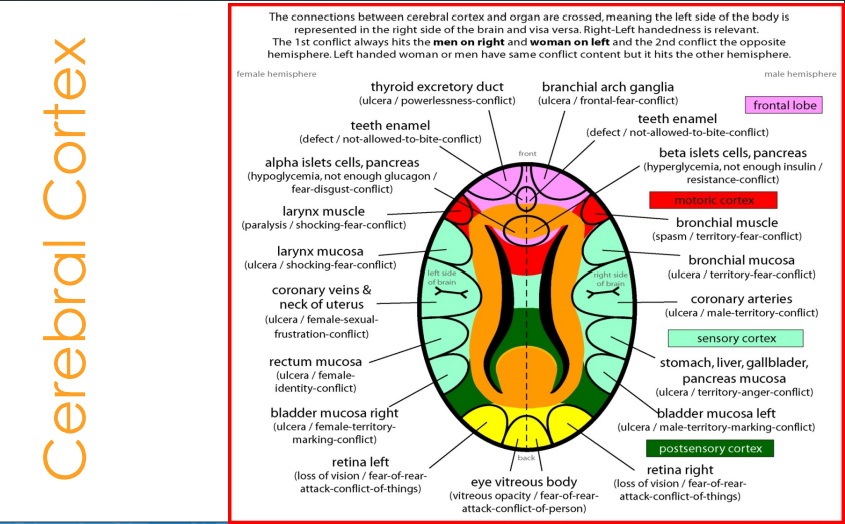
Cerebral Cortex ( – / + ) visual cortex in the occipital lobe left & right
Mind
Theme
Fear of threat or attack from behind (things), Persecution
Handedness and the affected retinal areas:
Right-handed people look with the left of each retinal half of both eyes and left visual center to the right partner side. Partner conflicts concern the left of each retinal half and the left visual center.
Right –handed people look with the right of each retinal half of both eyes and the right visual center to the left towards the mother/child –side. Mother-kid conflicts concern the right of each retinal half and the right visual center.
For left-handed people vice versa.
Emotions, Thoughts
Fear, guilt or shame
Fear of something one cannot control that is threatening or lurking from behind.
- At any moment I could be caught!
- I should have acted differently.
- The danger is looming over me.
- I can’t shake that off!
META-Meaning
- I am secure. Now, I can look around fearlessly.
- I accept myself as I am, and take learnings on board.
Organ
Stress Phase Symptoms
Functional decrease in color or contrast perception, retinal atrophy or degeneration. Opacity of the vision (glaucoma), tunnel vision, scotoma. Often the visual cortex of both hemispheres is concerned (see constellations below), and a persecution complex may develop (paranoia).
In the same conflict pattern, we often see contracted eye- and neck muscles fascia, midbrain +/-).
Regeneration Phase A
During that regeneration phase, an edema forms between the inner (neuro-)retina and the nourishing pigment layer. This can lead to a retinal detachment that is particularly dramatic if the retinal cavity (Fovea centralis) is concerned, where the detachment causes a dramatic reduction in vision and possibly blindness if not addressed properly. In case of a KCT-syndrome intense complications can arise (oedema). Typical symptoms:
- „grey spot“ (scotoma) in the visual field
- image distortion (metamorphopsy)
- far-sightedness (hyperopia)
- impaired colour vision
- loss of contrast
Possible diagnosis: RCS (Retinopathia centralis serosa)
Healing Peak
Oedema is reduced/”squeezed out”, short unconsciousness/absence
Regeneration Phase B
In regeneration phase B, function is returning. Detachment heals with scars, leading to floaters (Mouches Volantes) and deformation of the eyeball. This contributes to vision impairment like near- or farsightedness (myopia, ambliopia) together with eye muscle tension. Eye-training and other ways to retrain and correct the vision might be needed.
Biological Meaning
The functional reduction in stress phase hides the feared threat and is meant to facilitate the escape. Near- and farsightedness reflect the indivdual coping strategies, hiding what one doesn’t want to deal with.
Social
Examples
- A woman refuses to let her abdominal pain be checked by a doctor. Disease is lurking, but her fear of doctors prevents her from seeing one. Her nearsightedness increases.
- A woman has panic attacks and can’t define what is triggering them. She perceives opaque vision and many floaters.
- A woman with RCS has recently moved to a new community after having lived most of her life alone. She thrives there, but had previously feared the company of other people and not being good enough. She recognizes old conflicts with her mother being at the root of her fear, and finds the power to clear them at last. (Odum)
Additional Information
Macula degeneration is a condition connected to the retina as well as to the chorioid of the eye. While a retina detachment happens through the healing oedema in regeneration phase A, there is often seen an excessive growth of blood vessels from the choroid and behind the retina. This happens in stress phase of a “visual chunk” conflict triggered by the vision impairment.
Constellations
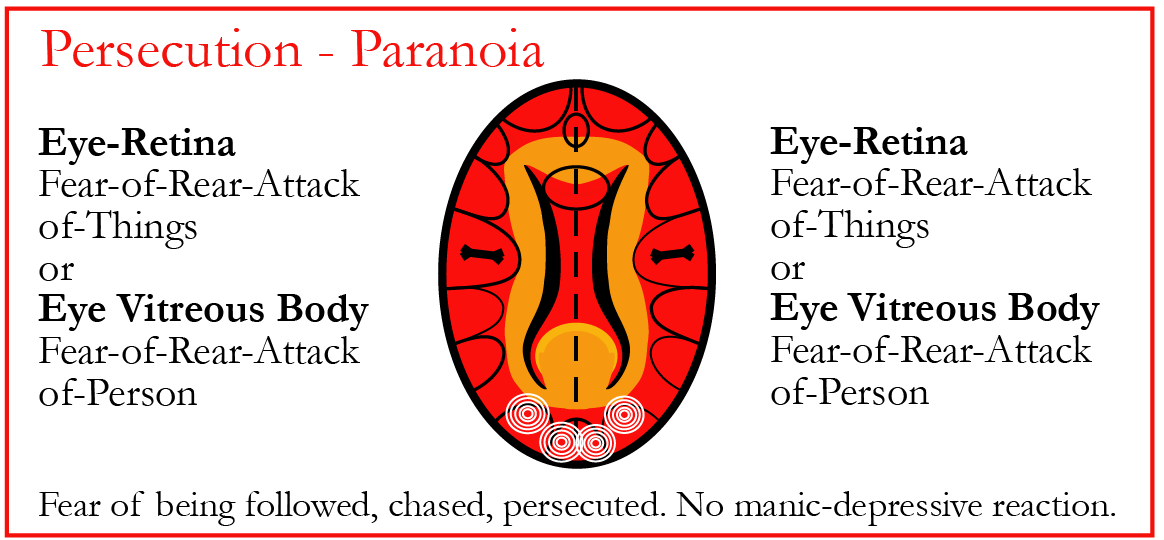
Paranoia: Retina relays of both hemispheres are concerned. The person feels persecuted. Conspiracy theories are often seen. If the conflicts have a sexual/territorial theme, manic and depressive states can occur.
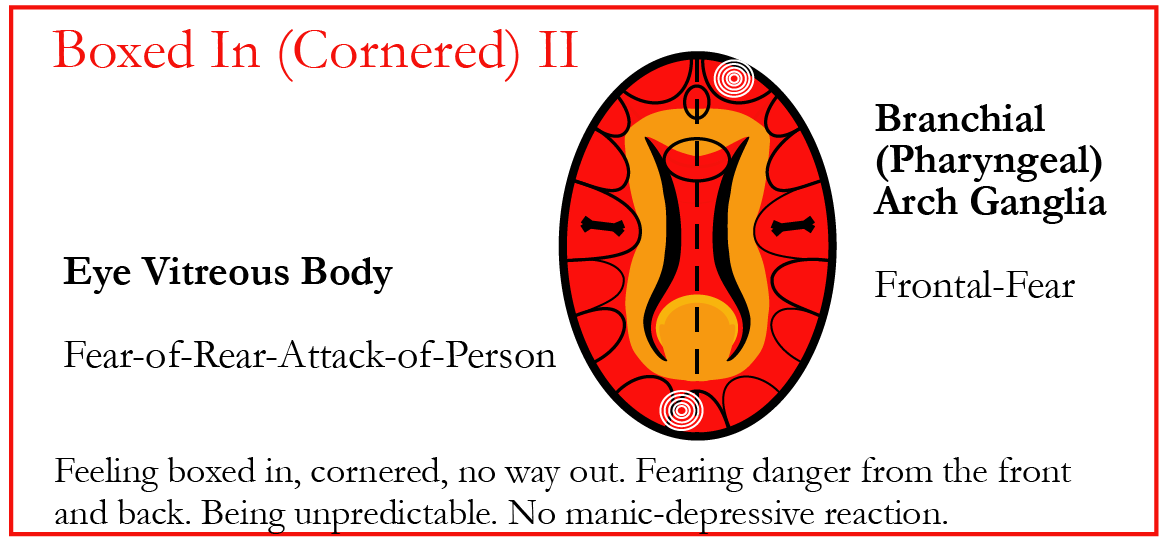
Cornered/Boxed in: One retina relay and one frontal relay are concerned archaic thyroid ducts/archaic pharyngeal ducts). This can be mono- or bilateral. Freeze response or unpredictable spontaneous behaviour to survive the perceived threats.
Differential Diagnosis
Crystalline Lens (Cerebral Cortex -/+): Decrease in trophic, thinning of the lense in stress phase (Loss of meaning in life), reinforcement and possibly loss of elasticity in regeneration phase, leading to presbyopia.
Vitreous Body (Cerebral Cortex -/+) stress phase (persecution fear): Loss of intraocular pressure, Regeneration phase: glaucoma (increased intraocular pressure because of healing oedema).
Cornea (Cerebral Cortex -/+): Processes of thinning/damage (trigger: loss of visual contact) and reinforcement can lead to changed shape of the cornea, resulting in astigmatism.
Chorioid (Brain Stem +/-): The stress reaction of excessive blood vessels growing has an influence on detachment and degeneration of the retina.