
Eyes – Lacrimal Ducts & Nasolacrimal Duct
Anatomy
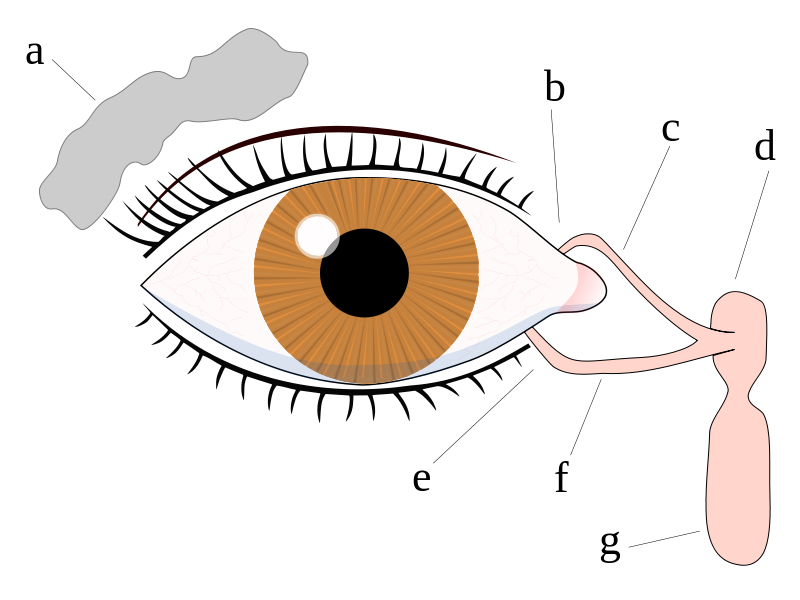
The lacrimal glands are paired glands that secrete the aqueous layer of the tear film. They are situated in the upper outer portion of each orbit. The tear fluid contains salt, oil and proteins. It is lead via the excretory ducts into the lacrimal sac. It nourishes and cleans the cornea, being spread by the conjunctiva of the inner eyelid when blinking.
The nasolacrimal duct carries tears from the lacrimal sac into the nasal cavity. Excess tears flow through nasolacrimal duct which opens in the nose. This is the reason the nose starts to run when a person is crying or why you can sometimes taste eye drops. Like the lacrimal sac the duct is lined by stratified columnar epithelium containing mucus-secreting goblet cells (Brain Stem +/-) and is surrounded by connective tissue. The canal containing the nasolacrimal duct is called the nasolacrimal canal.
a = lacrimal gland, b = superior lacrimal punctum, c = superior lacrimal canal, d = lacrimal sac, e = inferior lacrimal punctum, f = inferior lacrimal canal, g = nasolacrimal canal
[ https://commons.wikimedia.org/w/index.php?curid=1045167|graphic: Erin Silversmith ]
Brain
Relay:
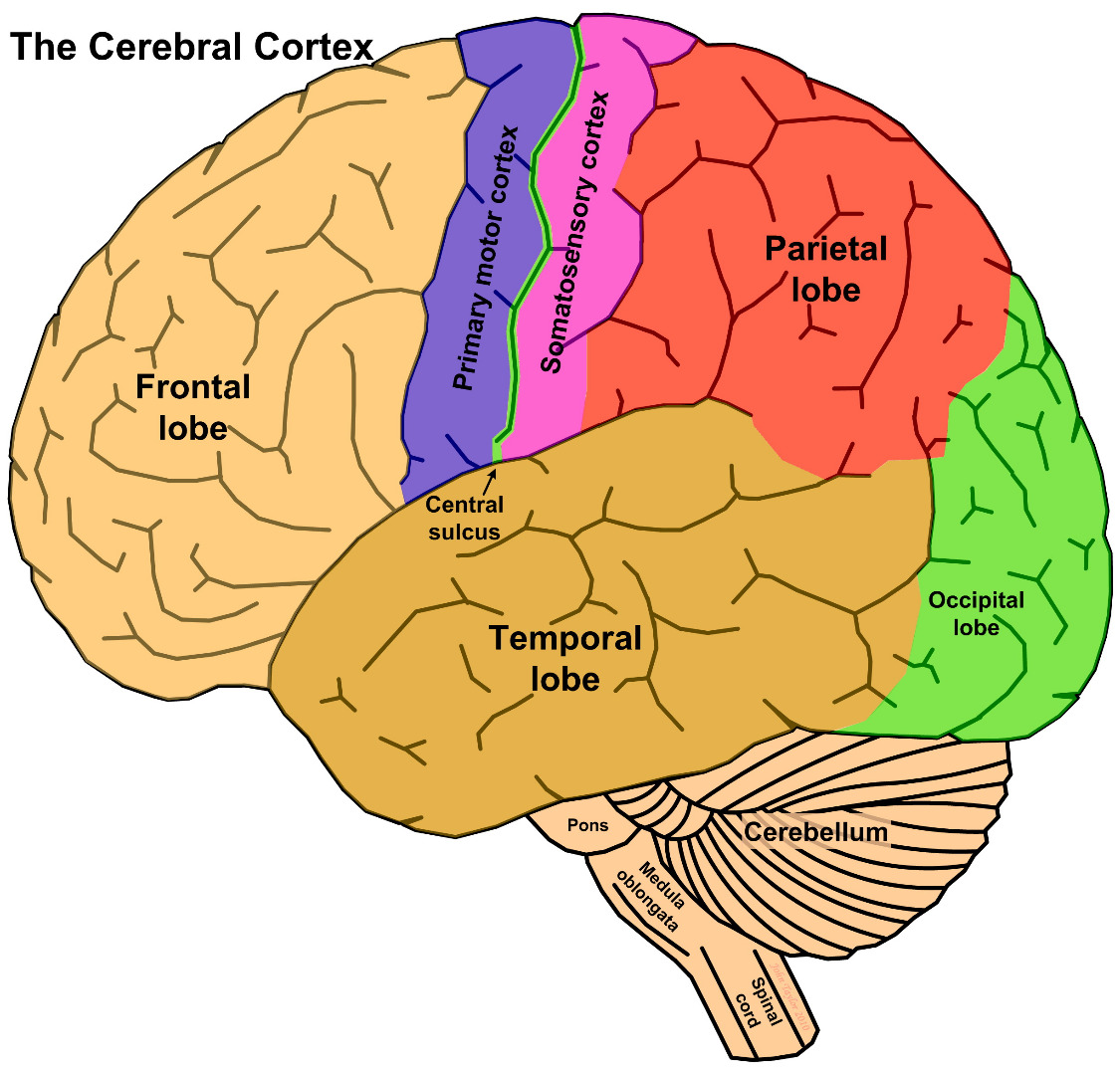
Cerebral Cortex ( – / + ) premotoric sensory area lateral left & right, brain-organ-relation crossed
Mind
Theme:
Visual Recognition, Attention
Emotions, Thoughts:
The wish to be seen and acknowledged, or the wish to not be seen.
- I want them to see and recognize me!
- Look at me!
- He can’t look me in the eyes.
- I can’t look her in the eyes.
- I don’t want them to see me like this!
META-Meaning:
I feel loved and recognized, because I love and recognize myself.
Organ
Sensitivity reaction according to Inner Skin/Stomach Mucosa Pattern with hyperesthesia in stress phase ”(”point of discussion” /Kora)”
Stress Phase Symptoms:
Widening of the ducts by smooth muscle reaction which leads to momentary release of tear fluid and possibly epiphora (wet eyes). Later in the process there may be ulcer formation in the lacrimal ducts accompanied by dragging pain (IS).
Regeneration Phase Symptoms:
Swelling and inflammaion of the excretory ducts and lacrimal canal (Canaliculitis) which leads to congestion and dry eyes or epiphora, and sometimes could be diagnosed as a tumor.
In chronic processes, lacrimal stones (dacryoliths) can build up, or a stenosis can occur because of repair with scar tissue.
Biological Meaning:
Because of the extended diametres of lacrimal ducts in stress phase, a larger amount of lacrimal fluid can be forwarded faster, in order to see clearer and also to draw attention to oneself (crying).
Social
Examples:
- A child, after having got a little brother, feels that her parents don´t have eyes for her anymore but just for the baby. She cries because the lacrimal ducts hurt, and gets her mother’s attention.
- A boy is mobbed at school and on his way home. He wishes himself to be invisible for his persecutors. Safe at home, he gets dry eyes.
- The client feels disregarded at work, since the office was changed and her desk moved. In the evenings, she suffers from dryness in the eyes.
Additional Information
Differential Diagnosis:
Lacrimal gland (Brain Stem +/-): Increased production of tear fluid in stress phase of “visual chunk” conflict, dry eyes after several regeneration phases in recurring processes because of functional degradation with scar tissue.
Conjunctiva (Cerebral Cortex -/+): itch, pain & increased tear flow in regeneration phase after loss of visual contact.
Other possible reasons for dry eyes include: - Staring, too little blinking (eye muscles, eyelid muscles) e g due to work behind a computer screen
- Blepharitis
- Dry air through air conditioning
- Low testosterone level (also due to medication)
- Eye surgery
