Eyes – Iris & Ciliary Body
Anatomy
The iris is the blind of the eye which surrounds the pupil. It’s pigment layer collects scattered light. It is divided into two major regions:
- The stroma connects a sphincter muscle (sphincter pupillae) which contracts the pupil and a set of dilator muscles (dilator pupillae) which open it. They are directed by the autonomous nervous system: in stress the pupil widens and in relaxation it narrows. The back surface of the stroma is covered by the iris pigment epithelium.
- The outer edge or root of the iris is attached to the sclera and the anterior ciliary body. The ciliary body produces aqueous humor which constantly drains through the region just in front of the root of the iris, with the result that diseases of the iris often have important effects on intraocular pressure and indirectly on vision. The eye lens is suspended with zonula fibres, and is accomodated/adjusted by ciliary muscles. The iris and ciliary body together are known as the anterior uvea.
Brain
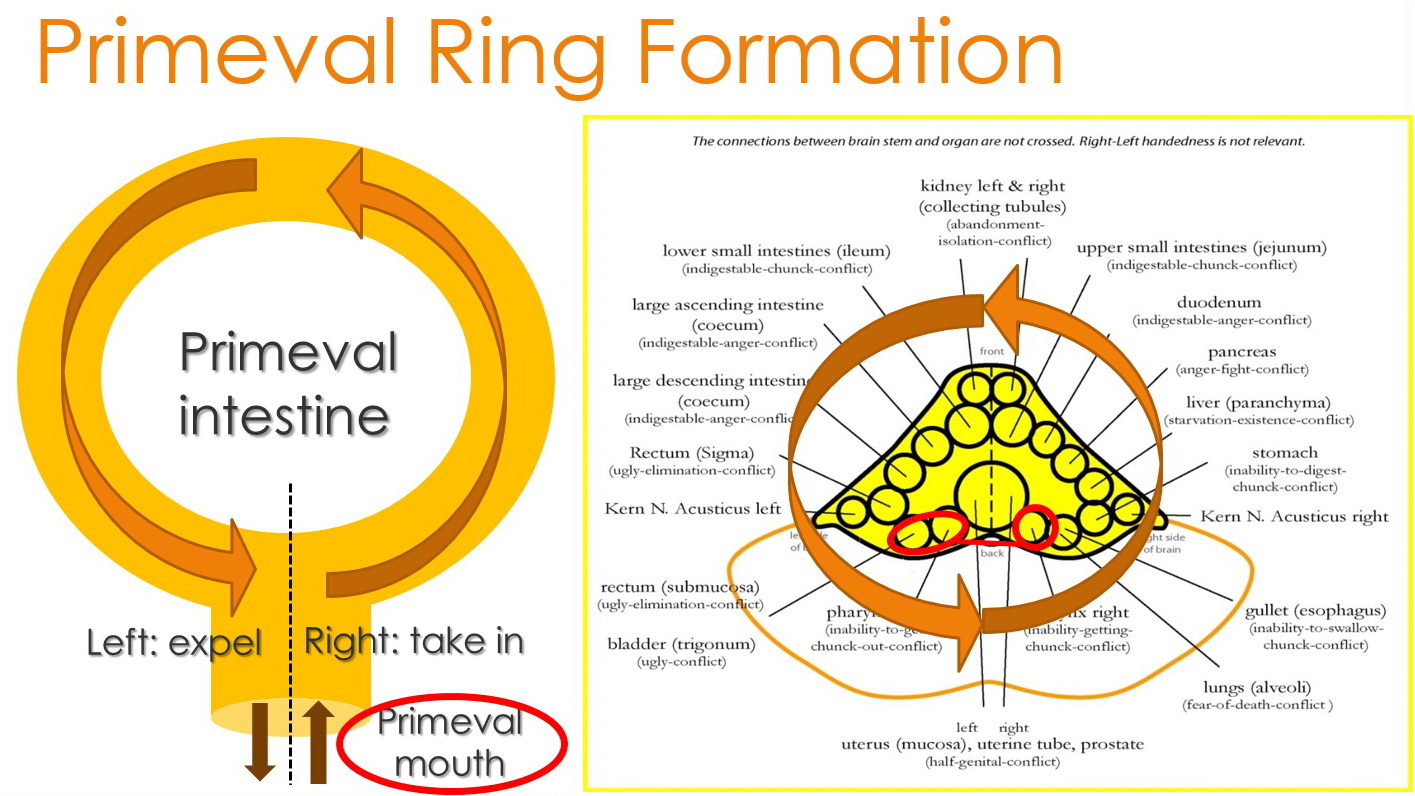
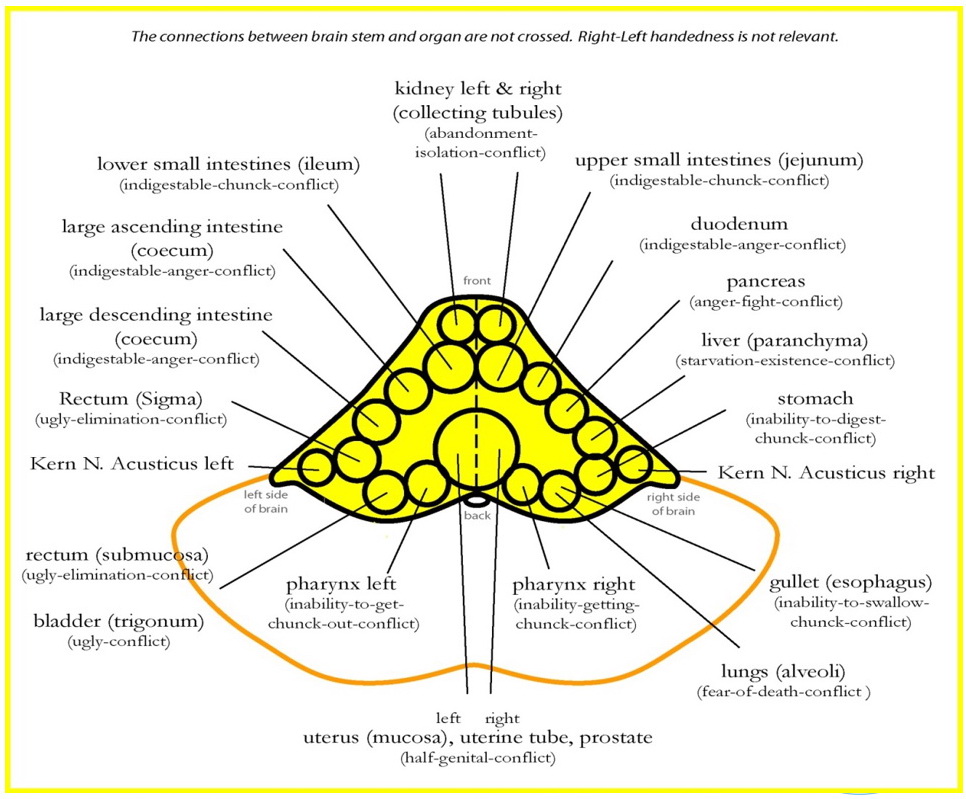
In the Brain Stem, the primeval ring structure is reflected: organ tissue relays with assimilative and digestive functions from oesophagus to small intestines are situated in the right brain stem, while excretory organs from caecum to rectum are relayed in the left brain stem. Medial on both sides are the relays of mouth/pharynx, middle ears and lacrimal glands, as well as the pineal and pituitary glands and the thyroid.
Relay
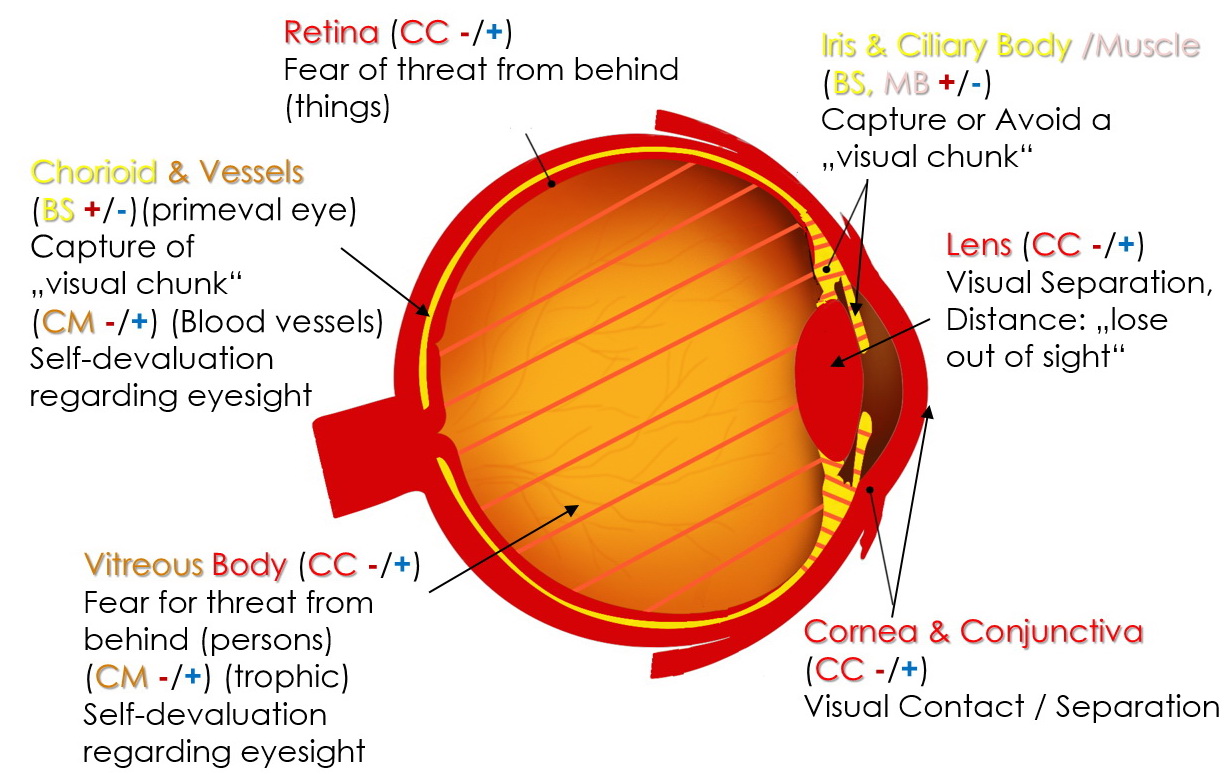
Brain Stem ( + / – ) lateral left & right, for iris and ciliary body
Midbrain (+/-) lateral left & right, for sphincter and dilator muscles
Mind
Theme
“Visual Chunk”: Capturing or avoiding light
Emotions, Thoughts
Pressure, Strain
- I can’t see that!
- The light is hurting my eyes!
- I was incapable of keeping my eye on it.
- My sight was inadequate.
- I will never forget that sight.
- I wish I had never seen that.
- I need to see that to catch it!
META-Meaning
- Everything I need to see is within my reach, and I can let the rest pass.
- I find it easy to look and to see.
- I trust my eyes.
Organ
Stress Phase Symptoms
1. Increase of tension in the affected muscles (too much or too little light). Due to that contracture, the pupil cannot adapt to the incidence of light, which leads to myosis or mydriasis (night-blind or overly light-sensitive).
2. Proliferation in iris pigment cells (iris naevus) and thickening of the stroma. Possibly incorporation of substances from medication or processes in other organs.
3. Increase of production of aquaeous humour which leads to high inner pressure and can be diagnosed as glaucoma.
Regeneration Phase Symptoms
1. Normalization of tonus in the smooth muscles.
2. Inflammation of iris and ciliary bodyr (iridocyclitis) and degradation of the reinforced tissue. Possibly angle closure glaucoma (Oedema in the anterior or posterior eye chamber) during regeneration phase A.
Iris coloboma (gap formation) is seen after eye damage or as incomplete embryonic development.
Biological Meaning
By functional increase in the stress phase, capturing or avoiding light / a visual chunk is facilitated.
Social
Examples
- A construction worker has looked into a welding bow which blinded him temporarily. After the incident, the sphincter pupillae is very tense and doesn´t allow much light to enter the eye.
- A child has been kept in a dark and secluded place for several months. When set free, his eye muscles are not capable to adapt to the light.
- The elderly client cannot maintain her big house and garden, but she doesn’t get the help she would like from her children. She dislikes to see the “decay” and develops changes in the iris. After deciding to move into a small flat, she gets uveitis and later, glaucoma is diagnosed. (Klapp)
- The patient had severely increased eye pressure caused by pressure at his workplace (he saw “the big pile of work” which he had to cope with short-termed). Some hours later the pressure has decreased – the ciliary body produced less aqueous humour. (Odum)
Additional Information
Constellations
Brain Stem Constellation possible: perplexity, lethargy, passiveness, reduced movement. Purpose: new orientation
Differential Diagnosis
Chorioid (Brain Stem, +/-): proliferation of blood vessels or pigment layer in stress phase (“visual chunk”) can cause vision and contrast impairment (involved in “macula degeneration”); Regeneration phase: chorioiditis, uveitis.
Retina (Cerebral Cortex, -/+): stress (persecution by things/feelings): tunnel vision, scotoma, glaucoma; Regeneration phase: temporary retina detachment, then normalization. In chronic processes: macula degeneration.
Vitreous Body (Cerebral Cortex & Medulla, -/+): stress (persecution by persons): degeneration, reduced intraocular pressure; in regeneration phase: opacity, glaucoma, increased pressure; chronic: Mouches Volantes.