
Eyes – Chorioid
Anatomy:
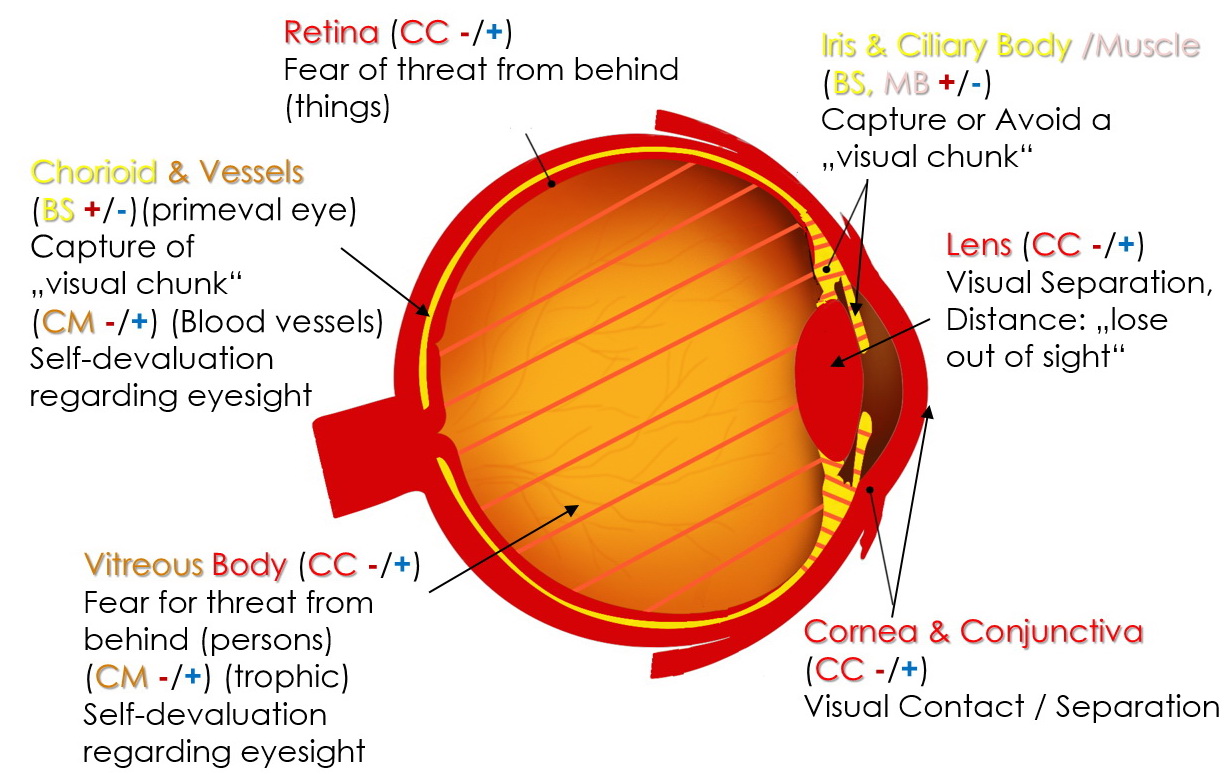
The chorioid is a 4-layered tissue situated between the retina and the sclera. It is rich in vessels that supply the eyeball. It is the “archaic eye”, sensitive to light and darkness. Melanin, a darkly colored pigment present throughout the chorioid, helps it to limit uncontrolled reflection within the eye that would potentially result in the perception of confusing images. Phylogenetically, choroid is a protrusion of meninges (pia mater).
Brain:
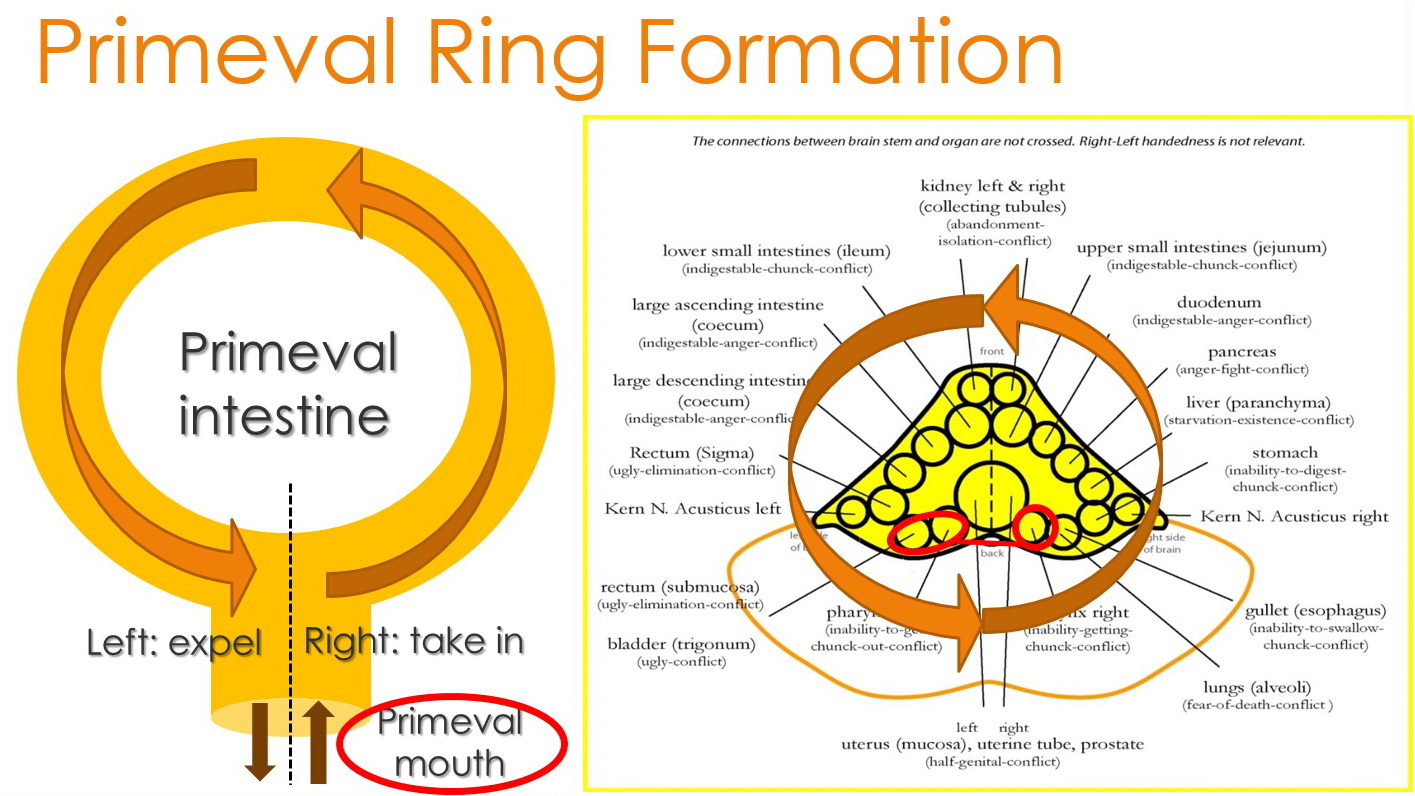
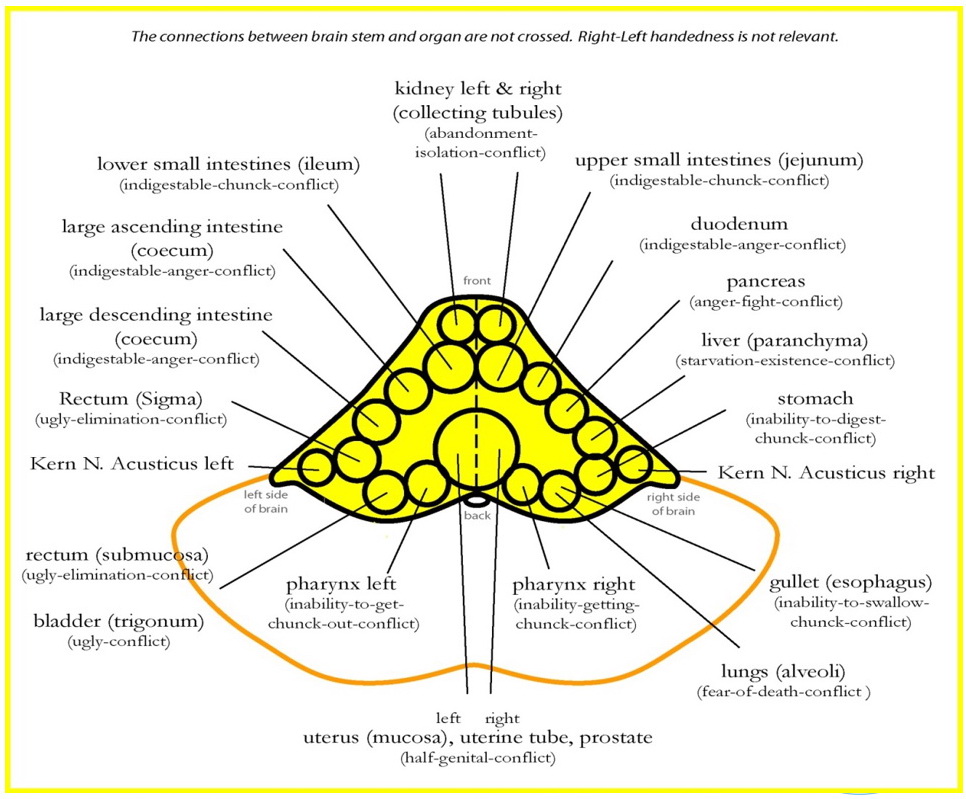
In the Brain Stem, the primeval ring structure is reflected: organ tissue relays with assimilative and digestive functions from oesophagus to small intestines are situated in the right brain stem, while excretory organs from caecum to rectum are relayed in the left brain stem. Medial on both sides are the relays of mouth/pharynx, middle ears and lacrimal glands, as well as the pineal and pituitary glands and the thyroid.
Relay:
1. Brain Stem ( + | – ) (lateral left & right) for pigment
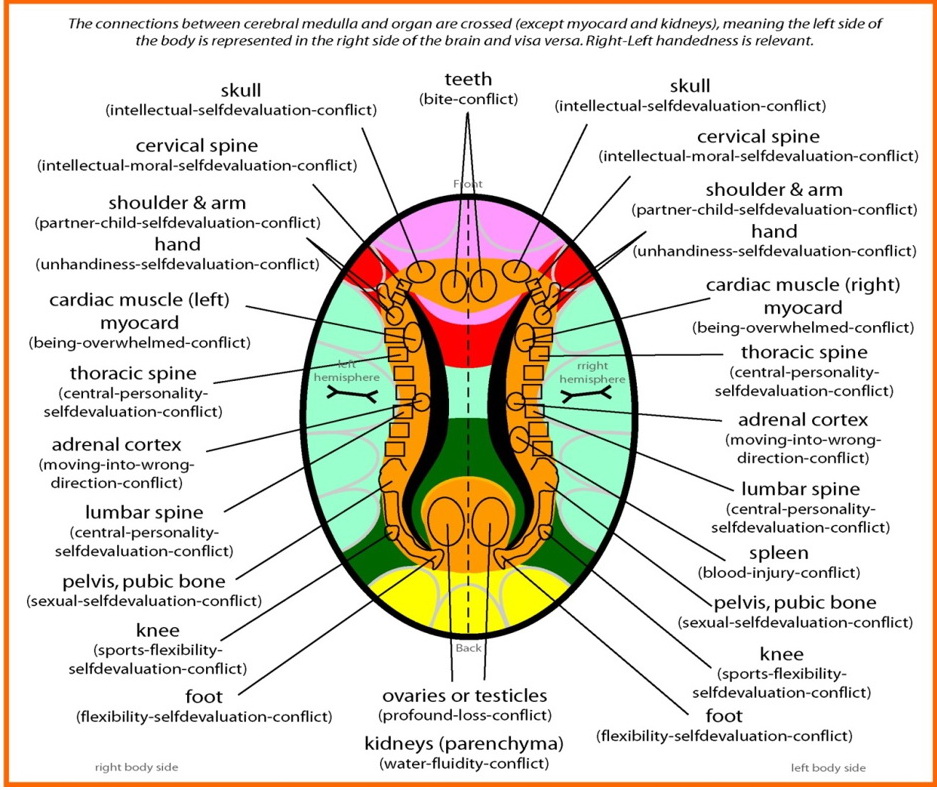
2. Cerebral Medulla ( – | +) (frontal) for blood vessels
Mind
Theme:
1. (BS): Need to acquire, avoid or get rid of a “Visual Chunk”
2. (CM): Visual trauma with self-devaluation aspect
Emotions, Thoughts:
Attention, pressure, fear, hopelessness
- I need to see this!
- This is blinding me!
- This sight is haunting me.
- I can´t see with so little light!
- I wish I never had seen this.
META-Meaning:
- Light and shadow belong together and are balanced in my life.
- I can find and let in just as much light as is a benefit for me.
- My eyes are well-protected.
- I see everything I need to.
Organ
Stress Phase Symptoms:
1. (BS): Firstly there is a functional increase in light reflexion, later a cell proliferation and thickening of the choiroid coat. The diagnosis can be choroidal / uveal melanoma (with melanin pigmentation). Symptoms can be changes in visual function (colour vision impaired, night-blind). See also additional Information.
2. (CM): The blood vessel walls inside the choroid weaken in stress phase, which can lead to polypoidal ”choroidal vasculopathy”.
Regeneration Phase Symptoms:
1. (BS): Inflammation and cell-degradation of the reinforcement of the chorioid (uveitis, chorioiditis), possibly by fungi or mykobacteria (Candida, leper, tubercle). Main symptom is cloudy vision. Painless when only chorioid and not retina or iris is affected.
2. (CM): During regeneration phase A, the blood vessel walls are weak and can rupture, especially with stress-active KCT which enhances oedema. Then neovascularization takes place. Bacteria like Borrelia or Syphilis can be present.
Biological meaning:
1. (BS): The functional increase and tissue reinforcement in stress phase is meant to help to assimilate or avoid the “visual chunk”.
Social:
Examples:
- An elderly woman has moved from her home, but sees it regularly, being sad how it looks now, neglected.
- A young woman sun-bathes on the beach with glasses on. While she sleeps, the glasses work as a burning lense, damaging her eyes.
- A young woman joins a farm with no electricity. There is just little candlelight at night, and much work has to be done in the dark outside. She develops very good contrast vision and can see in the dark. After this phase (regeneration trigger), this skill decreases. (Klapp)
- A man experiences hypersensitivity to light, and a stinging pain throughout the eye, since extensive sungazing. He is shy and has problems to “let his light shine”. The sungazing was his only strategy to process the death of his father. He needs to step out of the shadow of his father. (Odum)
- A woman with a chorioid melanoma suffers deep hopelessness believing she is sinful and can only be saved by the light of God. This is a trans-generational pattern from her ancestors. She needs to forgive and release herself. (Odum)
Additional Information:
The chorioid plays a role in the development of macula degeneration: in the wet form, blood vessels from the chorioid grow under the retina. In the dry form, the Bruch´s membrane thickens and builds up deposits (drusen formation). Both of these reactions belong to stress phase or recurring processes.
Constellations:
Brain Stem Constellation possible: perplexity, lethargy, passiveness, reduced movement. Purpose: new orientation
Differential diagnosis:
Intracranial Lymph vessels (Cerebral Medulla, -/+) “oculocerebral lymphoma”, a tumor of the eye in regeneration phase, can be misdiagnosed as uveitis (pseudo-uveitis)
Iris(Brain Stem, Midbrain +/-): Iris and ciliary muscle proliferation and tension influence adaptivity of the pupil in stress phase (capturing information), thereby hypersensitivity to light or night-blindness.
Retina(Cerebral Cortex, -/+): vision impairment by retina detachment in regeneration phase of persecution fear (temporary healing oedema), thereby partly loss of vision; Retinitis pigmentosa can also be misdiagnosed as uveitis.
Vitreous Body (Cerebral Cortex & Medulla, -/+): stress phase (persecution fear): degeneration, reduced intraocular pressure; in regeneration phase: opacity, glaucoma, increased pressure; chronic: Mouches Volantes.
