Eyes – Eye Muscles
Anatomy
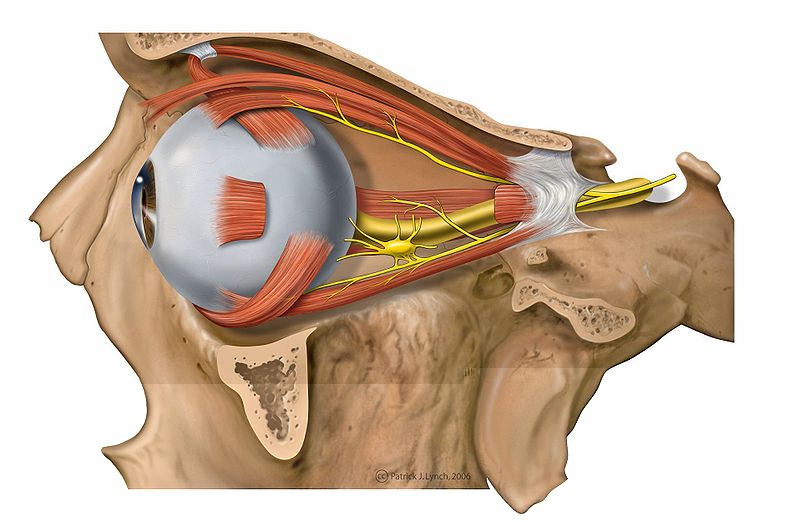
We have extra- and intraocular eye muscles. The intraocular muscles are described in the chapter “Iris – Ciliary body“. The extraocular muscles are striated muscles, voluntarily and unvoluntarily controlled. The unvoluntary control and alignment is directed by the midbrain and muscle fascia. When these muscles are habitually contracted , they have the ability to change the shape of the eyeball, which leads to shortsightedness or squint. The eye muscles are the fastest reacting muscles of the body.
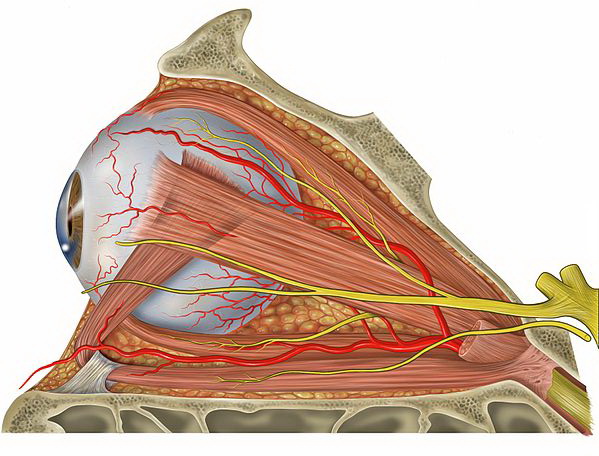
Five of the extraocular muscles have their origin in the back of the orbit in a fibrous ring called the annulus of Zinn: the four rectus muscles and the superior oblique muscle. The four rectus muscles attach directly to the sclera of the front half of the eye.
- The superior and inferior recti do not pull straight back on the eye, because both muscles also pull slightly medially. This posterior medial angle causes the eye to roll with contraction of either the superior rectus or inferior rectus muscles.
- The superior oblique muscle originates at the back of the orbit, getting rounder as it courses forward to a rigid, cartilaginous pulley, called the trochlea, on the upper, nasal wall of the orbit. It travels posteriorly for the last part of its path, going over the top of the eye. Due to its unique path, the superior oblique, when activated, pulls the eye downward and medially.
- The inferior oblique muscle originates at the lower front of the nasal orbital wall, and passes under the LR to insert on the lateral, posterior part of the globe. Thus, the inferior oblique pulls the eye upward and laterally.
The eye muscles are controlled by 3 cranial nerves: - N. oculomotorius (Cranial nerve III) supplies 4 of 6 external eye muscles plus the levator palpebrae
- N. trochlearis (Cranial nerve IV) controls the superior oblique muscle
- N. Abducens (Cranial nerve VI) controls the rectus lateralis muscle
Cranial nerve origin, view from below
graphics: Patrick J. Lynch
Brain
brain parts
cerebral cortex areas
Relay:
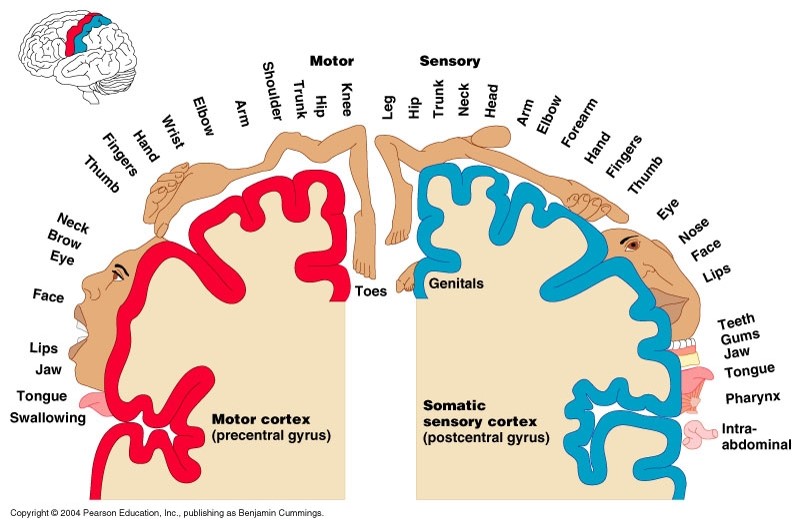
1. Cerebral Cortex ( – | + ) lateral motoric area left & right, for motoric innervation
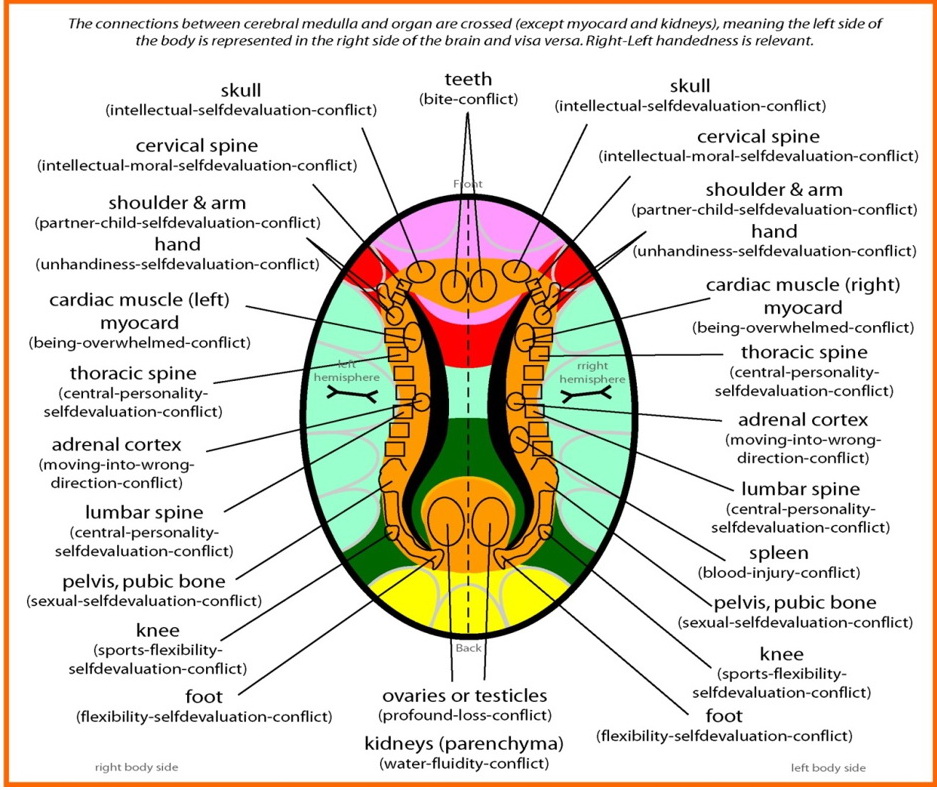
2. Cerebral Medulla ( – | + ) frontal for muscle trophic
3. Midbrain (+/-)-pattern for muscle fascia and muscle alignment
compare Brain Stem:
Mind
Theme:
1. (CC): Not able to evade visual stress
2. (CM): Visual Overwhelm and Strain, Self-devaluation
3. (MB): Endure visual stress
Emotions, Thoughts:
Pressure, frustration, resistance
- This is too much and I can’t see it anymore.
- Why can´t I see that?
- I have to recognize that!
- I mustn’t lokk there!
- I can’t look away!
- I need to find the way out!
META-Meaning:
- Now, I see the beauty and ease in life.
- I use all my senses to get a complete picture.
- When I am calm, I feel powerful to perceive everything.
Organ
Stress Phase Symptoms:
1. (CC): Transmission reduction in the affected cranial nerve, paresis/paralysis in certain eye muscles.
2. (CM): After a self-devaluation concerning vision, weakening and cell loss (dystrophy, necrosis) in muscles can be detected. This often follows theme 1 or 3. In imbalances, a squint develops (strabism).
3. (MB): Tension in eye muscles. The possible symptoms are eye fatigue, changes in the shape of eyeballs and thereby nearsightedness (myopia) or farsightedness (hyperopia). These forms of vision defects can be treated with eye relaxation exercises or vision training.
Regeneration Phase Symptoms:
1. (CC): Fluctuating return of function.
2., 3. Relaxation of eye muscles, increased muscle trophic and tissue replenishment. By the Cerebral Medulla reaction pattern, this reinforcement can lead to reduced flexibility and myopia, astigmatism or squint (strabism).
Healing Peak
Spasms, twitching or muscle tic. The direction of the tic reveals the attempted way out of the threat.
Biological Meaning:
1. (CC): Short-termed paralysis “playing dead” is an emergency survival strategy.
2., 3. The muscular tension in stress phase is meant to help to focus on the aim, as well as the strengthening of the tissue after finished regeneration.
Social
Examples:
- The patient is overworking and is overexerting his eyes with computer work. His nearsightedness gets stronger.
- A mother of four is overwhelmed by the task of keeping all children under control, she can´t have an eye on all at the same time. She gets far-sighted.
- A baby is separated from her mother after birth. Her left eye muscles become partly paralyzed. (Klapp)
Additional Information
Although under voluntary control, most eye movement is accomplished without conscious effort. The III, IV, and VI cranial nerves are involved in the innervation of the extraocular eye muscles, meaning that there are nerve fibers from brain stem, cerebral medulla and cortex (with their emotional representations) connected.
The vestibulo-ocular reflex stabilizes images on the retina during head movement by producing an eye movement in the direction opposite to head movement, thus preserving the image on the center of the visual field. This reflex is driven by signals from the vestibular system in the inner ear.
Constellations:
Visual Megalomania (Muscles of both eyes/hemispheres affected): often combined with visual constellation in Cerebral Cortex producing visions or hallucinations.
Differential Diagnosis:
Retina(Cerebral Cortex -/+): Ulceration in stress phase (persecution fear); retina detachment in regeneration phase A, degenerative processes in long or repeating processes. Short- or far-sightedness can then be residual states.
Crystalline Lens(Cerebral Cortex -/+): Decrease in trophic, thinning of the lense in stress phase (lost meaning in life); reinforcement and possibly loss of elasticity in regeneration phase, leading to presbyopia, astigmatism or myopia.
Cornea(Cerebral Cortex -/+): Loss of visual contact – Processes of thinning/damage and reinforcement can lead to changed shape of the cornea, resulting in astigmatism.
Kidney Collecting Tubules Constellation(Brain Stem +/-): produces a divergent squint (strabismus divergens) with the goal of circumferential vision without movement. (“Waiting for things to change”)