Inner Ear – Hearing
Anatomy
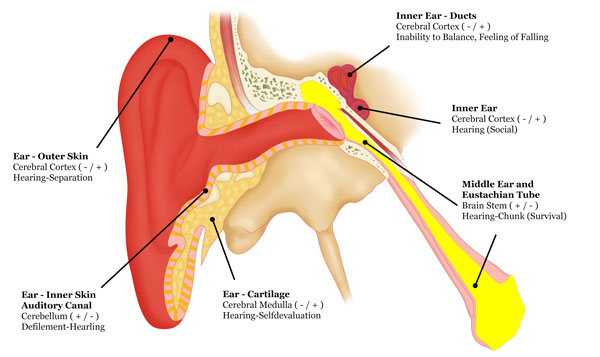
The inner ear is the innermost part of the ear. It is mainly responsible for sound detection and balance. The inner ear consists of the bony labyrinth, a hollow cavity in the temporal bone of the skull with a system of passages comprising two main functional parts:
- The cochlea, dedicated to hearing; converting sound pressure patterns from the outer ear into electrochemical impulses which are passed on to the brain via the auditory nerve.
- The vestibular system, dedicated to balance
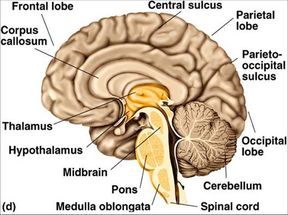
Inside the cochlea lie the cell bodies of the acoustic nerve (Nervus Cochlearis/Acusticus) which are connected to the sensory cells of the organ of Corti. The acoustic nerve reaches – together with the vestibular nerve – kernels in the medulla oblongata, and from there goes via the auditory pathway to the auditory centre in the temporal lobes of the cerebral cortex.
Brain
Relay:
Auditory relays in Brain Stem and C Cortex
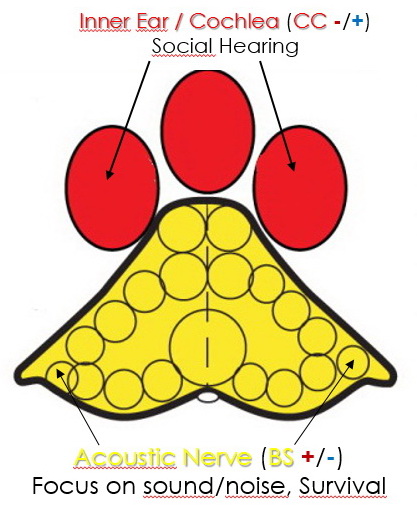
1.Cerebral Cortex ( – / + ) basal postsensory area, for Cochlea & Auditory Centre
2. Medulla oblongata, Brain Stem (+/-) lateral left & right, nucleus of Acoustic Nerve
Mind
Theme:
1. Social Hearing (voice) – Not wanting to hear something
2. Survival, Prey Hearing (sound) – Needing to hear something
Emotions, Thoughts:
1. Anger, disbelief
- I don’t want to hear this.
- Be quiet.
- Why do you say this?
- I can’t believe what I am hearing.
- Her voice is sticking with me.
- This left a ringing in my ears.
2. Impatience, pressure - I need to hear that!
- Shut up!
- I’m so longing to hear that!
- I must get rid of that sound.
META-Meaning:
I choose to accept the positive learning message in what I hear, and release everything else for good.
Organ
Stress Phase Symptoms:
1. (CC) Functional reduction and a loss of the ability to hear certain frequencies, masked by a tinnitus (roaring, buzzing, ringing, whistling in the affected ear). Due to this hearing conflict the body tries to avoid hearing these frequencies.
2. (BS) Functional gain in the hearing of sound, noise. Filtering function reduced.
Regeneration Phase Symptoms:
1. (CC) The hearing function recovers slowly. The typical symptoms include an acute hearing loss and an edema in the inner ear and in the cerebral hearing center for – the above mentioned – specific frequencies. The symptom of tinnitus may persist also during this phase.
When bone structure is affected, otosclerosis may develop after intense process with viral infection (this sometimes is observed connected to measles), or after recurrences.
Tinnitus sometimes appears after a hearing loss: a residual symptom after a noise disturbance. In this case it works as a conditioned auditory reflex to warn for an auditory threat.
2. (BS) Normalization of the hearing of sound, noise. Filtering function restored.
Healing Peak:
1. sudden hearing loss
2. Hyperacuity during hours
Biological Meaning:
1. Through to the function loss in stress phase, the organism tries to mask the unbearable voices around.
2. The functional increase in stress phase makes the “hearing-chunk” of information easier to catch.
Social
Handedness is important but also direct association is possible (for example the left ear reacts when a left-wired woman has a traumatic conversation with her child but is holding her phone on left ear).
Examples:
- A teacher endures high noise levels constantly. She develops otosclerosis.
- A couple often fights loudly. Both the man and their daughter get tinnitus.
- A client got tinnitus (deep buzz) after she heard on the telephone about the death of her mother. Nowadays many stressors increase the tinnitus – whenever she hears inconvenient news. She is aware that the symptom fulfills a purpose for her. (Weiner, MHU archive)
- A policeman who had many auditory conflicts in his working life as well as at home, suffers an acute loss of hearing shortly after his retirement. Even later he experiences stress-related tinnitus, which gets better when he follows his own interests. (Klapp)
- Acoustic trauma (work-related noise, concerts etc) often cause reduced hearing on certain frequences.
Additional Information
- Humans can generally hear sounds with frequencies between 20 Hz and 20 kHz. Human hearing is able to discriminate small differences in loudness (intensity) and pitch (frequency) over that large range of audible sound. This human range of frequency detection varies significantly with age occupational hearing damage and gender; some individuals are able to hear pitches up to 22 kHz and perhaps beyond while others are limited to about 16 kHz. The ability of most adults to hear sounds above about 8 kHz begins to deteriorate in early middle age.
- Tinnitus appears when the hair-cells in the cochlea are folded, so that the acoustic nerve doesn’t receive a signal. The nerve compensates the missing signal with a constant sound – the tinnitus. Later, this mechanism can be adopted by the acoustic centre, and the tinnitus be created by the brain.
Constellations:
1. Hearing Constellation: When both ears are affected, auditory hallucinations and bilateral tinnitus are possible. When the conflicts have a territorial/social theme, this constellation (hearing voices) shows mania and depression (schizophrenia).
2. Brain Stem Constellation possible: perplex, stunned, reduced movement. Purpose: new orientation.
Differential Diagnosis:
Hyperacuity comes in the beginning of stress phase for the Middle Ear, or in constellation for the Inner Ear.
Hearing impairment can come in both relays during stress phase and regeneration phase A.
Middle Ear – Eustachian Tube(Brain Stem, +/-) tissue reinforcement, possibly hearing impairment and obstruction of the Eustachian Tube in stress phase (need for information); otitis media and tumour degradation with purulent discharge in regeneration phase.
Middle Ear, Ossicles & Muscles (Cerebral Medulla, -/+) Stress (self-doubt): functional loss; reinforcement and possibly otosclerosis after regeneration phase
Inner Ear, Vestibulum (Cerebral Cortex, -/+) vertigo in stress phase (loss of control)