Larynx Mucosa
Anatomy
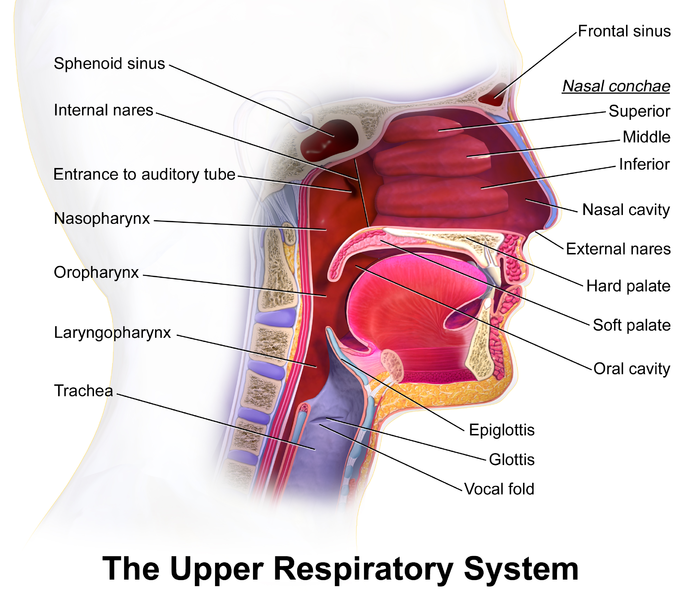
The larynx or voice box is a organ in the neck involved in breathing, sound production, and protecting the trachea against food aspiration. It manipulates pitch and volume. The larynx houses the vocal cords, which are essential for phonation. The vocal cords are situated just below where the tract of the pharynx splits into the trachea and the esophagus.
The voice box forms the transition between the throat and the wind pipe. It consist of several cartilages, muscles, the vocal cords and the mucous membrane lining the inner side (squamous epithelium). The voice box and especially the vocal cords are essential for phonation and also for the formation of speech sounds. The epiglottis closes the voice box during swallowing to protect against the entrance of food into the wind pipe. In a frightening situation, the opening (and widening) of the voice box allows you to breathe in quickly and deeply.
The vocal apparatus consists of two pairs of mucosal folds. These folds are false vocal folds (vestibular folds) and true vocal folds (folds). The false vocal folds are covered by respiratory epithelium, while the true vocal folds are covered by stratified squamous epithelium. The false vocal folds are not responsible for sound production, but rather for resonance. These false vocal folds do not contain muscle, while the true vocal folds do have skeletal muscle.
During swallowing, the backward motion of the tongue forces the epiglottis over the glottis’ opening to prevent swallowed material from entering the larynx which leads to the lungs; the larynx is also pulled upwards to assist this process. Stimulation of the larynx by ingested matter produces a strong cough reflex to protect the lungs.
Brain
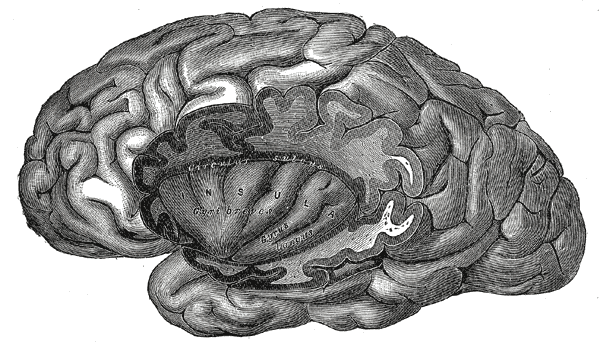
graphic: wikipedia, Henry Gray
Relay
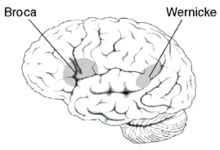
Cerebral Cortex (-/+) left frontal territorial area “10 o´clock”
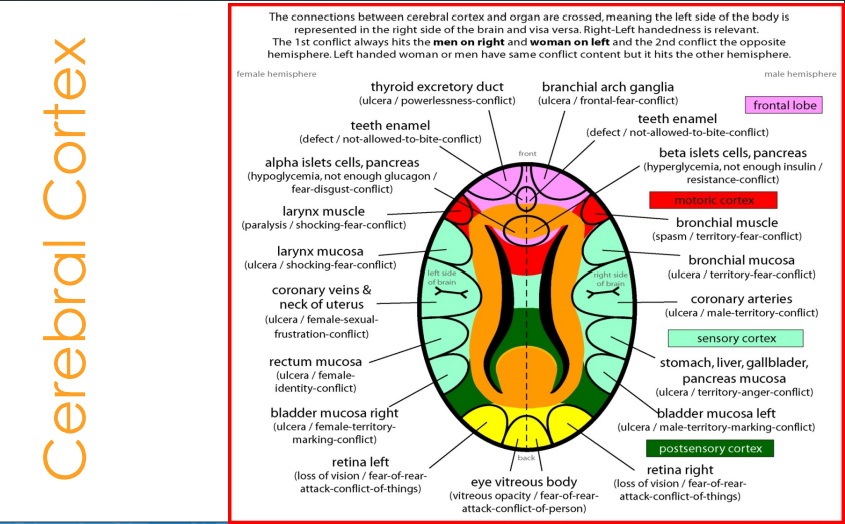
Broca’s area (speech center)
Mind
Theme
1. Scare-fright, speechlessness (female perception)
2. Territorial Fear (male perception)
Emotions and Thoughts
1. Fright of an unexpected danger, fear of attention.
- I froze with fear.
- I was dumbstruck.
- The words got stuck in my throat.
- What should I have said?
- It took my breath away.
2. Vigilance, indignation - Who’s that!
- I need to roar/bark him away!
- I need to make my voice heard!
- Nobody will get in here!
META-Meaning
- I speak with passion and clarity.
- I can express myself freely and easily.
- I respect and I am being respected.
Organ
Sensitivity changes according to Outer Skin/Epidermis pattern with hyperesthesia in regeneration phase.
Stress Phase Symptoms
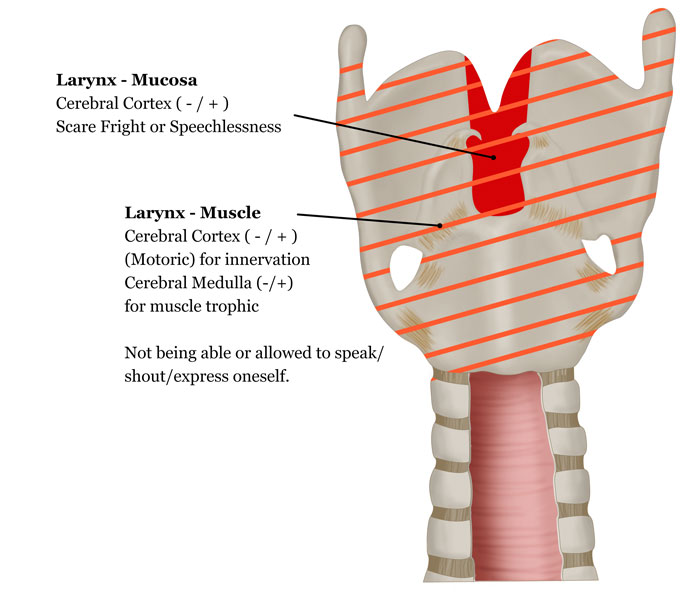
Inconspicious tissue reduction of the larynx or the vocal cords area, thereby slight voice change is possible. If the laryngeal muscles/motoric function co-react with the mucosa, speech dysfunctions like stutter occur due to paresis and possibly muscle reduction.
Regeneration Phase Symptoms
Tissue regeneration under swelling and hyperesthesia (therefore dry cough), respiratory noise (inspiratory stridor). The possible regeneration paths are:
1. Laryngeal inflammation (laryngitis) with hoarseness, dysphonia /from voice altering to aphonia/, hypersensitivity (hyperesthesia), possibly pain and itching (after the healing peak).
2. Pseudocroup (Subglottic laryngitis) with dry, barking cough, hoarseness, stridor (breath sound). Pseudocroup must be distinguished from real croup (diphtheria) which is accompanied by pseudomembrane formation (diphtheria of the tonsils, throat and nasal cavity is possible too).
3. Epiglottitis with fever, sore throat, muffled speech, shortness of breath, breath noises, difficulty in swallowing.
4. Vocal cord polyps are excessive healing tissue (squamous epithelium of the vocal cords)
5. Laryngeal tumors (squamous cells), laryngeal carcinoma (in case of a long chronic process)
6. Cysts, possibly originating from the obstructions of the ducts of salivary glands (mucous retention cyst)
7. Granuloma (knotty proliferation) in the larynx mucosa appears due to sub-optimal reparation with scarry inclusions of particles during regeneration phase B.
Healing Peak
Short loss of consciousness accompanied by numbness in the voicebox, drop of blood sugar, possibly spasm of larynx muscles
Biological Meaning
1. Loss of voice promotes surviving a danger by being silent.
2. Increased air flow by muscle reaction and widening of the glottis allows for reserve energy to defend one’s position.
Social
Examples
1. Scare-Fright:
- The police unexpectedly came in the bathroom with a search warrant while taking a shower. This was perceived as a scare-fright trauma.
- The client shall speak on an event, but feels triggered into freeze and fold by the stare and the voice of a colleague. Her throat is tense. The triggers stem from her childhood. When transforming the memory, she finds peace, forgiveness and the courage to speak before the crowd. (Klapp)
- Since having experienced a traumatic fall, a woman reacts with fright and fear upon auditory triggers of clank and clatter. (Klapp)
2. Territorial fear - The client became speechless when presented to her new boss, with whom she previously had a relationship. She reacts with drawing herself back (autistic constellation) (Klapp)
- After the birth of a little sister and return of her mother, a 2-year-old boy gets croup-cough.
- A woman worries about migrants moving into her neighbourhood. After a demonstration, she gets a feverish laryngitis.
- The client was betrayed by her husband and they live separated. After an ultimatum for a decision, he wants to move back to her but still keep seeing the other woman. This triggers her into speechlessness followed by laryngitis. (Wiggins-Hay, MHU archive)
Additional Information
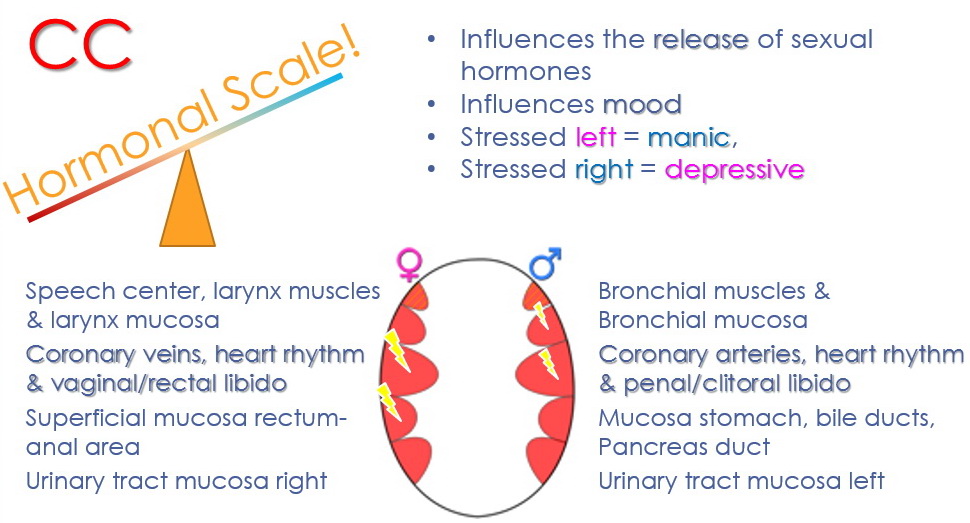
This relay belongs to the “territorial relays” in the peri-insular cerebral cortex, with the theme of social position and affiliation. Special rules apply for the meaning of side dominance. Conflicts affect the sexual and social “hormonal scale” and can promote manic or depressive episodes (see “territorial constellations” related to the function of the neurohypophysis).
Constellations
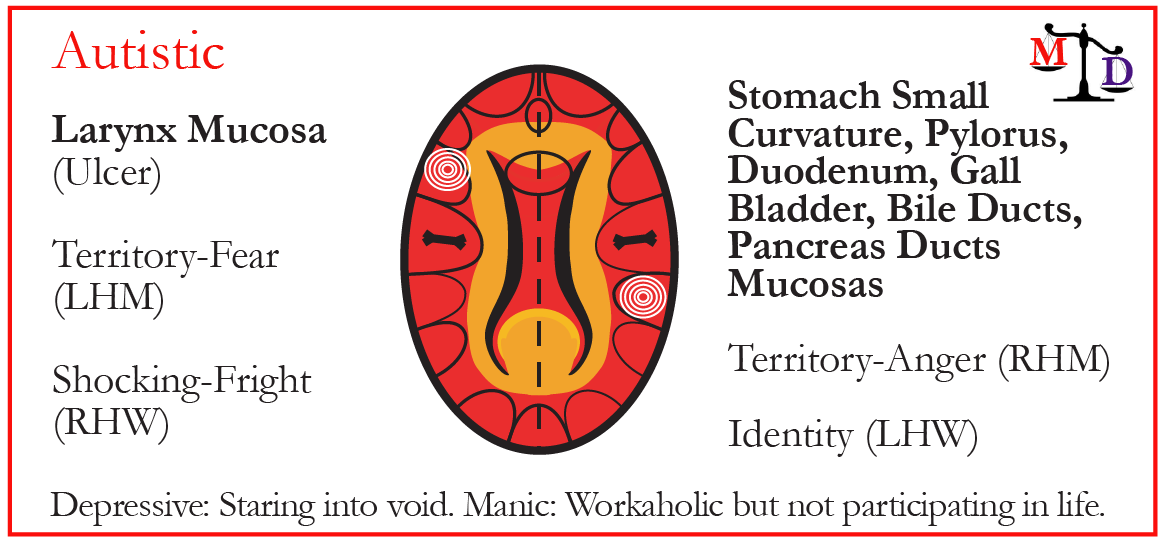
Autistic or Introvert Constellation: together with Stomach, Gallbladder or Pancreas Duct relay. The person shows an introvert and self-centered personality, distracted and living in their own world. Positive: Focus!
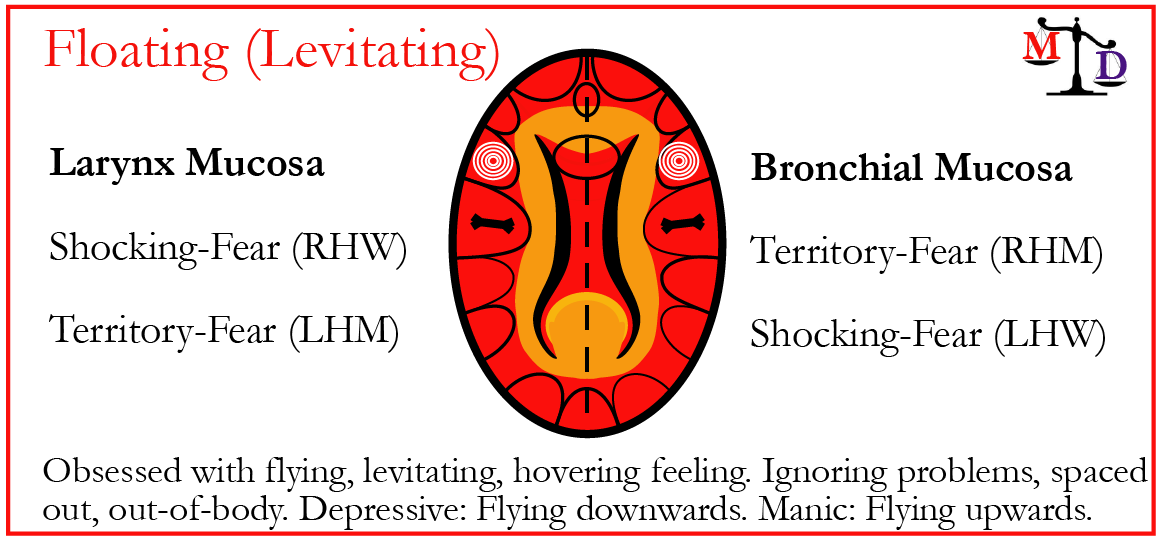
Levitating or Distanced Constellation: together with Bronchial Mucosa relay. Affinity to or dreaming of flying or hovering. Distanced world view, often spiritual or esoteric. Positive: wisdom!
If together with Retina or Vitreous Body relays, paranoia and spiritual world-saving beliefs.
If Autistic and Distanced Constellations are combined, we see eremite mindset and behaviour.
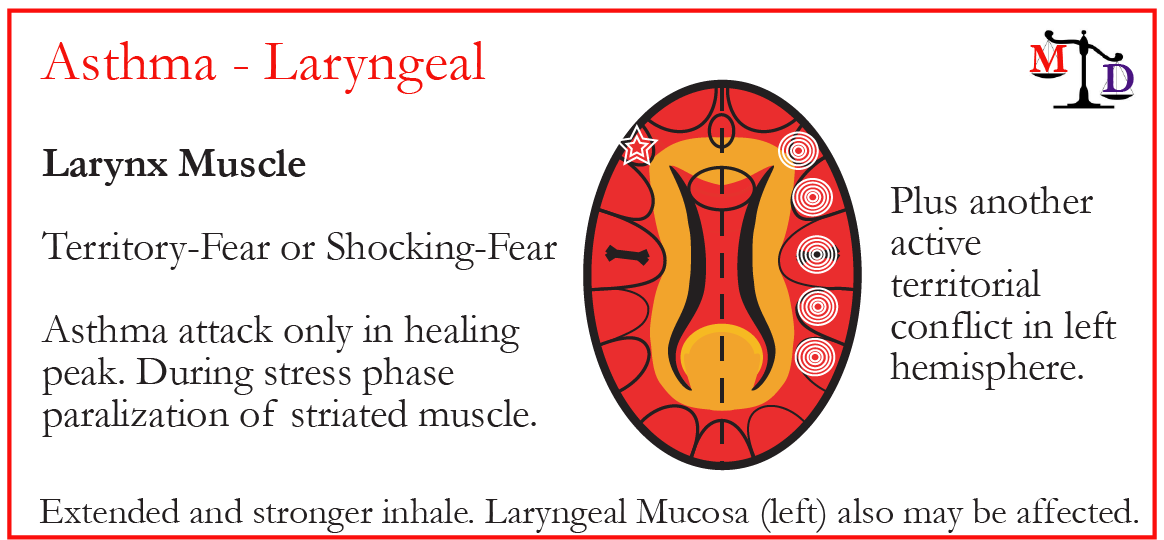
Laryngeal Asthma: When larynx striated muscles co-react with the mucosa, and another relay in a periinsular relay of the right hemisphere is stress-active.
These constellations can include manic or depressive states, depending on hormonal status and which hemisphere is triggered stronger.
Differential Diagnosis
Pharyngeal Arches (Cerebral Cortex, -/+) stress (frontal fear/powerlessness): hyperesthesia in lateral neck area or down to mediastinum; regeneration phase cysts in neck or mediastinum possible
Pharynx Respiratory Epithelium (Brain Stem, +/-) stress (assimilation and filtering of air/information): polyps or tumor formation; regeneration phase: sore throat or fungal infection, productive cough with pus.
Pharynx Mucosa (CC -/+) stress (prohibited swallowing or expression): hyperesthesia, harrumph, light irritant cough
Respiratory Goblet Cells (BS +/-) stress (suffocation fear): increased production of mucus, adenoma growth; regeneration phase: purulent bronchitis, cough with coagulated blood, chronic: cystic fibrosis
Tracheal & Bronchial Mucosa (CC -/+) stress (social fear): hyperventilation, depression; Regeneration phase: viral or bacterial bronchitis, high fever, deep cough with mucus