Uterus – Mouth and Neck (Cervix & Portio Uteri)
Anatomy
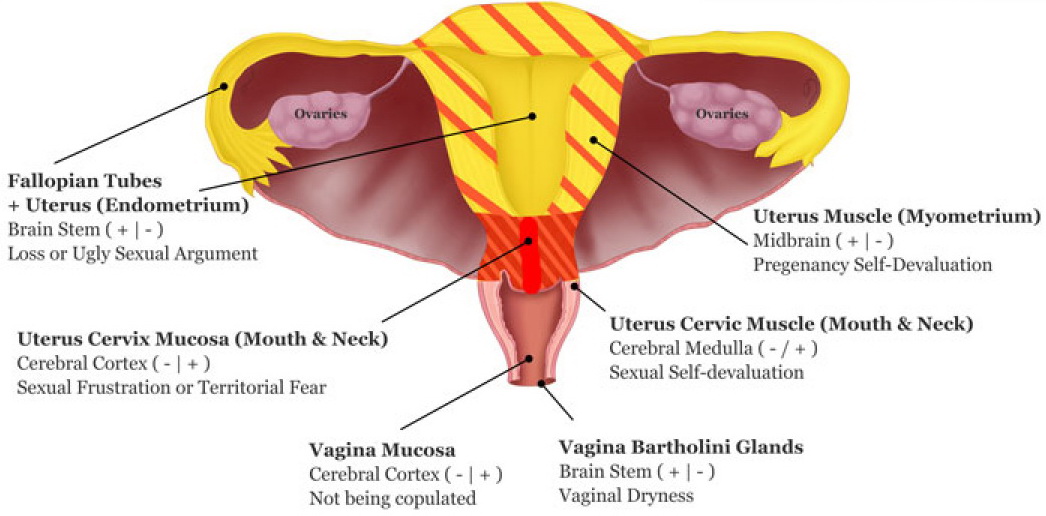
The cervix is the lower narrow portion of the uterus where it joins with the top end of the vagina – this part is called the mouth of the uterus. The cervix is cylindrical or conical in shape and protrudes through the upper anterior vaginal wall. Approximately half its length is visible with appropriate medical equipment; the remainder lies above the vagina beyond view.
The neck and mouth of the womb are covered with squamous epithelial mucosa. Evolutionarily, these cells migrated there from the vagina. Their walls consist of connective tissue with enclosed smooth muscle fibres. The uterus does not have a sphincter muscle.
Correction: there is no striated muscle in the cervix, but the wall consists of connective tissue (governed by the cerebral medulla) with longitudinal smooth muscle fibres.
Brain
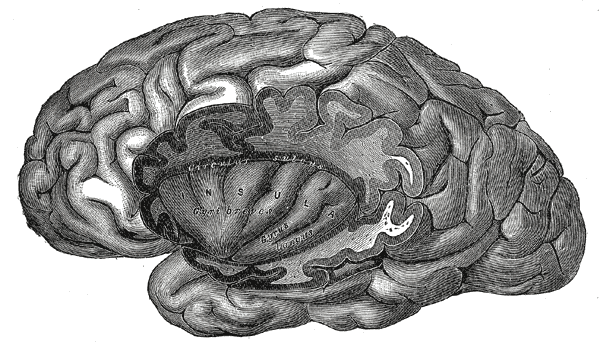
graphic: wikipedia, Henry Gray
Relay:
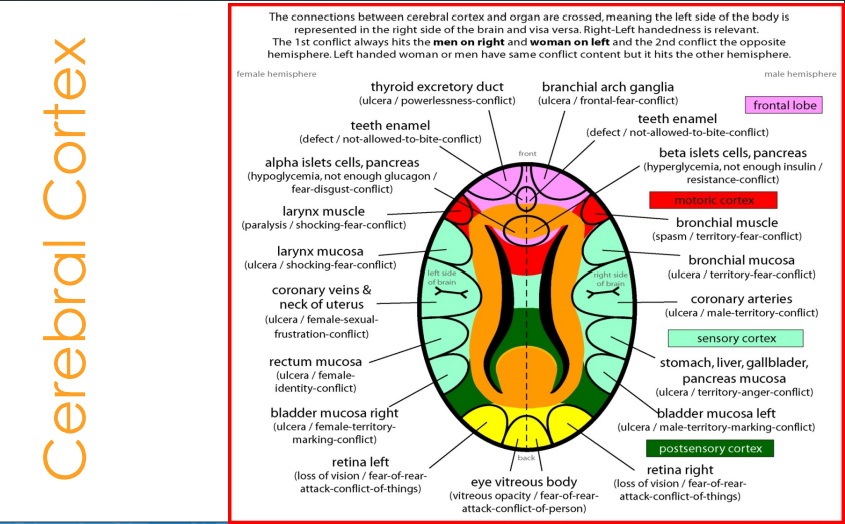
1. Cerebral Cortex ( – / + ) insular region medio-lateral left side, for mucosa and sensitivity
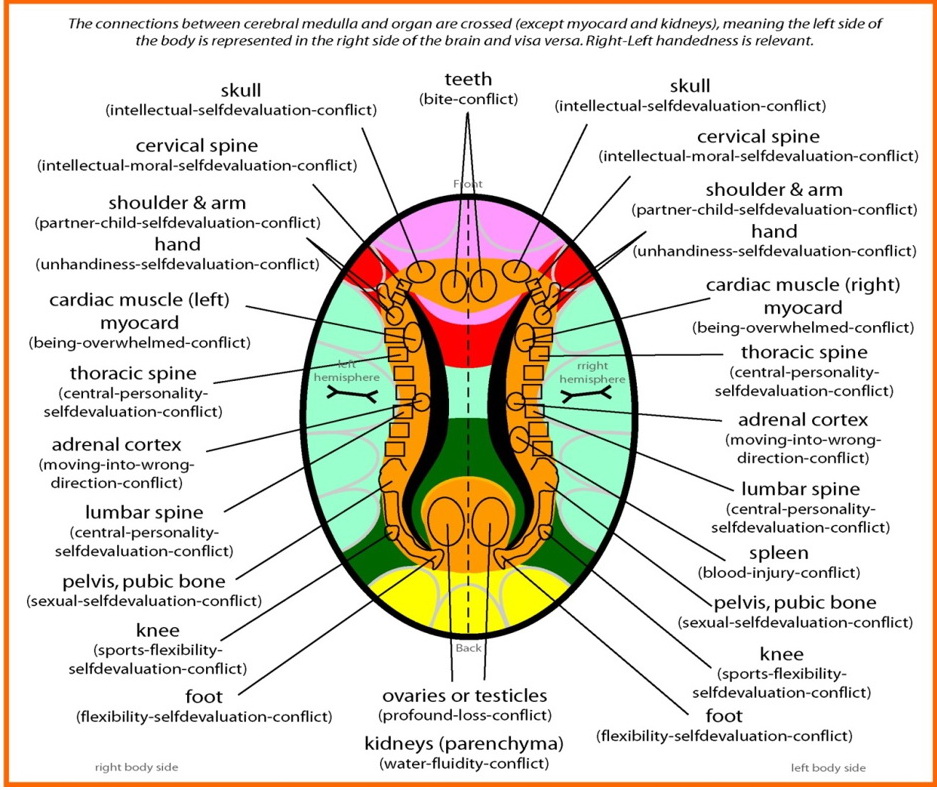
2. Cerebral Medulla ( – / + ) nedial left & right “pelvic region”, for organ wall (connective tissue)
Mind
Theme
1. (CC) Sexual conflict, loss of love, loss of status
2. (CM) Sexual or pregnancy self-devaluation
Emotions, Thoughts:
1. (CC) analogue to the relay of coronary veins:
Jealousy, self-abandonment
- Why doen’t he want me?
- Why doesn’t he love me anymore?
- My life lost it’s meaning.
- I feel abused.
- He cheated on me.
- They have taken my place!
- I have to fight for my rank!
2. (CM):
Self-consciousness, self-doubt, frustration - I am no good as a lover.
- I can’t give him enough.
- When do I find the right man?
- I am not good enough for him.
- I can’t be a good mother for my child.
- I can’t hold and support my baby!
META-Meaning:
- My loving self attracts the perfect partner and circumstances for me.
- I can choose the right partner for me!
- I am loving and worth to be loved.
- Now, I am confident to become a good mother.
Organ
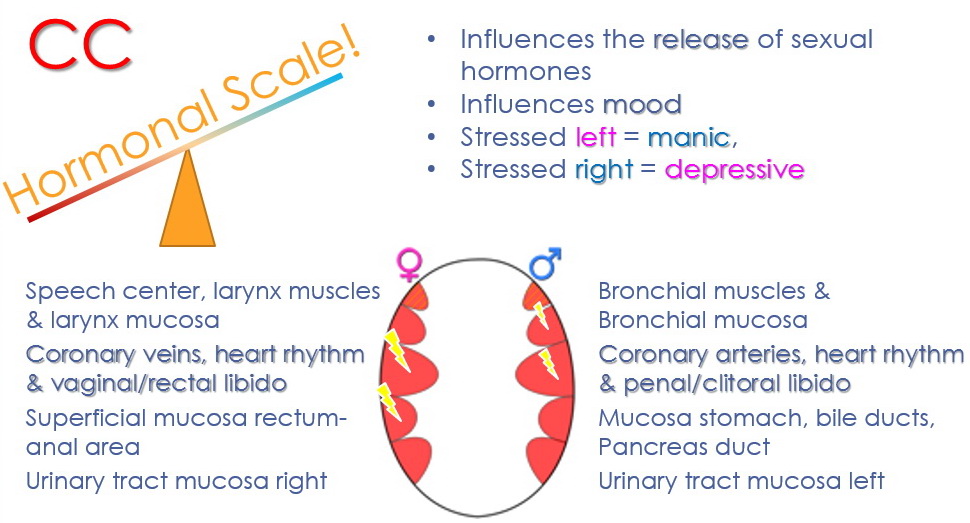
1. (CC) The cervix mucosa reacts analogue to the coronary veins, the heart rhythm centre and the vaginal libido. Stress can lead to reduced release of oestrogen and to manic states.
Sensitivity Reaction: according to Outer Skin/epidermis Pattern with hyperesthesia in Regeneration Phase
Stress Phase Symptoms:
1. (CC) Painless ulceration of the mucosa.
Reduction of oestrogen release can lead to menstrual irregularities (dysmenorrhoe, amenorrhoe), virilization and infertility, as well as to manic episodes.The vaginal libido is inhibited (frigidity).
Simultaneously, tachycardia and angina pectoris can appear when coronary veins are affected.
2. (CM) Weakening of cervix & portio which can lead to premature birth. Possible diagnose: erosion of cervix/portio.
Regeneration Phase Symptoms:
Recurrence of ovulation and menstrual period due to normalization or heightening of oestrogen levels, depressive states are possible. Inflammatory repair and reinforcement of the tissue, often with viral activity (HPV, herpes) and bacteria (chlamydia, gonococci), often with bleedings outside the menstrual cycle and discomfort or pain (increased sensitivity in the mucosa). Possible diagnoses: cervicitis, gonorrhea, cervical cancer (carcinoma, derived from epithelial cells) as well as a cancer of the portio (located in the vaginal part of the cervical mouth).
”Newer studies with patients have shown that cervical cancer originates in ontogenetic superficial tissue, and that resection inside this layer has brought very satisfactory results, when no infiltration of deeper tissue layers was present.” source
Healing Peak:
1. (CC) Accompanied by short-termed mania, heart pain, tachycardia or fibrillation and possibly absence/unconsciousness. Because of spasms of the coronary veins muscle there is a risk of thrombosis and lung emboly with dyspnea.
Biological Meaning:
The widening of the cervix and mouth in stress phase mechanically enhances the probability to get pregnant.
Social
Examples:
- A client with constant menstrual bleedings over weeks had sexual disagreements, and her wish for more children was suppressed. After an abortion she got the belief of not being worthy to become a mother again. (Hirth, MHU archive)
- A woman has premature births repeatedly. In regression she realizes the connection with traumas from her childhood and from her mother who was raped during flight. (Klapp)
- The client’s husband reacted negatively when she told him she was pregnant. The child was born healthy, but she lost trust in her husband. Years later, she develops cervical cancer.
- A woman is betrayed by her partner. She doesn’t want to admit it for herself, but loses her libido and begins manically to search for the meaning of her life. When he eventually leaves her, her world collapses and she gets apathic and depressive.
Additional Information
The cervix mucosa produces a tough mucus that closes the uterus and avoids entering of substances and microbes. During the days around ovulation, the mucus becomes thin and permeable for sperm.
The epithelium of the cervix varies. The transformation zone, also referred to as the ”squamocolumnar junction”, is adjacent to the borders of the ectocervix and the endocervix of the canal; and refers to the area where the change occurs between the squamous epithelium lining the ectocervix to the columnar epithelium that lines the endocervix. The squamous epithelium of the ectocervix is without keratin, and is continuous with the adjacent vagina. Underlying both types of epithelium is a tough layer of collagen. The transformation zone undergoes physiological changes at different times. At puberty, the columnar epithelium extends outwards, and cover portions of the ectocervix. The cervix also undergoes changes related to the menstrual cycle and pregnancy. Additionally, the transformation zone may retreat post-menopause, such that the ectocervix is again covered with stratified squamous epithelium. Also, when the endocervix is exposed to the harsh acidic environment of the vagina it undergoes metaplasia to squamous epithelium.
1. (CC) This relay belongs to the “territorial relays” in the peri-insular cerebral cortex, with the theme of social position and affiliation. Special rules apply for the meaning of side dominance. Conflicts affect the sexual and social “hormonal scale” and can promote manic or depressive episodes (see “territorial constellations” related to the function of the neurohypophysis).
Constellations:
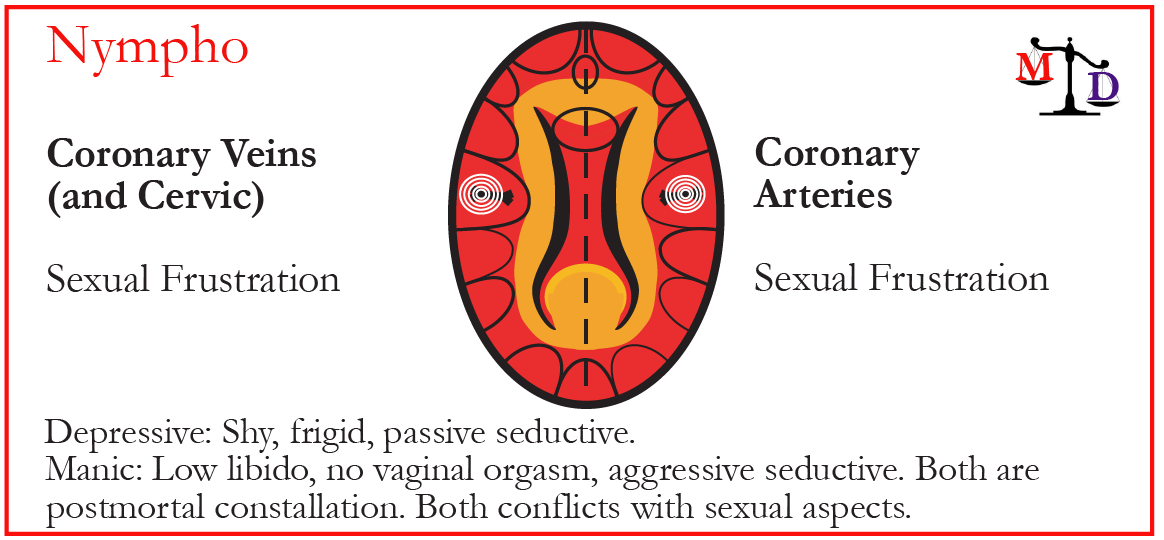
Nymphomania: together with Coronary Veins relay, if both conflicts had a sexual theme. Flirting and constant attraction of transitory lovers. Frigidity and often reduced potency.Positive: Unconditional love.
Differential Diagnosis:
Uterus – Endometrium (Brain Stem, +/-) Stress phase (sexual fight or loss): increased secretion and cell growth; regeneration phase: inflammation and degradation (fungal infection), strong menstrual bleeding
Uterus – Myometrium (Midbrain, +/-) Stress phase (with to bear a child): reinforcement (fibroid/myoma) and hypertonus; Regeneration phase: immobilization; Healing peak: hyperperistalsis
Pituitary anterior lobe – production of gestagen (Brain Stem, +/-) Stress phase (priority on pregnancy): increased production of gestagen, inhibition of ovulation, infertility
Pituitary anterior lobe – production of FSH (Brain Stem, +/-) Stress phase (with to reproduce): increased production, maturing of germ cells, increased fertility
Ovaries – interstitium oestrogen production (Cerebral Medulla, -/+): underproduction, infertility in stress phase (loss of a person), cysts in regeneration phase, at the end increased hormone levels.