
Testicles – Hormone production
Anatomy
The testicles are the male generative glands in the reproductive system. Like the ovaries (to which they are homologous) testicles are components of both the reproductive system (being gonads) and the hormonal system (being endocrine glands). The respective functions of the testicles are producing sperm (spermatozoa) and producing male sex hormones of which testosterone is the best-known. Both functions of the testicle sperm-forming and endocrine are under control of gonadotropic hormones produced by theanterior pituitary.
The hormone production is carried out by the interstitial Leydig-cells.
Testosterone stimulates bone– and muscle building, beard growth and sebaceous glands; it promotes development of primary and secondary male sexual characteristics and the production of sperm. It makes active, dominant and possibly manic.
The Leydig-cells also produce other steroid hormones as Dihydrotestosterone (DHT), Dihydroepiandrosterone (DHEA) and the female sex hormone Estradiol.
Brain
Relay:
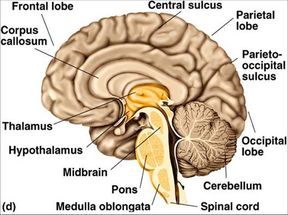
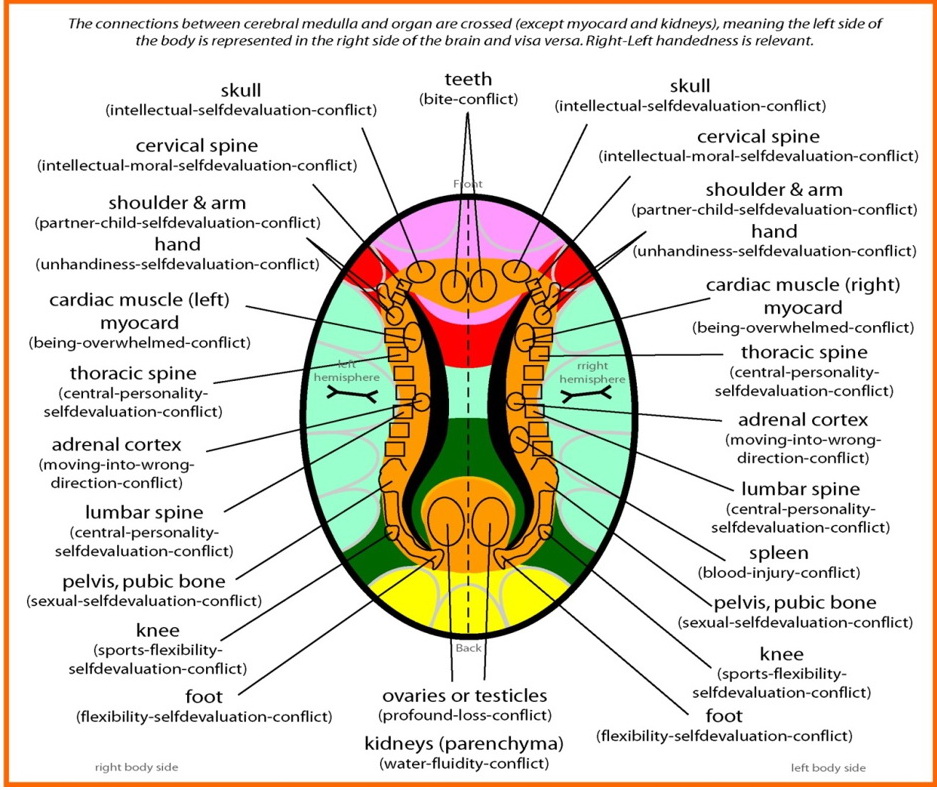
Cerebral Medulla / Upper Midbrain ( – / + ) posterior central left & right
Mind
Theme:
1. Traumatic loss of a person
2. Argument with sexual nuance
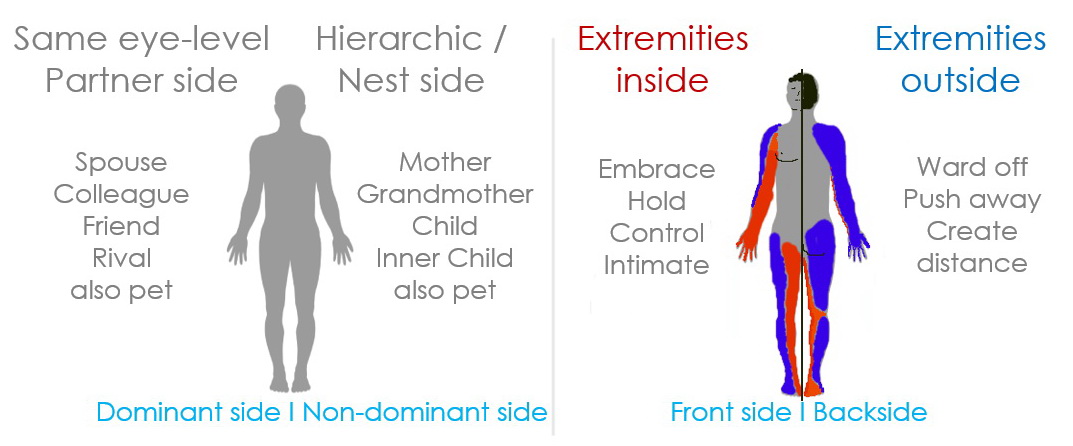
Side dominance is relevant for association:
Emotions and Thoughts:
Grief or Anger
- What will I do without her?
- I will never get over that she is gone!
- I can’t believe what she did to me/us!
- I am so disappointed!
- She is cheating on me!
META-Meaning:
I can feel and perceive my connection to all loved ones. All the universe is filled with love.
I am the master of my life and can communicate my wishes and needs clearly. The other one has her own story.
Organ
Stress Phase Symptoms:
Inhibition of the function of Leydig-cells cause a drop of testosterone level, leading to depression, loss of libido, muscle weakness, reduced beard growth and promoting osteoporosis. Possibly atrophy or necrosis. In prolonged stress testicles can shrink and cause infertility. Possible diagnoses: hypogonadism, pseudo-Klinefelter Syndrome.
Regeneration Phase Symptoms:
The hormone-producing function is restored and in the end augmented. First there can be inflammatory swelling (orchitis) with bacterial presence. Cysts can develop that are filled with liquid but during 9 months become consolidated (induration) and functional. As long as they have no own blood supply, they will invade adjacent tissues (“invasive adhesion”) Possible diagnoses: testicular cancer, cystic testicular carcinoma, Leydig cell tumor.
In case of a simultaneous water retention, the consolidation (induration) of cysts is not complete and exudative fluid remains in cysts. Functional cysts remain in place and won’t be decomposed in the process.
Biological Meaning:
After the healing is finished, more testosterone will be available in the organism in order to be more masculine and to increase reproductive capability.
Social
Examples:
- Daughter has been seriously injured in an accident and lies in coma. Her father gets depressive.
- An old but vital farmer lives for his cows. When his license to sell their milk is taken away, he suffers a loss and selfworth conflict and develops osteoporosis (Klapp)
- The client who has testicular cancer grieves for his beloved boxer hound who had to be taken away.
Additional Information
The functions of the testicle are influenced by gonadotropic hormones produced by the anterior pituitary. Luteinizing hormone (LH) results in testosterone release. The presence of both testosterone and follicle-stimulating hormone (FSH) is needed to support spermatogenesis. It has also been shown in animal studies that if testes are exposed to either too high or too low levels of estrogens (such as estradiol; E2) spermatogenesis can be disrupted to such an extent that the animals become infertile.
Constellations
Fertility Megalomania after activation in both hemispheres, one believes in building big families/tribes with many children.
Differential Diagnosis:
Testicular tumors must be distinguished from testicular hydrocele that often occurs in case of simultaneous water retention or a simultaneous testicular/abdominal injury.
Territorial Constellations / Depression (especially in Coronary Relays) leads to decreased testosterone level.
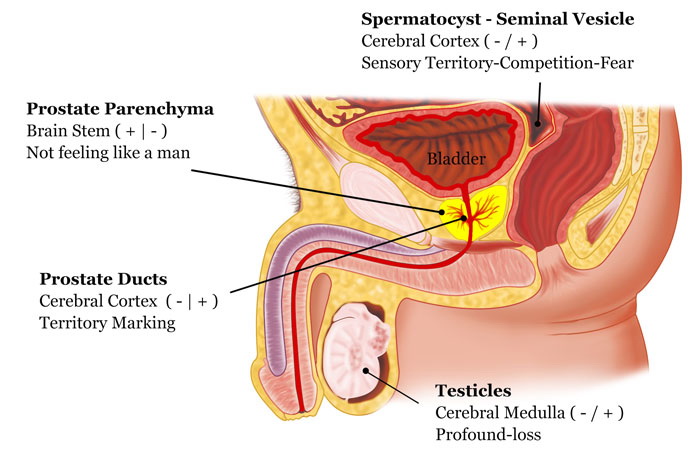
Prostate Gland(Brain Stem +/-) stress phase (male control): Proliferation of secrete (leading to enhanced nourishment of the sperm), Regeneration phase A: underfunction, reduced fertility
Prostate ducts & Spermatocyst/Seminal Vesicle (Cerebral Cortex -/+) stress (sexual territory): Widening of the vesicle, so that more prostatic secretion can be stored for ejaculation; Regeneration phase A: inflammatory swelling with obstruction.
Penis – Cavernous Body (Cerebral Medulla -/+) stress (sexual self-doubt): erectional dysfunction; Regeneration phase: slow regain of function; Constellation: sexual megalomania.
Pituitary anterior lobe – production of FSH & LH (Brain Stem, +/-) Stress (severe loss): increased production, maturing of germ cells, increased fertility
Dermis of the Scrotum (Cerebellum +/-) Stress (sexual vulnerability): increased production of sweat or skin fat; Regeneration phase: purulent inflammation, abscess, testicular tuberculosis
