Ovaries – hormone production
Anatomy
The ovaries are gonads (germ-cell producing) and endocrine organs. They are dark-black in color and located alongside the wall of the uterus in the lesser pelvis.
Ovaries secrete estrogen, testosterone and progesterone.
- Estrogen is responsible for the appearance of secondary sex characteristics for females at puberty and for the maturation and maintenance of the reproductive organs in their mature functional state. THe influence of estrogen makes psychologically and sexually receptive.
- Testosterone is produced by the ovaries and adrenal glands, it makes active and decisive. A lack of balancing testosterone promotes depressive states.
Progesterone functions with estrogen by promoting menstrual cycle changes in the endometrium. - Progesterone prepares the uterus for pregnancy, and the mammary glands for lactation. Together with estrogen, it effects the changes in the endometrium during the menstrual cycle.
Brain
Relay:
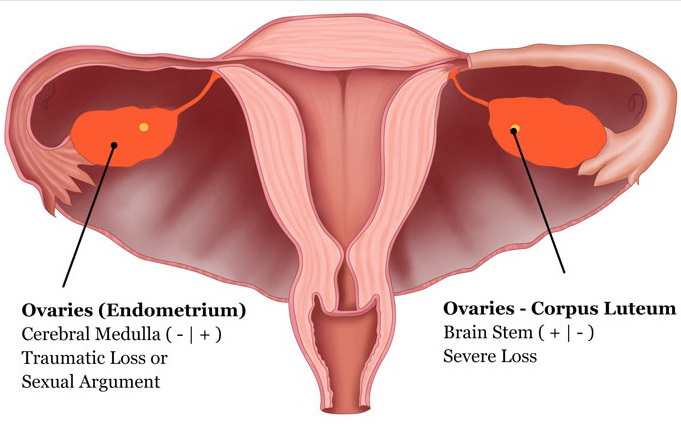
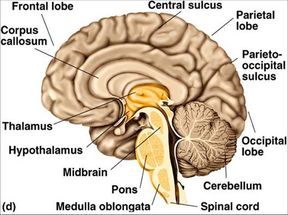
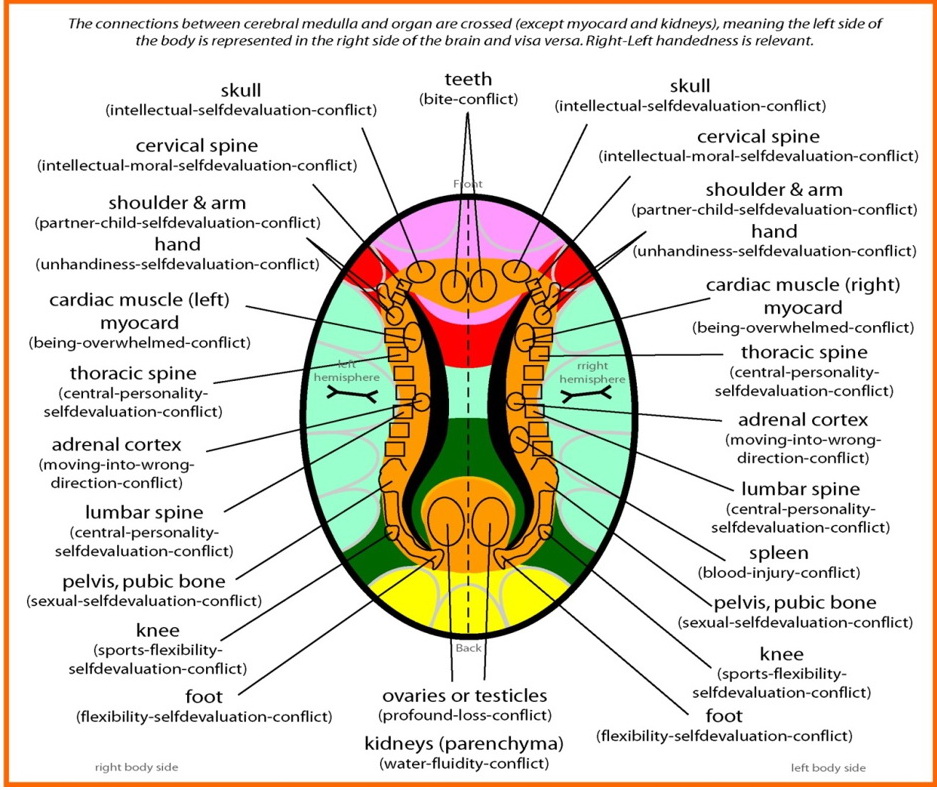
Cerebral Medulla / Upper Midbrain ( – / + ) posterior central left & right
Mind
Theme:
1. Traumatic Loss of a person
2. Argument with a sexual nuance
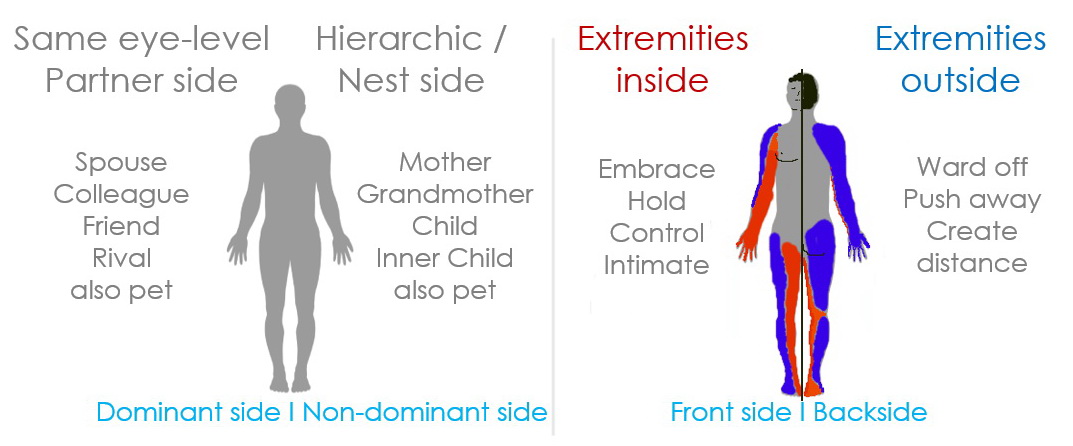
Side dominance is relevant for association:
Emotions and Thoughts:
Grief or Anger
- What will I do without him?
- i canot get over that he is gone!
- I can’t believe what he did to me/us!
- I am so disappointed!
- He doesn’t want me to bear his child.
- He is cheating on me!
META-Meaning:
1. Now, I can perceive and reflect the presence of my loved ones inside of me, which enables me to let go of the pain.
2. My beautiful essence attracts the right partner and the right surroundings for me. I am the master of my life and can communicate my wishes and needs clearly. The other one has his own story.
Organ
Stress Phase:
Decrease of function in the ovary affecting the interstitial oestrogen producing cells. Symptoms may be an irregular menstrual period, an abortion, a withdrawal bleeding or amenhorrea, infertility and virilization. On the physical level there may be cell atrophy, ovary necrosis or, in a long and repetitive process, shrunken ovaries.
Possible diagnoses: Dysmenorrhea, amenorrhea, hirsutism
Regeneration Phase:
The function of hormone production is restored and augmented, often after inflammatory swelling (adnexitis) in presence of bacteria. Ovarian cysts can form, which firstly contain liquid but later indurate as hormone producing organs. They may be diagnosed as an ovarian tumor.
During the course of 9 months, an ovarian cyst grows attached to the immediate organs in order to get the bloodsupply from the surrounding area (this would be diagnosed as an invasive adhesion). As soon as the own blood supply is ensured, the adhesion detaches and the cyst forms a compact and solid capsule.
In case of a simultaneously activated water retention, cysts can swell and tear the surrounding vessels, so the cysts fill up with semi-coagulated blood, (so called chocolate cysts), or they might rupture.
Polycystic ovaries appear in chronic patterns of loss or perceived sexual injustice.
Biological Meaning:
The indured cyst produces sexual hormones that make women look younger, helping them to attract a partner for to biologically replace the lost.
Social
Examples:
- A forty-year-old woman is afraid of being separated from her partner. She definitely wants to have another baby. At her age, the separation would mean the loss of her prospective baby (loss of the chance to have a baby).
- A woman found a new partner and satisfying sex life with 50. She appears a lot younger, and carries his baby which she gives birth to naturally and healthy. (Klapp)
- 2 years after the client separated from a tense relationship, she gets the diagnosis of an ovarial tumor. Another tumor is found after the traumatic loss of a family member. (Solomon, MHU archive)
- Polycystic ovaries in young girls are often due to conflicts in their relationship with their father. (Eldemellawy)
Additional Information
The oestrogens produced in the ovaries lead to the monthly proliferation of the endometrium. The size of ovaries can vary during the monthly cycle; after menopause it is markably reduced.
Estrogen increases the sensitivity for hearing, as well as memory function for sounds and speech.
Estrogen dominance
This is a symptom of a relative excess of estrogen, or lack of progesterone, that characterizes menopausal conditions. In hormonal change, symptoms as irritability, mood swings, weight gain, edema, cravings for sweet, sleeplessness and ovarial cysts can appear. This is promoted by medication, estrogen-containing food (meat, beer, soy products) and water contamination with hormones.
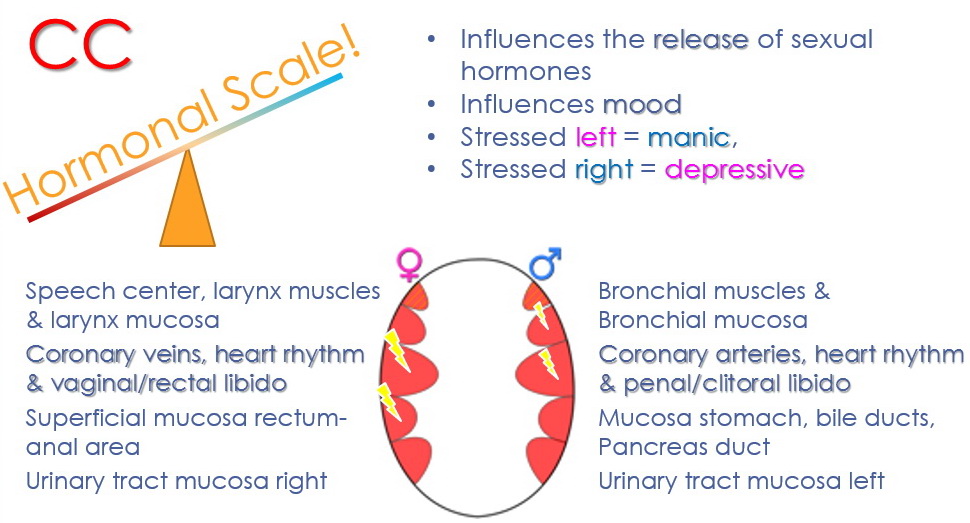
Conflict weight on the right side of the “hormonal scale” increases estrogen dominance:
Polycystic Ovary Syndrome PCOS
There is a genetic disposition (ovary-related conflict pattern passed on in the female ancestors line) which then gets triggered by current conflicts and lifestyle, represented in obesity and hirsuitism. Besides loss and female identity theme, conflicts regarding attractivity and abandonment play a role here, as well as diet and lack of motion.
Constellations
Fertility Megalomania after activation in both hemispheres, one believes in building big families/tribes with many children.
Differential Diagnosis:
Ovaries – germ cells (Brain Stem, +/-) stress phase (severe loss): hyperplasia or teratoma
Uterus – Endometrium (Brain Stem, +/-) Stress phase (loss or sexual fight): increased secretion and cell growth; regeneration phase: inflammation and degradation (fungal infection), strong menstrual bleeding
Pituitary anterior lobe – production of gestagen (Brain Stem, +/-) Stress phase (pregnancy): increased production of gestagen, inhibition of ovulation, infertility
Pituitary anterior lobe – production of FSH (Brain Stem, +/-) Stress phase (fertility): increased production, maturing of germ cells, increased fertility
Cervix / Uterus Mucosa / Coronary Veins (Cerebral Cortex, -/+): dysmenorrhea and amenorrhea can also occur in the stress phase of a sexual or female territorial conflict.
Territorial Constellations in the Cerebral Cortex lead to imbalances in the release of sex hormones, as well as to personality changes and manic or depressive episodes.