Nerves – Sensory Innervation
Anatomy
Sensory neurons are nerve cells that transmit sensory information (sight, sound, touch, temperature etc.). They are activated by sensory input, and send projections to the Central Nervous System (brain or spinal cord) where they are wired up with motoric or other sensory nerves. The neurons leading towards the CNS are called afferences, those that lead away from the CNS efferences:. Together they create a reflex arc.
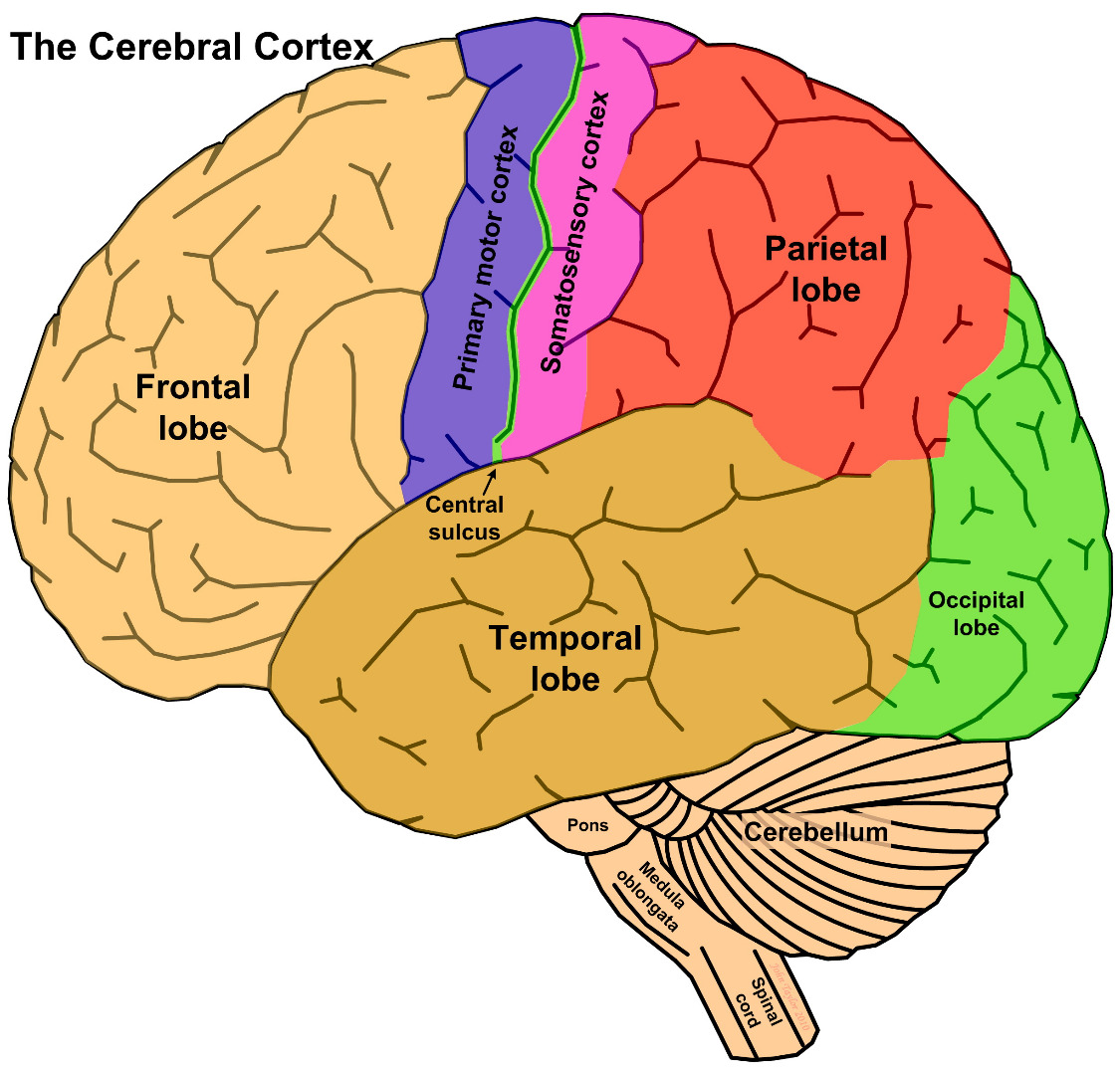
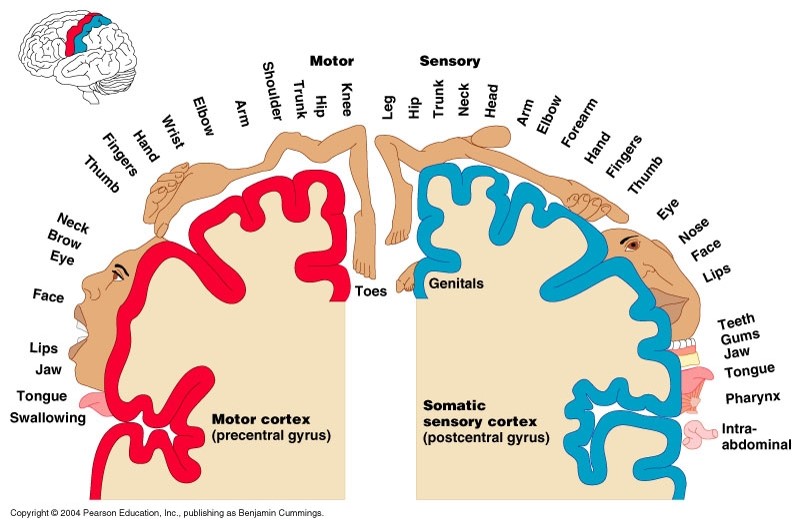
Afferent stimuli that exceed a certain level of intensity, create an electrical impulse (action potential) that after travelling to the brain, is processed in the sensory areas of the cerebral cortex which represent a “homunculus” (picture of the whole body). Special sensory areas are the visual cortex in the occipital lobe, the auditory cortex in the temporal lobes, and association areas, as well as the folded in part of the cerebral cortex, the insula. The insular region is associated with assessment of olfaction, gustation and emotion, and contains the territorial relays.
Brain
Relay:
Cerebral Cortex sensory areas & insular region
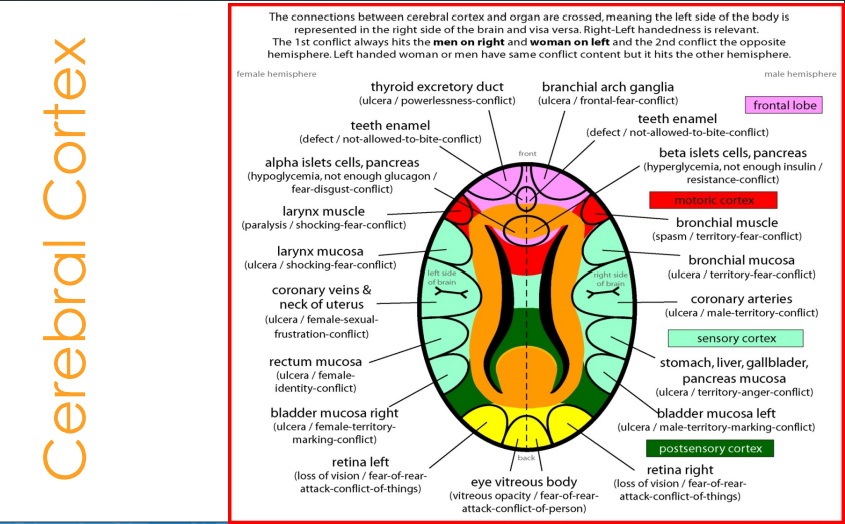
Mind
Theme:
Sensory Trauma: not wanting, being able, or allowed to feel / perceive
- Visual cortex: not wanting or being able to see, visual trauma
- Auditory cortex: not wanting or being able to hear, auditory trauma
- Territorial area: Threat of one’s social position
Sensory trauma, deprivation or fear of touch can refer directly to the concerned area, or also be associated like in this scheme:
Emotions, Thoughts:
Resistance, anger, fear, uncertainty
- I don´t want to feel that!
- That is just too much!
- Leave me alone!
- I should be able to feel that!
- I can´t perceive that!
META-Meaning:
- Now, I can face, embrace and handle all that the universe gives me to experience.
- Now I am ready to explore this deeper.
- I can communicate my needs and boundaries clearly.
- Now I restore my curiosity.
Organ
The sensitivity changes according to the patterns of epidermis/Outer Skin pattern with hyperesthesia in regeneration phase, or according to digestive mucosa/Inner Skin pattern with hyperesthesia in stress phase, depending on the tissue/location
Stress Phase Symptoms:
No change in cellular structure in the sense of cell proliferation or cell loss. This phase is characterized by:
1. OS: Functional loss of sensitivity characterized by a numbness or anesthesia in the affected location. It can be diagnosed as sensory paralysis. - Epidermis
- Superficial nasal & sinus mucosa
- Conjunctiva & cornea of the eye
- Mucosa of respiratory tract
- Mucosa of urinary tract
- Superficialrectum mucosa
2. IS Functional gain of sensitivity (hyperesthesia) - Mouth– and stomach mucosae
- Pancreas duct
- Bile ducts & gall bladder
- Intima of coronary vessels and aorta
- Muscle fascia
- Periosteum & Meninges
- Structures derived from pharyngeal arches
Regeneration Phase Symptoms:
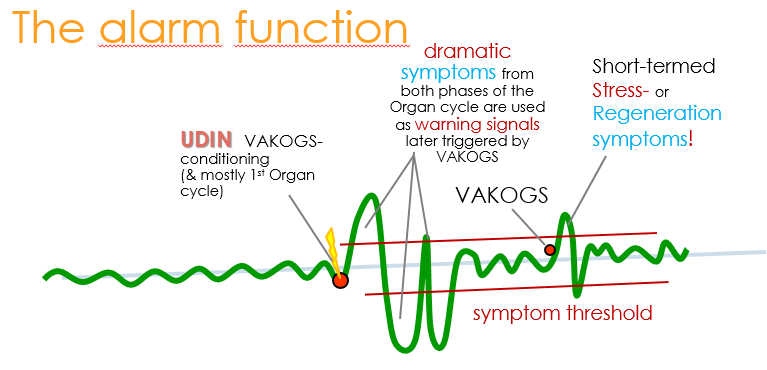
Slow return of nerve function. Firstly, the numbness can remain during the first phase due to the brain relay being flooded with oedema. Later paresthesia like tingling sensations or itching, which often become another stress trigger that makes the process chronic. In tissues of the IS pattern (see above), there is a reduction and then normalization of sensitivity in regeneration phase.
Also by the conditioned alarm mechanism, paraesthesia or itch can be provoked.
Healing Peak:
Absence/unconsciousness and sensitivity changes according to OS or IS patterns (similar as in stress phase).
Biological Meaning:
Sensory paralysis imitates the apparent death reflex of an animal followed by an enemy and cannot escape from the situation. The biological essence of the conflict and the body reaction is in the few minutes while the living being must pretend to be dead. It is even a strategy for a merciful death without pain, when the “prey” has given up and surrenders. This is similar to the Cerebellum Constellation with desensitizing under encompassing threat/attack.
Social
Examples:
- A woman has to leave her home and family behind. She worries about their wellbeing and is triggered to experience a paresthesia on her left shoulder and upper arm.
- An artist experiences a paresthesia in his calves and feet. He is constantly struggling with finances.
- A woman has left her home and old problems behind. Whenever she is reminded of the place, she feels an itch in the back of her neck. After recognizing and letting go of the problem, the symptom vanishes at once. (Klapp)
Additional Information
Constellations
Sensory Constellation (sensory conflicts in both hemispheres): enhanced perception, hypersensitivity, hallucinations. If the conflicts have a sexual theme, the hormonal scale swings to create depressive or manic moods.
Differential Diagnosis:
Other causes of anesthesia:
- Nerve-injuries after accidents or surgery
- Strong brain oedema or brain tumor damaging the sensory or postsensory cortex due to the raising intracranial pressure
- Intoxication
Other causes of hyperesthesia/hyperacuity: - Stress phase of endodermal parts in middle and inner ear(overacute hearing)
- Stress phase of endodermal nasal mucosa & olfactory nerve (overacute smelling)
- Stress phase of ciliary muscle (hypersensitivity to light)
- Intoxication, drug influence
Nerves – Motoric innervation (Cerebral Cortex,-/+): Motoric paralysis in stress phase (not able to perform) and healing peak
Brain – Meninges (Cerebellum +/-): Reinforcement of the fibrous tissues in stress phase (attack to brain or beliefs), inflammatory degradation /meningitis with symptoms including possible sensory affection in regeneration phase.
Epidermis(Cerebral Cortex -/+) Sensory reaction as above but also trophic skin reaction.
Periosteum(Cerebral Cortex -/+ or +/-) Sensory reaction as above but also trophic reaction.
Nerves – Myelin Sheath(Cerebellum +/-): reduced sensitivity and reinforcement of the nerve sheath in stress phase (fear for pain), paresthesia in regeneration phase. In multiple sclerosis, the myelin sheath is degraded, which reveals a recurring process.