
Nerves – Myelin Sheath
Anatomy
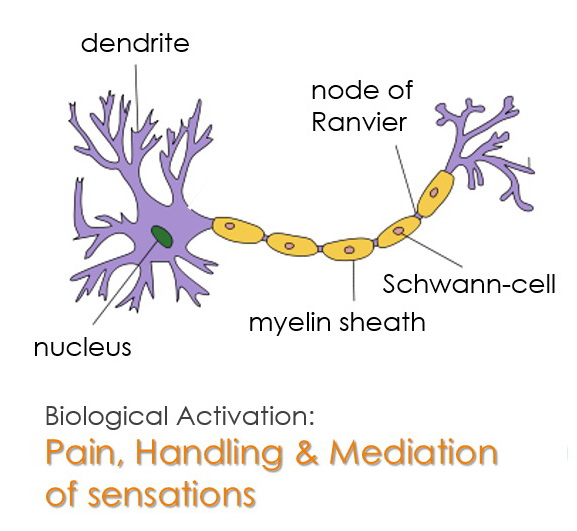
Myelin sheath (nerve sheath) is the sheath surrounding the axon (not the dendrites) of myelinated nerve cells, consisting of concentric layers of myelin formed in the peripheral nervous system by the plasma membrane of Schwann cells, and in the central nervous system by the plasma membrane of oligodendrocytes (both types are glia cells). It is interrupted at intervals along the length of the axon by gaps known as nodes of Ranvier. Myelin, consisting of phospholipids, is an electrical insulator that serves to speed the conduction of nerve impulses (saltatoric conduction from node to node). Moreover, when a peripheral fiber is severed, the myelin sheath provides a track along which regrowth can occur.
Brain
Relay:
Cerebellum ( + / – )
Mind
Theme:
Fear of Contact, pain conduction and evaluation
Emotions, Thoughts:
Fear, resistance
Touch is perceived as threatening because it has become a trigger for unreleased pain (from blow, accident, trauma). Can be mediated by the strong pain from periosteum innervation (CC).
- I’m hurt!
- Let me go!
- I don’t want that!
- I don’t like to be touched.
- I have to block that feeling!
META-Meaning:
I am well-protected, can take care of myself, and let go easily of unwanted perceptions.
I love to touch and to be touched with respect and without fear.
Organ
Stress Phase Symptoms:
There is a reduction in sensitivity and a proliferation of glia cells. These fibromas can concern several integumentary layers. A cerebellum constellation might play a key role in this process.
Possible diagnoses: peripheral glioma, Schwannoma, Neurofibroma or Neurosarcoma. (See Additional Information)
Morbus Recklinghausen with neurofibromas and pigment changes seems to be connected to inherited patterns.
Regeneration Phase Symptoms:
Neurofibromas can remain, or be degraded by bacteria or mycobacteria. In this case, a sebaceous cyst (atheroma) forms. Sensitivity returns spontaneously, possibly temporarily heightened.
In case of a chronic process, demyelination can occur which can have a wide range of symptoms including loss of vision/hearing, odd sensation in legs, arms, chest, or face, such as tingling or numbness, weakness of arms or legs, speech impairment and memory loss. The risk of secondary conflicts of self-devaluation is strong. Possible diagnoses of this chronic pattern are Multiple sclerosis (MS), Guillain–Barré syndrome, chronic inflammatory demyelinating polyneuropathy, Charcot–Marie–Tooth disease (CMT).
Biological Meaning:
The proliferated insulating nerve sheath is meant to neutralize pain.
Social
Examples:
- A young woman had a tough childhood with violence and abuse. She developed dermal neurofibroma on her back. (Klapp)
- An immigrant boy who feels mobbed in school because of his strange accent and looks, gets neurofibroma in his face.
- An athlete with a family history of MS cases is devastated when she gets the diagnosis herself. It triggers secondary conflicts and she feels progressive weakness. Through persistent training while clearing traumatic memories and thoughts, she rebuilds her ability. (Valentic, MHU archive)
Additional Information
Neurofibromas are subdivided into two broad categories: dermal and plexiform. Dermal neurofibromas are associated with a single peripheral nerve, while plexiform neurofibromas are associated with multiple nerve bundles.
Dermal neurofibroma typically arise in the teenage years and are often associated with the onset of puberty. They can lead to stinging, itching, pain and disfiguration.
Fibromyalgia might be connected to demyelination: http://www.examiner.com/article/could-fibromyalgia-have-autoimmune-demyelinating-cases
The symptoms of demyelination can be distinguished from other neural affections which can lead to similar diagnoses, like MS, Guillain-Barré, or encephalomyelitis. Of course, different programs and phases can be combined to create these diagnoses.
Multiple sclerosis (MS, disseminated sclerosis, encephalomyelitis disseminata), according to conventional medicine, is an inflammatory process in which the insulating covers of nerve cells in the brain and spinal cord are damaged. This damage disrupts the ability of parts of the nervous system to communicate, resulting in a wide range of signs and symptoms, including physical, mental, and sometimes psychiatric problems. MS takes several forms, with new symptoms either occurring in isolated attacks (relapsing forms) or building up over time (progressive forms). Between attacks, symptoms may go away completely; however, permanent neurological problems often occur, especially as the disease advances.
Constellations
Cerebellum Constellation: reduced sensitivity (physical and emotional), “emotional burnout”
Differential Diagnosis:
Skin – Dermis(Cerebellum +/-) Stress in vulnerability: Reinforcement by cell proliferation with or without pigment in stress phase, skin tumors. In regeneration phase degradation with pus, acne.
Skin – Epidermis(Cerebral Cortex -/+) stress in wanted or unwanted contact: dry, flaky, pale skin; Regeneration phase: red sensitive skin, eczema
Sensory Nerves(Cerebral Cortex -/+) Sensory trauma: Numbness or sensory paralysis in stress phase, paresthesia in regeneration phase, absence with numbness in Healing Peak.
Motoric Nerves(Cerebral Cortex -/+) Inability to act: Weakening or paralysis of the innervated muscles in stress phase and beginning regeneration, later spasms, twitching. In Healing Peak epileptic seizures.
Periosteum innervation(Cerebral Cortex-/+) stress in unjust contact or separation: hyperesthesia, flowing pain, reduction of blood flow in the affected area
