Nerves – Motoric Innervation
Anatomy
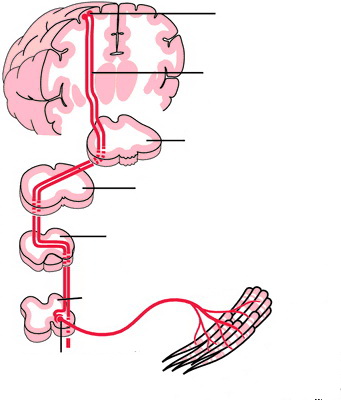
A motor neuron (or motoneuron) is a nerve cell (neuron) that originates in the motor region of the cerebral cortex, whose cell body is located in the spinal cord and whose fiber (axon) projects outside the spinal cord to directly or indirectly control muscles.
A motor unit is made up of a motor neuron and the skeletal muscle fibers innervated by that motor neuron’s axonal terminals. Groups of motor units often work together to coordinate the contractions of a single muscle; all of the motor units within a muscle are considered a motor pool.
All muscle fibers in a motor unit will be of the same fiber type. When a motor unit is activated, all of its fibers contract. Control of muscle contraction force is accomplished by controlling how many motor units are activated for a given motion.
The number of muscle fibers within each unit can vary within a particular muscle and still more widely from muscle to muscle; the muscles that act on the largest body masses have motor units that contain more muscle fibers, whereas smaller muscles contain less muscle fibers in each motor unit. For instance, thigh muscles can have a thousand fibers in each unit, while extraocular muscles might have ten. Additionally, muscles which possess more motor units (and thus more individual motor neuron innervation) are able to control force output more finely.
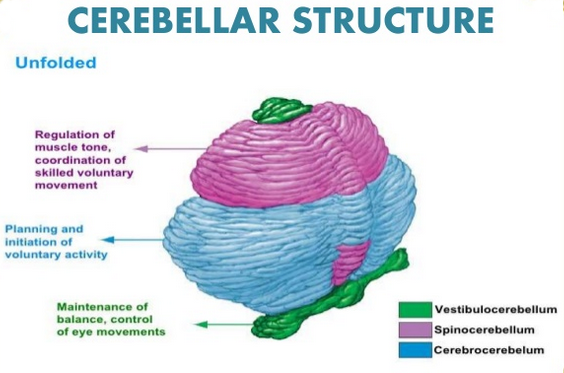
Modulation of motoric happens during passage of the cerebellum, where the impulse is inhibited by interneurons.
Also muscle fascia that posses much sensory innervation, thus providing feedback for posture and movement, play a role in skeletal muscle regulation and coordination. Their smooth muscle cells follow the “old brain” pattern (+/-) and promote hypertension rather than paralysis in stress phase.
Smooth organ muscle and cardiac muscle are steered unvoluntarily by the ANS and the enteric nervous system.
Brain
Relay:
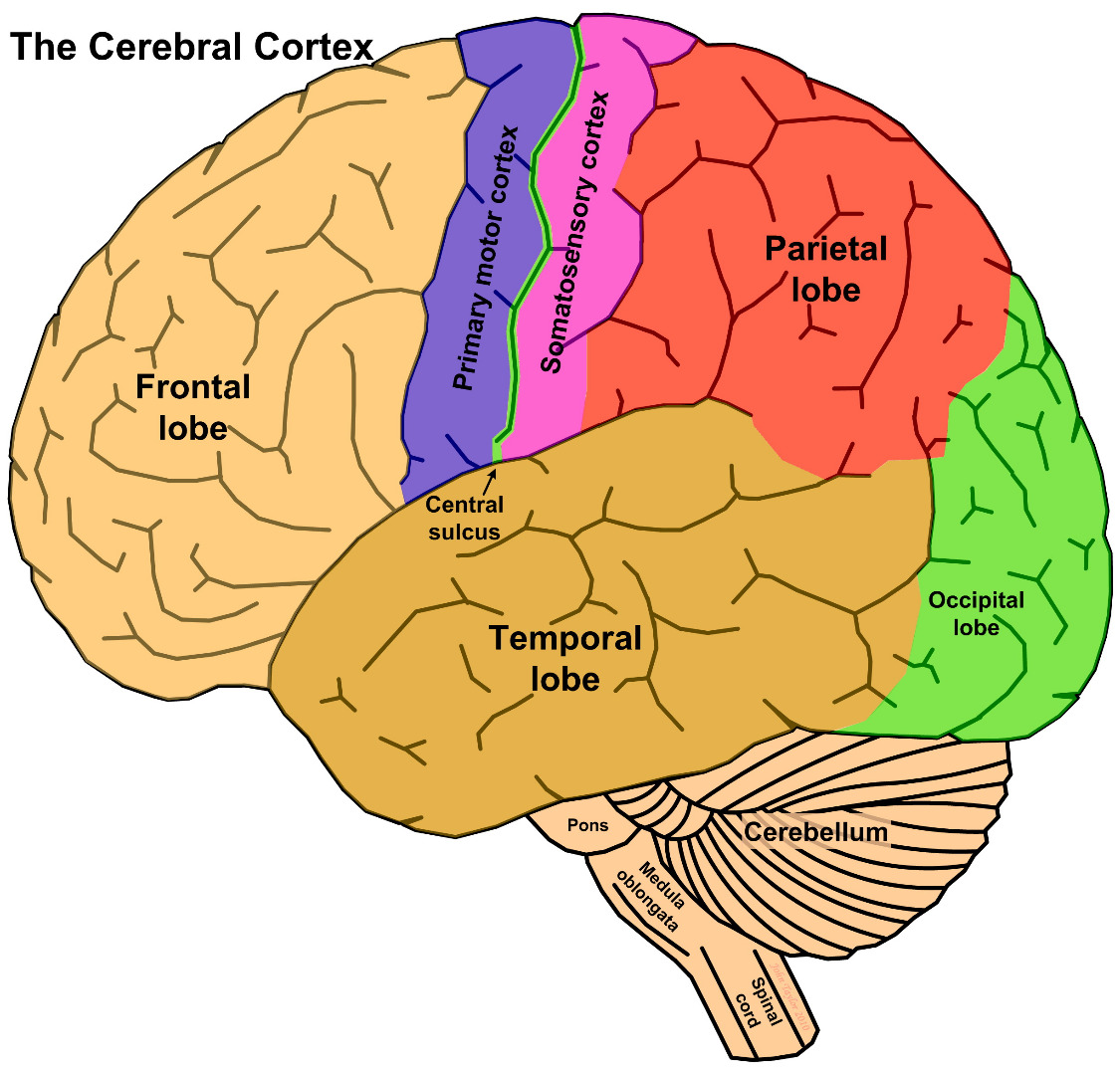
1. Cerebral Cortex motoric area (-/+)
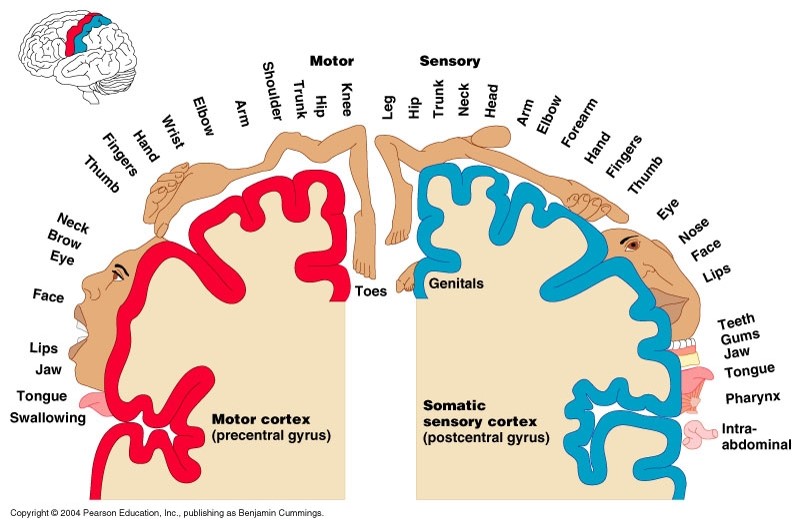
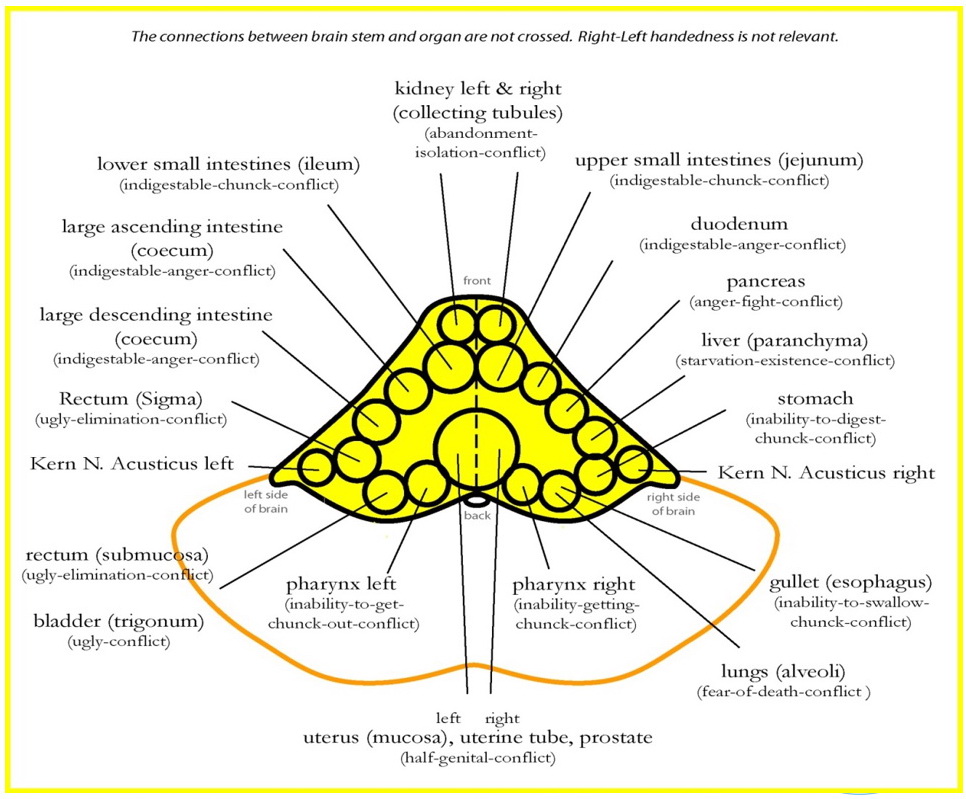
2. Midbrain (+/-): smooth muscle innervation via ANS, smooth muscle cells in skin & muscle fascia
compare Brain Stem
Mind
Theme:
1. Paralyzing Trauma
2. Physical overload
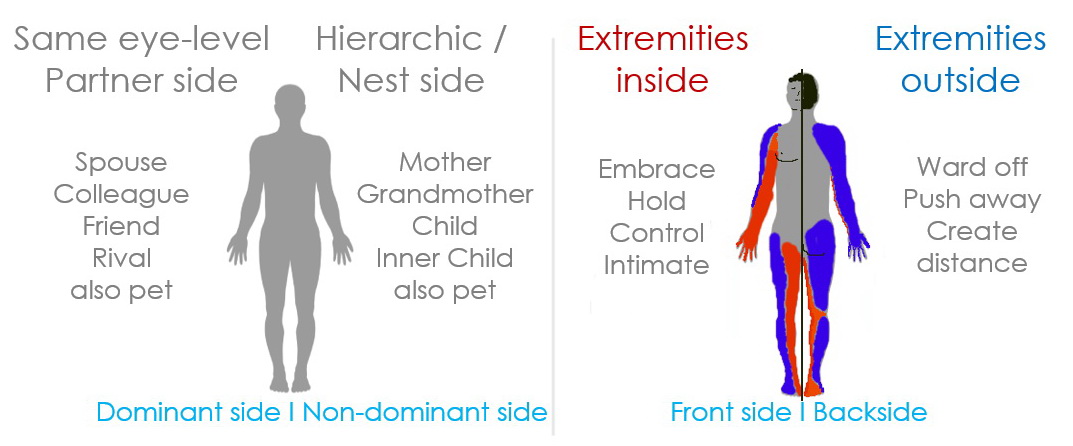
- Legs: Being unable to escape from something, to get away or to come along with something/someone.
- Arms/hands (Flexors/Adductors): Not being able to hold on to something/somebody.
- Arms/hands (Extensors/Abductors): Not being able to ward off someone, to push away or to keep away someone.
Emotions, Thoughts:
Shock, surrender or Freeze, survival instinct
- I can’t do what I need to!
- I can’t flee!
- They escape me!
- It doesn’t work!
META-Meaning:
- Now, I can shake off what happened and welcome energy in motion!
- I have another go!
- There is always another solution.
Organ
Stress Phase Symptoms:
1. No primary change in cellular structure in the sense of cell proliferation or cell loss, but functional loss of striated muscles due to the decreased function or inhibition of motoric innervation. The leading symptoms are: muscle weakness, reduced physical capability and paralysis or feeling paralyzed.
First there would be a motor paralysis of specific muscles, which then tends to spread. The paralysis is not painful. In case of a longer duration there is a considerable danger of a secondary conflict, as the patient is unable to perform, or because he foresees himself sitting in a wheelchair after a medical prognosis. Affection of muscle tissue leads to muscular dystrophy or muscular atrophy.
Possible diagnoses: (cold) stroke, multiple sclerosis (MS), primary lateral sclerosis, amyelotrophic lateral sclerosis (ALS), polio, Guillain-Barré-Syndrome
2. Fascia: Hypertension and rigidity upon an assault or demanding situation.
Regeneration Phase Symptoms:
1. Returning nerve and muscle function. In short-termed conflicts usually spontaneous recovery induced by shaking, otherwise slow recovery of paralysis.
2. Fascia: Normalisation of tonus and muscle innervation.
Healing Peak:
1. Shaking, seizures, unvoluntary movement, accompanied by a brief loss of awareness (absence seizure). Sometimes it is not accompanied by convulsions but a full body “slump”, where the person simply will lose body control and slump to the ground. The medical syndrome of recurrent, unprovoked seizures is termed epilepsy.
Biological Meaning:
Paralysis imitates the apparent death reflex of an animal followed by an enemy and cannot escape. This reflex affects also sensitivity, and is induced by the dorsal, unmyelinized part of the vagus nerve according to Stephen Porges’ Polyvagal Theory. The biological essence of the conflict and the body reaction is in the few minutes while the living being must pretend to be dead. In our civilization, conflicts can last for months or years, so the inhibition doesn’t make any biological sense but can lead to long-term diseases that can be overcome through the Social Engagement System by re-training perception, awareness and motivation.
Social
Examples:
- A woman is halted and tested for alcohol by the police. She feels wronged and insulted. After the incident, her feet weaken and she feels to walk “slurry”. Later, she gets the diagnosis MS.
- A newbought kitten is attacked by a larger cat in his territory, and barely succeeds to get out of the fight. After that, her hind legs get weaker and paralysed.
Additional Information
Motoric conflicts are often followed by self-devaluation influencing muscle trophic, which leads to more motoric conflicts in a vicious cycle.
These conflicts (like many others) can be experienced already by the fetus in the womb, when the fetus is unable to escape from stress situations (noise, medical examinations) or assimilates the conflicts of his mother.
Constellations:
Motoric Constellation (motoric conflicts in both hemispheres): Urge to move, restlessness, tic,
Restless leg syndrome with paraesthesia in the affected restless legs usually belongs to this constellation but the conflict/stress trigger is a sensual one.
Differential Diagnosis:
Other causes of paralysis:
- Nerve-injuries at accidents or operations
- Brain edema; damage to the motor cortex due to raising intracranial pressure
- Brain tumors
- Poisoning by toxins or drugs
Nerves – Sensory innervation (Cerebral Cortex, -/+ or +/-): Numbness or hypersensitivity (according to the sensitivity pattern) in stress phase and healing peak
Nerves – Myelin sheath (Cerebellum, +/-): chronic fear of pain or resistance to pain can lead to demyelination and symptoms like sensory and motoric losses like in multiple sclerosis.
Brain – Meninges (Cerebellum +/-): Reinforcement of the fibrous tissues in stress phase (attack against brain or beliefs), inflammatory degradation /meningitis with symptoms including possible motoric affection in regeneration phase.
Striated Muscles (Cerebral Medulla -/+) trophic decrease & weakening in stress phase (performance self-devaluation),
Fascia and Smooth Muscles (Midbrain +/-) hypertension in stress phase (performance, protection), normalisation in regeneration phase, also trophic changes in the muscle tissue.