
Facial Nerve
Anatomy
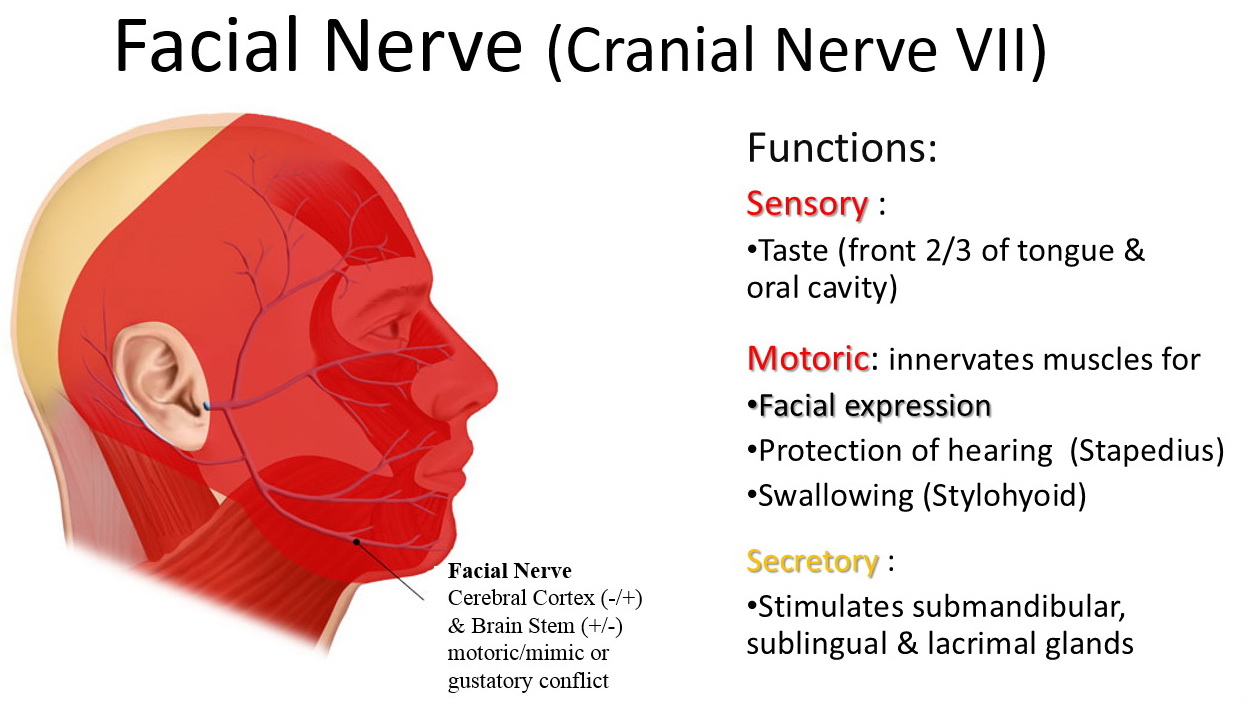
The facial nerve is the seventh cranial nerve (cranial nerve VII). It emerges from the brain stem between the pons and the medulla, and controls the muscles of facial expression, and functions in the conveyance of taste sensations from the anterior two-thirds of the tongue and oral cavity . It also supplies preganglionic parasympathetic fibers to several head and neck ganglia. The main function of the facial nerve is motor control of most of the muscles of facial expression. It also innervates the posterior belly of the digastric muscle, the stylohyoid muscle, and the stapedius muscle of the middle ear. All of these muscles are striated muscles of branchiomeric origin developing from the 2nd pharyngeal arch.
The facial nerve is essential for the Social Engagement System (SES) for stress relief (see Polyvagal Theory). .
Brain
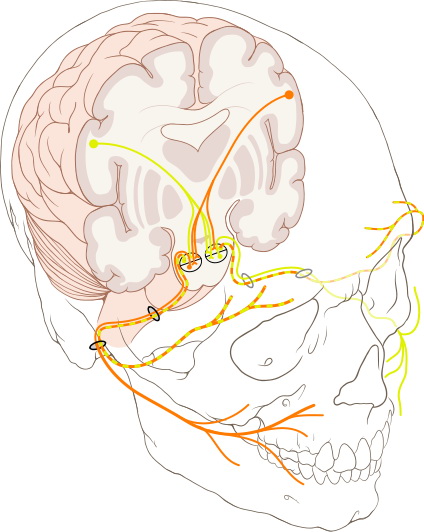
Relay:
1. Cerebral Cortex / N Facialis ( – / + ) for motoric and sensory functions
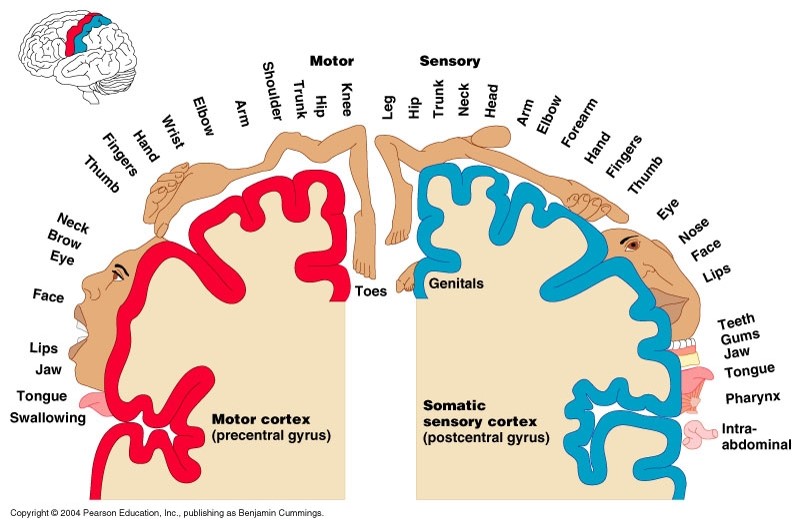
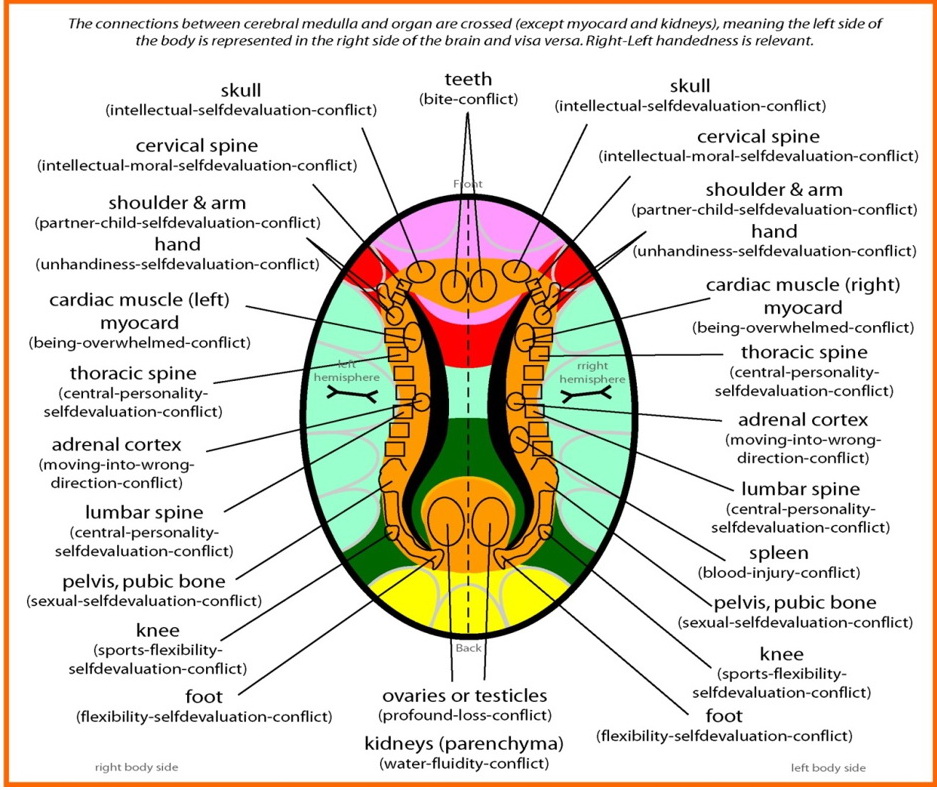
2. Cerebral Medulla / N Facialis ( – / + ) in “head area” for muscle trophic
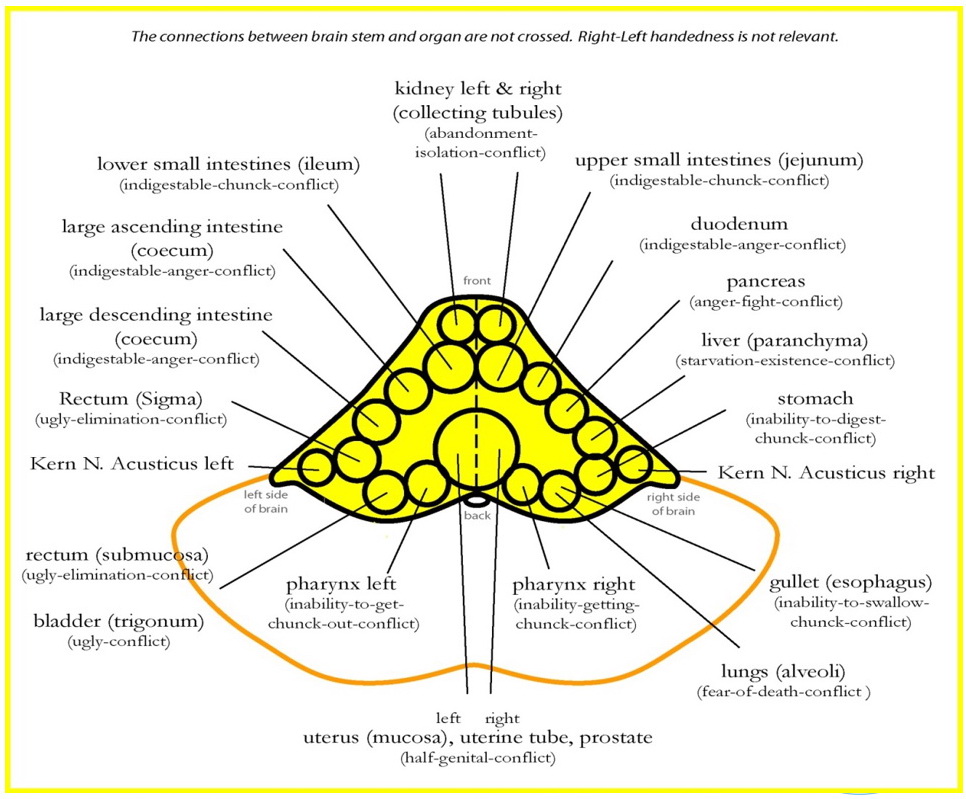
3. Brain Stem / N Facialis (+/-) dorso-medial left & right, for part of sensory functions tongue), unvoluntary motoric, secretory and absorptive functions
Mind
Theme:
1. Social fear of losing one´s face or having to keep a straight face
2. Self-Devaluation because of losing one´s face
3. Gustatory conflict (see Digestive System tongue, salivary glands)
Emotions, Thoughts:
Shame, fear, disgust
- I have to keep a straight face.
- I am making a fool of myself.
- I can’t keep smiling.
- I couldn’t make them feel safe with me.
- I can’t wipe it off my face.
- This tastes disgusting!
META-Meaning:
I love and forgive myself and let go of what others might think of me.
Organ
Stress Phase Symptoms:
No cellular but functional change: Functional loss and a paralysis or paresis (partial paralysis) of the facial nerve and muscles (often diagnosed as stroke or Bell’s palsy). This can include both motoric and/or sensory functions (paresthesia). Muscle tissue may weaken and show atrophy. Loss of taste, reduced saliva secretion, reduced production of lacrimal fluid are possible, as well as hypersensitivity to sound ( hyperacusis ) and loss of the stapedius reflex.
Regeneration Phase A:
By the development of brain edema, impulse transmission gets limited and further loss of function can occur. Bell’s palsy (or stroke) may also be diagnosed in this phase.
Healing Peak:
Short absence – unconsciousness, twitching facial muscles, salivation: “epileptic seizure”.
Regeneration Phase B:
The facial nerve and muscles gradually recover their function, seizures can occur.
Biological Meaning:
The stress reaction is one of rescue by shutting down, as a “freeze” response when fight or flight seem impossible or unsuccessful. The expected or feared pain is reduced by numbness.
Social
Examples:
- Man felt like being slapped into his face by remarks of girlfriend.
- Rumors were spread about sexual orientation and woman was afraid that people will think badly of her and she loses her face.
- An elderly lady struggled to get over the death of her grandson in a car accident. With a complicated relationship to her stepdaughter, she couldn’t show and release her feelings. She developed a sensory and motoric paresis of the left face which could be partly reversed with coaching. (Klapp)
Additional Information
The diagnosis “stroke” can have varying symptoms: typical are hemiplegia with loss of motor functions in face, arms, legs and speech. The reason can be brain oedema, bleedings (hemorrhagic) or loss of blood flow (ischemic) in the brain.
Differential Diagnosis:
Smooth Muscle in Fascia of the facial muscles (Midbrain, +/-) with hypertension and hypertrophy. Stress: Need to protect”
Trigeminus Nerve(Cerebral Cortex -/+) with similar reactions regarding tactile, proprioceptive, and nociceptive afference of the face and mouth, and activation of the muscles of mastication. Stress: Holding back feelings & expression
