
Tendons
Anatomy
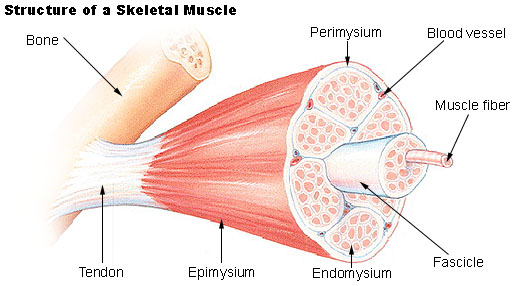
A tendon is a tough band of fibrous connective tissue that usually connects muscle to bone and is capable of withstanding tension. Tendons are similar to ligaments and fasciae; all three are made of collagen. Ligaments join one bone to another bone; fasciae connect muscles to other muscles. Tendons and muscles work together to move bones. Not all tendons are required to perform the same functional role, with some predominantly positioning limbs, such as the fingers when writing (positional tendons) and others acting as springs to make locomotion more efficient (energy storing tendons).
Tendons consist of dense regular connective tissue fascicles encased in dense irregular connective tissue sheaths. Tenocytes produce the collagen molecules, which aggregate end-to-end and side-to-side to produce collagen fibrils. Fibril bundles are organized to form fibres with the elongated tenocytes closely packed between them.
There is a three-dimensional network of cell processes associated with collagen in the tendon. The cells communicate with each other through gap junctions, and this signalling gives them the ability to detect and respond to mechanical loading with growth and remodeling processes, much like bones.
Brain
Relay:
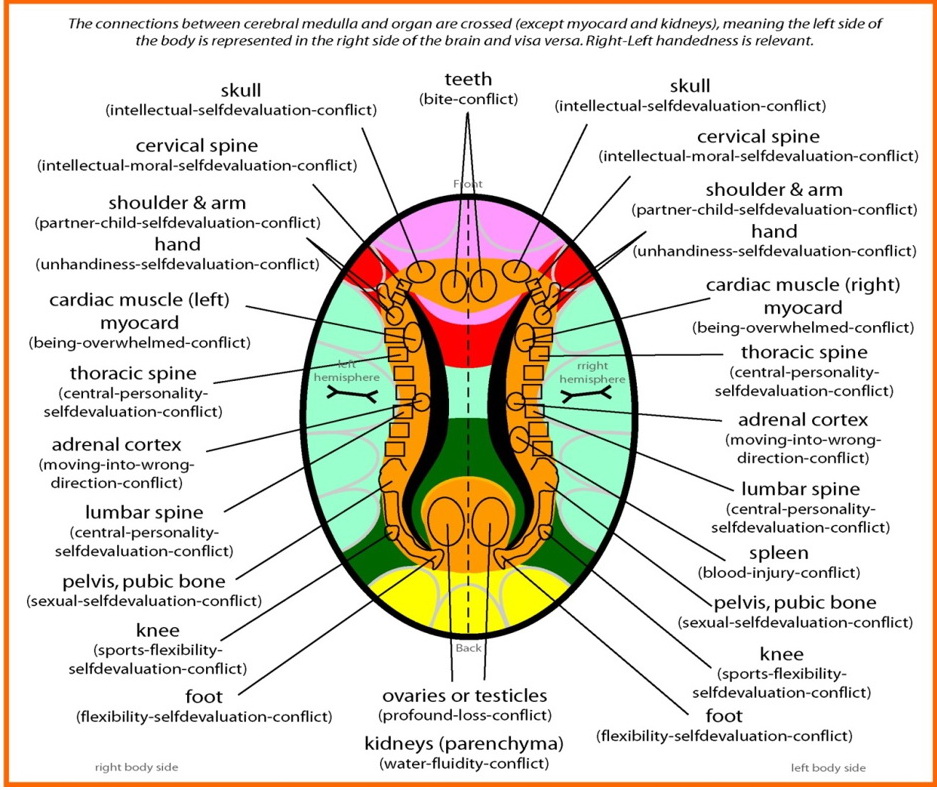
Cerebral Medulla ( – / + )
Mind
Theme:
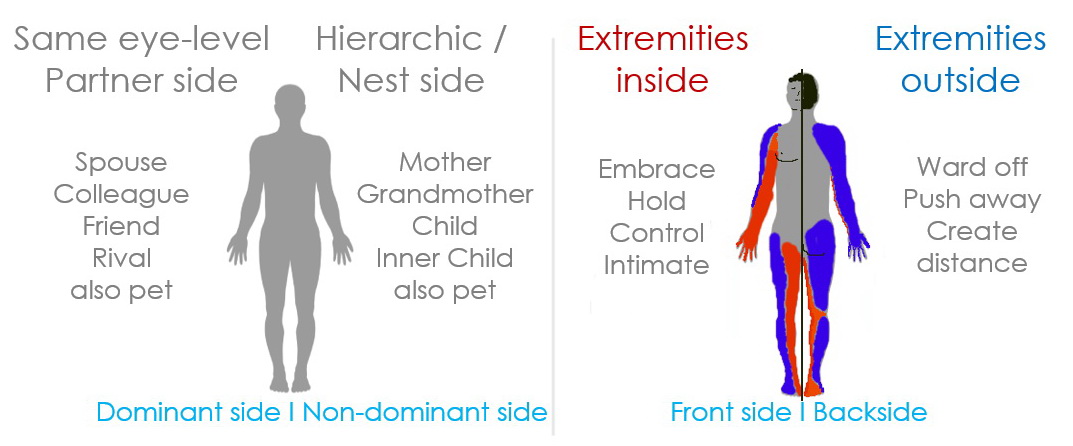
Functional self-worth according to the location and it´s associations
Association to locality:
For special associations according to locality see “Musculoskeletal System – Overview“!
Emotions, Thoughts:
Frustration, self-doubt
- I´m not strong enough.
- I can´t do this!
- I don’t get on fast enough!
- They hit my achilles heel!
META-Meaning:
- I can do much more than I believe!
- I love the way I act and perform in the world.
- Now, I am able to support myself.
- I can pass the stress on.
Organ
Stress Phase Symptoms:
Functional decline and destabilisation of tendons, which can be a causative factor for tendon rupture. Possible diagnoses are tendinosis or necrosis of the tendon.
Regeneration Phase Symptoms:
Repair and reinforcement: First swelling, heat and pain. Diagnosis may be tendon inflammation (tendinitis), tendosynovitis or tendovaginitis. Tendons may also be involved in diagnoses of fibromyalgia.
Prolonged or recurring processes can lead to shortening of the tendon, compare muscle fascia (protective function)
Biological Meaning:
After finished regeneration, the affected tendon will be stronger as before.
Social
In processes of the Cerebral Medulla, thoughts and beliefs play a major role, which can feed the destructivity of the stress phase. Typical evil cycles develop from the symptoms in regeneration phase, and have to be broken step by step with resourcing.
Examples:
- A man in midlife crisis is changing his life but feels he struggles to shake of properties and responsibilities of the past to move on with ease. He has recurring troubles with his achilles tendons.
- A woman overstrains her fingers in writing, focusing only on her work. When she anticipates completion and holidays, she gets a tendinitis in the wrist.
- A man is changing his life but has difficulties letting go of property and responsibility to move on with ease. His achilles heel is shortened, which improves by mindfulness, letting go and daily walks.
- A man who is unsatisfied with his job but still holds on to it, develops a snapping finger (tendovaginosis stenosans) on his dominant hand. (Klapp)
Additional Information:
Constellations:
Megalomania, Motivational Constellation (both hemispheres affected in Cerebral Medulla): the turnaround of self-devaluation, belief in one’s abilities and achievements in spite of handicaps. This constellation remains through the whole cycle until regeneration is finished in one of the hemispheres.
- Skull: Intellectual megalomania
- Cervical spine: Justice (rebel-)megalomania
- Thoracic spine: Honesty megalomania
- Lumbar spine: Passion megalomania
- Shoulder: Responsibility megalomania
- Arms: Manager megalomania
- Hands: Dexterity megalomania
- Pelvis: Sexual megalomania
- Hip: Patience megalomania
- Legs: Stability megalomania
- Feet, knees: Stability or mobility megalomania
Differential Diagnosis:
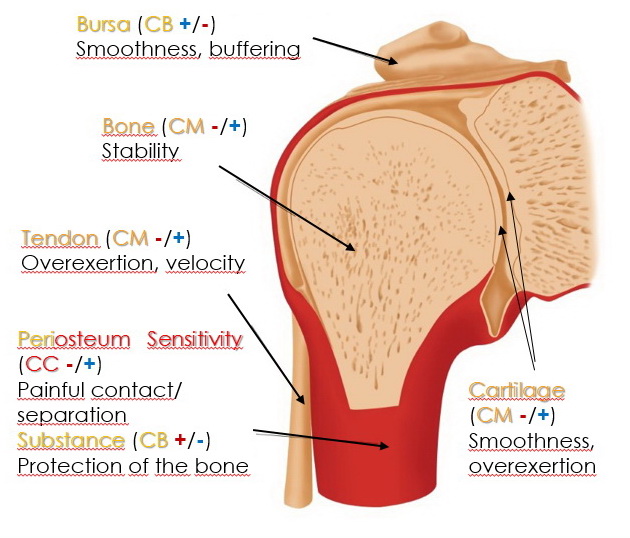
Skeletal Muscles and Bones (Cerebral Medulla, -/+): tendons are the insertion of muscle into bone tissue. They can be differentiated from elastic muscle fibers by their construction mainly out of collagen fibers.
Muscle Fascia (Cerebellum & Midbrain +/-): tendons are specific parts of fascia which do not cover muscles but act as mediator to bone tissue. Stress phase (Protection through muscle): increase of tonus & mass; Regeneration phase: relaxation upon sustained signal.
Periosteum (Cerebellum +/- & Cerebral Cortex -/+) Stress phase (indignating pain): thickening, reduced blood flow; Regeneration phase: rheumatic pain.
The insertion of tendons into the diaphysis of the bone is via interlacing with elastic fibers of the periosteum. In regeneration phase, tendon pain can mediate to the periosteum.
