
Myelin Sheath of Nerves
Anatomy
Each peripheral nerve is covered externally by a dense sheath of connective tissue the epineurium. Underlying this is a layer of flat cells forming a complete sleeve the perineurium. Perineurial septa extend into the nerve and subdivide it into several bundles of fibres. Surrounding each such fibre is the endoneurial sheath. This forms an unbroken tube which extends from the surface of the spinal cord to the level at which the axon synapses with its muscle fibres or ends in sensory receptors. The endoneurial sheath consists of an inner sleeve of material called the glycocalyx and an outer delicate meshwork of collagen fibres. Peripheral nerves are richly supplied with blood.
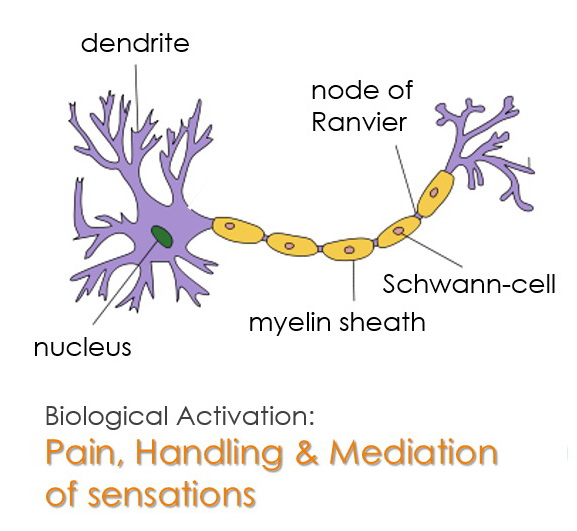
The myelin sheath is an electrically-insulating phospholipid layer that surrounds the axons of many neurons in the central and autonomic nerve systems. It runs in spirals around the axon, interrupted by Ranvier nodes. By saltatoric conduction from node to node, speed of transmission is enhanced. In the central nervous system, myelination happens through oligodendrocytes, in the peripheral nerves through Swann-cells. Both of these are glia cells.
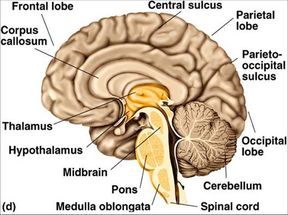
Brain
Relay
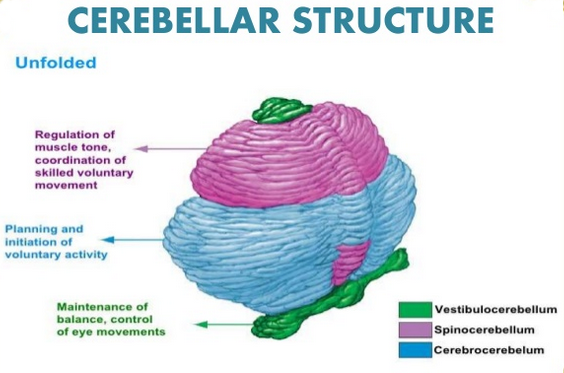
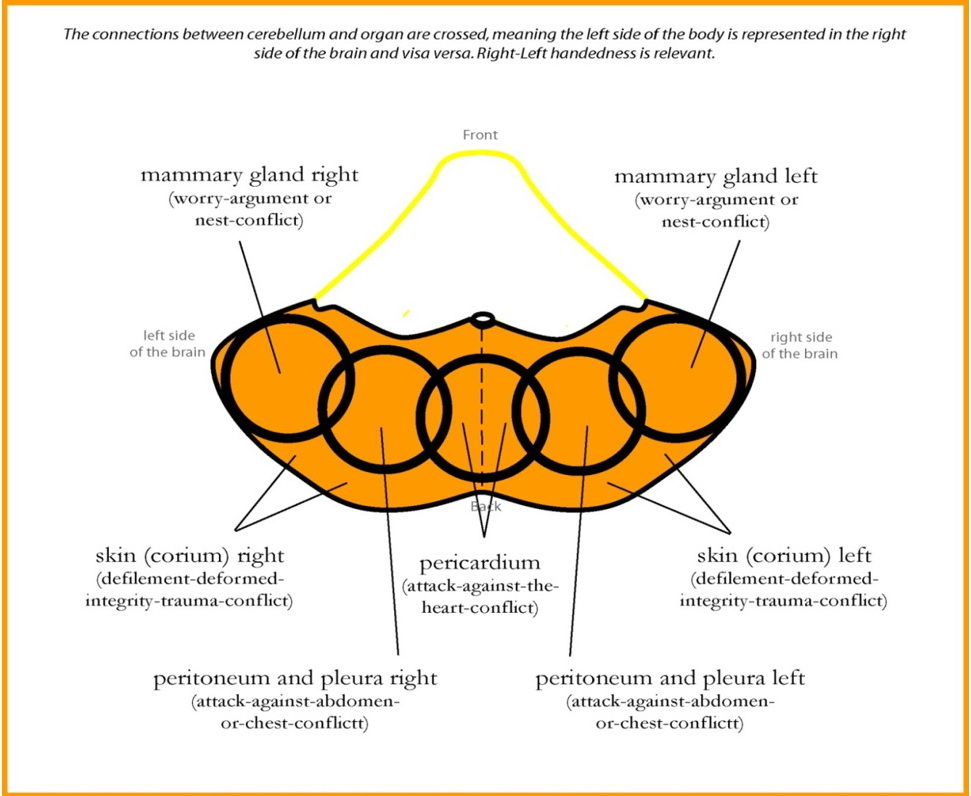
Cerebellum ( + / – ) dorsal left & right
Mind
Theme
Fear for touch, pain sensation (conduction and evaluation)
Emotions and Thoughts
Fear, resistance
Touch is experienced as threatening when coupled to stored painful experiences (blow, accident, trauma) Can also be connected to a strong pain from the periosteum.
- Leave me!
- This hurts!
- I don’t want that!
- I don’t like to be touched.
- I have to block that off!
META-Meaning
- I love to touch and be touched carefully.
- Now I can allow myself to feel and be secure.
- I am well-protected!
Organ
Stress Phase Symptoms
Enhanced activity and proliferation in the glia cells which can concern several layers of skin and connective tissue and be diagnosed as neurofibroma, Schwannoma, peripheral glioma or fibroma. The sensory stimulation (deep sensitivity of the cerebellum) is peripherally perceived as normal but it is not transmitted. It means that the perception is ‘absorbed’ by the neurofibroma: pain is as reduced as sensitivity, but total loss of sensation (anesthesia) is also possible. Possibly the cerebellum constellation plays a major role here.
An inherited pattern with neurofibroma and pigment changes is Morbus Recklinghausen.
Regeneration Phase Symptoms
Neurofibromas can remain, or be degraded in presence of microbes (fungi, mycobacteria), in which case a sebaceous cyst appears (atheroma) Sensitivity is restored immediately after the conflict resolution, possibly resulting in temporary hypersensitivity.
In chronic processes or sensitization, the myelin sheath can be degraded which leads to impairment of impulse conduction in the affected nerves. Typical syndrome is multiple sclerosis, here often both motoric and sensory qualities are affected and lead to muscular atrophy as a consequence of self-devaluation..
Possible diagnoses: disseminating encephalomyelitis (ADEM), motoric axonal neuropathy, Baló sclerosis, chronic inflammatory demyelinating polyneuropathy, Guillain-Barré syndrome, funicular myelosis, Miller-Fisher syndrome, transverse myelitis.
Biological Meaning
The enhanced insulation and desensitiation is meant to neutralize the perception of pain.
Social
Examples
- A 7 y o girl has to leave her playmates because her family moves to another country. She suffers a motoric and a pain conflict as well as abandonment, and develops progressive MS.
- A woman with emotional background of violation (contact- pain-, defilement- and sexual conflicts) successively gets neurofibromas over big parts of her body. (Klapp)
- An athlete who gets the diagnosis MS feels devastated. The generally reversible process of self-devaluation and muscle weakening gets chronic by her own associations, values and thoughts and she experiences progressive weakness. Through perseverant transformation of emotions and beliefs accompanied by individual training, she rebuilds her strength. (Valentic)
- A young woman bears unconscious guilt and beliefs that she is “bad” by birth. She learns a healing profession to counterbalance the inner conflict. She successively develops MS with motoric and sensory paralysis. Through spirituality she finds her inner solution, and with patience and training she regains her capabilities and finds her identity.(Kujama)
Additional Information
Neurofibromas are divided into 2 categories: dermal and plexiform. Dermal neurofibromas are connected to one single peripheral nerve, while plexiforme neurofibromaas are associated to several nerve bundles. Dermal neurofibromas appear mostly in the beginning of puberty. They can cause stinging, itch, pain and deformity.
Fibromyalgia is possibly connected to demyelinization of nerves. http://www.examiner.com/article/could-fibromyalgia-have-autoimmune-demyelinating-cases
Constellations
Cerebellum Constellation: physical & emotional desensitization in vulnerability concerning both hemispheres, “Emotional burnout”
Differential Diagnosis
Fibromyalgia (which is usually a combination of several skin and/or bone processes)
Skin-Epidermis (Cerebral Cortex -/+): hypesthesia and dry, pale skin in stress phase (contact – distance)
Skin-Dermis (Cerebellum +/-): overfunction of sebacious glands in stress phase (vulnerability), fatty skin, melanoma; regeneration phase: abscess, acne, skin tuberculosis, leper
Periosteum – Bone sensitivity (Cerebral Cortex -/+): hypersensitivity, strong pain in stress phase (indignating pain)
Sensory Innervation (Cerebral Cortex -/+): Stress phase (feeling inhibited): anesthesia, numbness; regeneration phase: paresthesia, itch, tingling sensations
Motoric Innervation (Cerebral Cortex -/+): Stress phase (action inhibited): paralysis
