
Pituitary Gland – Anterior Lobe
Anatomy
The pituitary gland is very small in size: just equal to the size of a pea. It lays at the base of the brain in a protective bony enclosure, which is called sella turcica. The pituitary gland is made up of two lobes: anterior lobe and posterior lobe.
The anterior pituitary gland (Adeno-Hypophysis) is often called the “master gland” because it influences the secretions of nearly all other glands. The anterior pituitary gland produces six major hormones:
1) growth hormone (GH)
2) prolactin (PRL)
3) adrenocorticotropin hormone (ACTH)
4) thyroid stimulating hormone (TSH)
5) follicle- stimulating hormone (FSH)
6) luteinizing hormone (LH).
Each pituitary hormone controls the secretions of a specific target peripheral gland. The secretions from peripheral glands control the release of regulator hormone from hypothalamus.
Regulatory hormones are produced by parvocellular neurosecretory cells present in the hypothalamus. The Hypothalamus secretes these hormones into hypothalamic capillaries which lead to infundibular blood vessels. Infundibular blood vessels lead to the capillaries present in anterior pituitary. Here, the regulatory hormones diffuse out of the capillaries and attach to endocrine cells of the pituitary. They control the release of hormones by the pituitary. This vascular relationship of hypothalamus and anterior pituitary is called the hypothalamo-hypophyseal portal system. Secretion of hormones from pituitary gland is pulsatile which shows that the stimulation by specific hypothalamic releasing factors is not continuous. Thus, the functions of pituitary glands are modulated by the feedback of peripheral glands.
Anterior regulates several physiological processes including carbohydrate and lipid metabolism, growth, inhibition of the perception of pain, milk production and production of sex hormones.
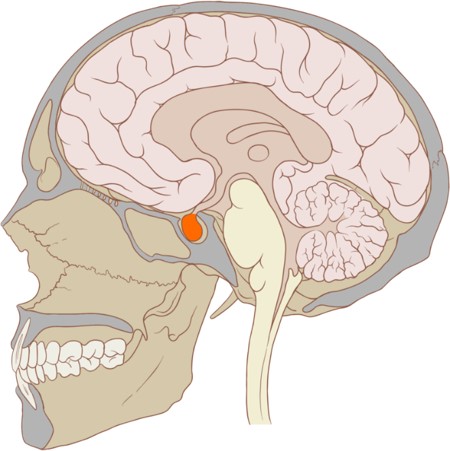
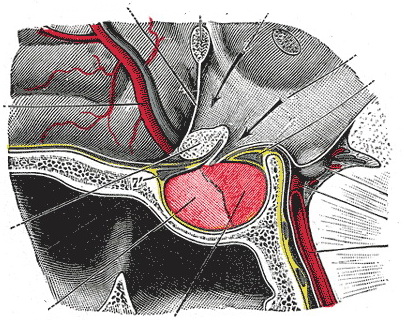
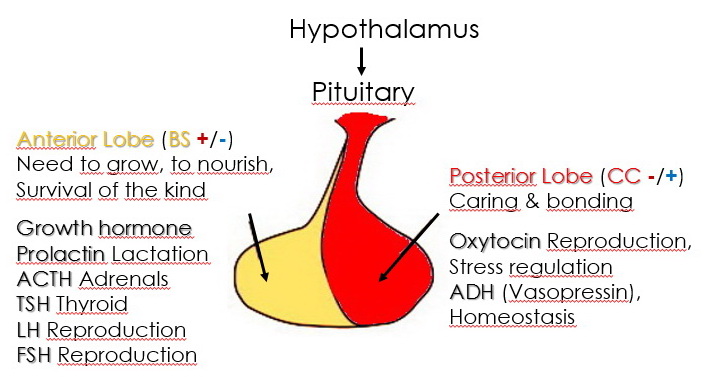
Brain
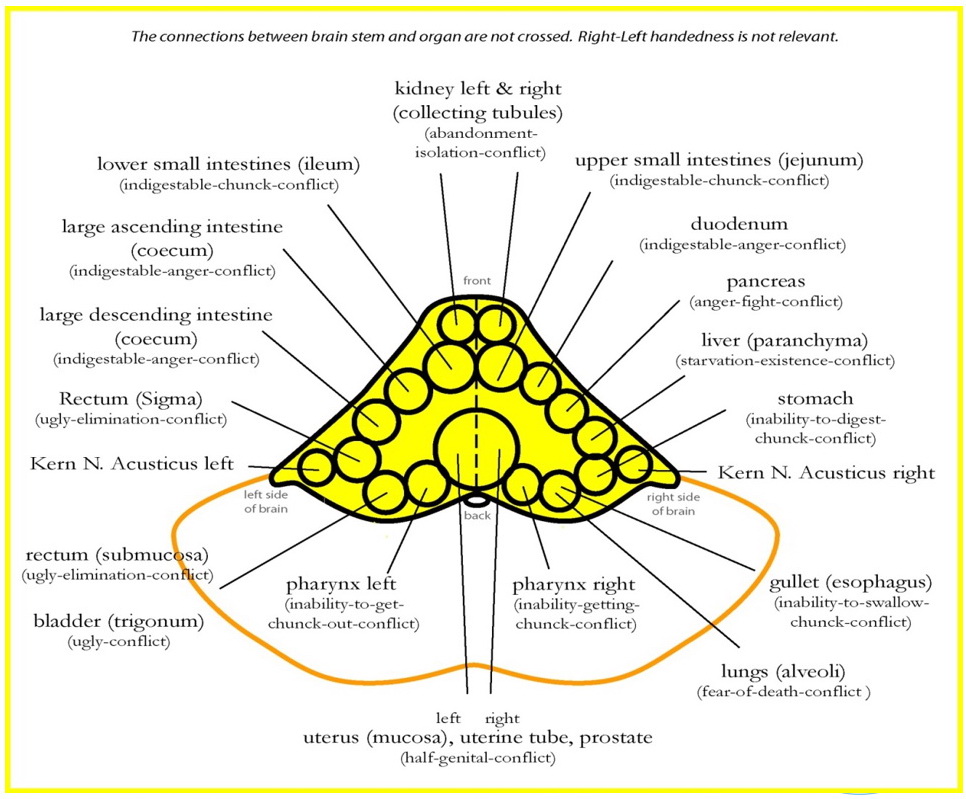
In the Brain Stem, the primeval ring structure is reflected: organ tissue relays with assimilative and digestive functions from oesophagus to small intestines are situated in the right brain stem, while excretory organs from caecum to rectum are relayed in the left brain stem. Medial on both sides are the relays of mouth/pharynx, middle ears and lacrimal glands, as well as the pineal and pituitary glands and the thyroid.
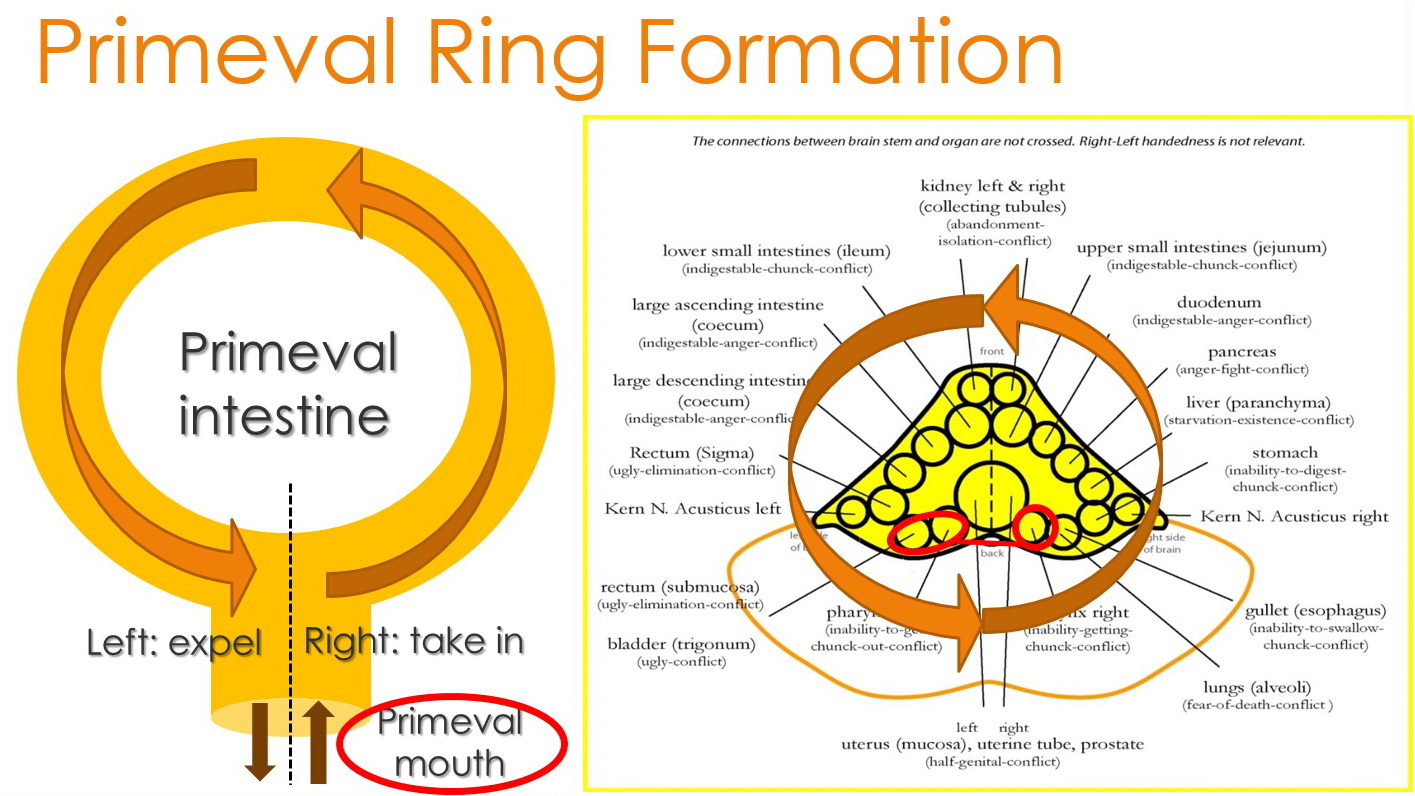
Relay:
Brain Stem (+/-) dorso-medial
Mind:
Theme:
Survival of self and the kind, related to the respective hormonal function:
1. GH: Not being able to arrive at a value or chunk because it is out of range.
2. PRL: Need to nurture or provide for your child or family (see breast glands), wish for a child.
3. ACTH: Need for surplus energy in stress situations, fight/flight response
4. TSH: see thyroid gland
5. LH & FSH: see germ cell production in gonads, need to mature
Emotions and Thoughts:
1. GH: Impatience
- I can’t reach that!
- I’m too small for that!
- I want to be as big and strong as he is.
- I should have reached that goal!
A common conflict in most of the children is not being able to get something that is out of reach. The conflict ultimately results in release of growth hormones.
2. PRL: Worry - My baby needs more milk!
- Is my child thriving?
- I should stay around the baby.
- I want another child!
The mother rapport and visual triggers of children induce release of prolactin.
3. ACTH: Aggression, Fear - Now is the time to fight!
- I need to get away!
- I must save me/them!
These feelings mobilize energy resources.
META-Meaning:
- I am complete in all aspects.
- I have been blessed in abundance.
- Everything, that I need to thrive, is within my reach.
Organ
Stress Phase Symptoms:
Increase of secretory functions by hyperplasia (pituitary adenoma):
1. GH: Release of growth hormone leads to physiological growth up tp gigantism in children. In adults (after epiphyseal plate closure), it causes acromegaly with growth in nose, fingers, toes, chin and zygomatic arch.
2. PRL: Release of prolactine hormone by prolactinoma leads to lactation in mothers, adenoma can cause lactation even far from the breastfeeding period (galactorrhea). It also inhibits the libido and the menstruation cycle in women. Likewise, a decrease in the production of testosterones can cause impotence in men.
3. ACTH: Release of energy for fight- or flight-reactions, high blood pressure, hyperglykemia; overproduction leads to Cushing-Syndrome.
4. TSH: Overproduction causes secondary hyperthyreosis (rare)
5. & 6. LH & FSH: Induction of sexual maturity and maturation of germ cells. Overproduction leads to precocious puberty in children.
The tumor´s expansion can cause headaches and visual disturbances by pressing on the ophtalmic nerve.
Prolonged stress phases, unfavourable environmental factors, or chronic conflict cycles can lead to exhaustion of the gland with decrease in hormone production. This can effect dwarfism/hyposomia/microsomia (conflict cycles experienced by mother and/or child).
Regeneration Phase Symptoms:
Regulation of hormonal balance. Encapsulation or microbial degradation of the tumor.
Biological Meaning:
1. GH: Growing means increasing one’s chances to reach a value or desired “chunk”.
2. PRL: Milk production signalizes one’s ability to provide for one’s child or to nurture one’s family.
3. ACTH: Release of corticosteroids mobilizes the energy needed in emergency.
4. TSH: Speeding up the metabolism mobilizes the energy and speed needed in emergency.
5. LH & FSH: Early maturation and fertility facilitate reproduction and replacement of losses.
Social
Examples:
- A boy who is mobbed in school starts to visit a martial arts school. He hits a growth spurt through the challenge, which resolves his problem. (Klapp)
- A client with a large breast tumor reports that she since earlier, when she wanted another child, had a pituitary overfunction and lactation. She had all her life identified as caregiver for children and later her parents. (Klapp)
- A woman whose grandchild falls from a boat into the water, reacts lightning fast, grabs the child and pulls it up with one arm. Later, she can’t explain how she got that strength. (Klapp)
- A single mother seeks for a community that provides her an opportunity to make a living for her children and allows her children to thrive. The children get late into puberty and have growth spurts first after some detachment from their mother. (Klapp)
Additional Information
The activity of the pituitary is closely interconnected with the other endocrine glands through the feedback loop to the hypothalamus. So, the endocrine systemshould be taken as a functioning unit.
The pituitary gland is represented by the 6th or third eye chakra, characterizing understanding, light and overview.
Constellations
Brain Stem Constellation possible: perplexity, lethargy, passiveness, reduced movement. Purpose: new orientation
Differential Diagnosis:
Also tumors of adrenal glands or pancreas can lead to an increased production of growth hormone and to acromegaly: either by secreting it or by producing Growth Hormone Releasing Hormone (GHRH), the hormone that stimulates the pituitary to produce growth hormone.
Cushing syndrome can be a sign of prolonged regeneration phase of the adrenal cortex (CM -/+) after (incomplete) resolution of an orientation conflict.
Retardation and postponed sexual maturation, loss of fertility, and inhibition of libido can be caused by constellations of the territorial areas of cerebral cortex insular region.
