Peritoneum
Anatomy
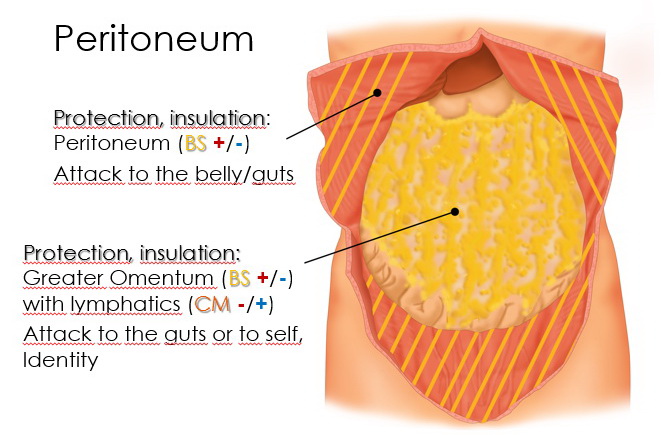
The peritoneum as visceral fascia is a protective skin for the abdomen, consisting of 2 layers:
- The parietal part is a serous membrane that forms the lining of the abdominal cavity
- The visceral part covers the inner organs liver, Stomach, spleen, parts of small and large intestine, and the ovaries in females.
Between both layers is a small amount of liquid for mobile support of the abdominal organs. The peritoneum also serves as a conduit for blood and lymph vessels and nerves. Only the parietal part is sensory innervated.
The folds at small and large intestines are called mesentery.
The Greater Omentumis a part of the peritoneum which serves as an insulating or protective layer for the intestines. It hangs down from the larger curvature of the stomach and creates an apronlike fold in front of the guts. It contains mainly adipose and lymphatic tissues.graphic: Pearson Education
Brain
Relay:
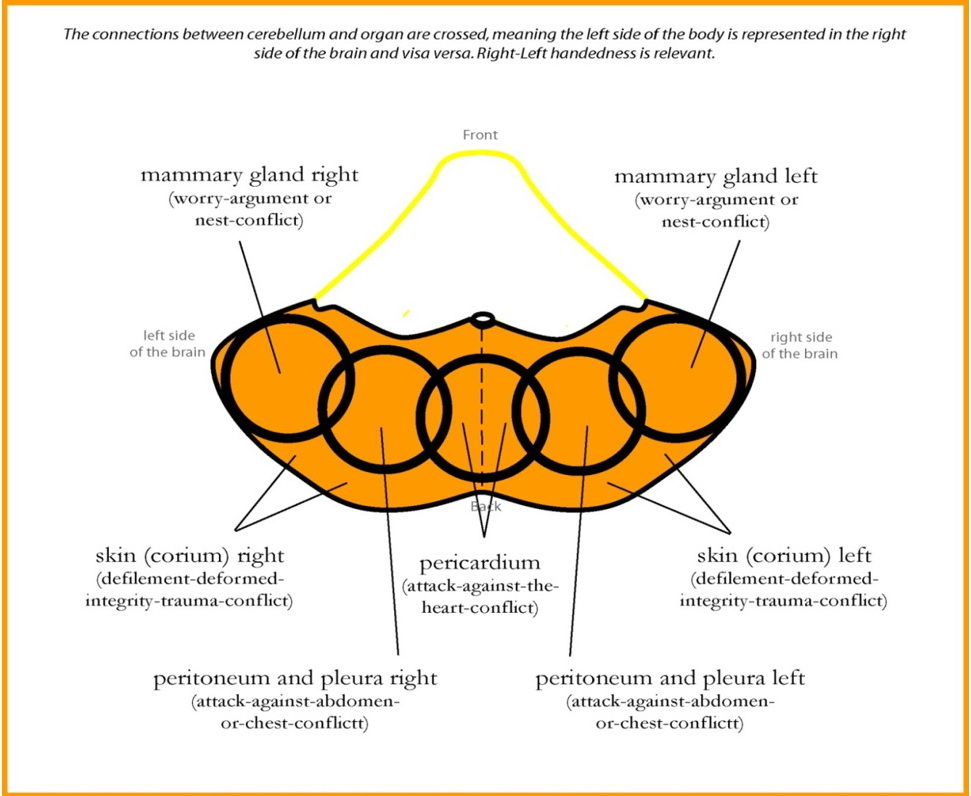
Cerebellum ( + / – )
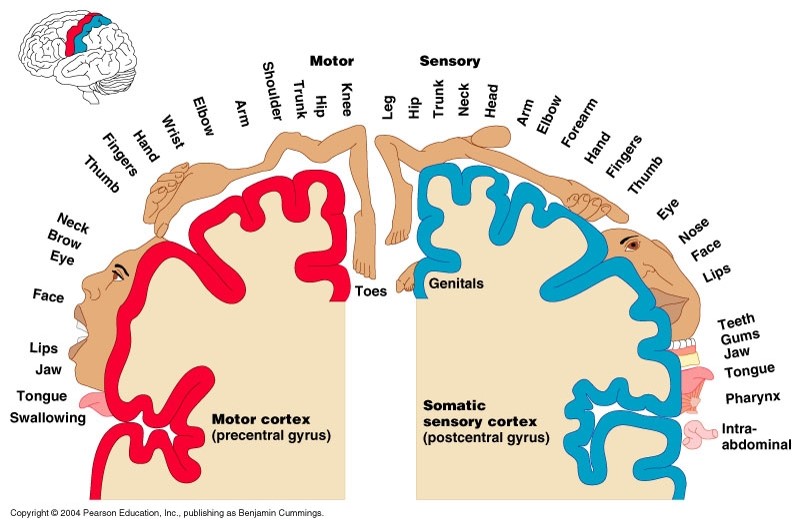
Cerebral Cortex (-/+) lateral sulcus, for sensitivity
Mind
Theme:
Attack against the abdomen (physical or associated)
Emotions, Thoughts
Vulnerability, fear, resistance
- This hit me in the guts!
- I won´t give in to that surgery.
- I can´t imagine being cut open.
- I have to protect my belly!
META-Meaning:
- Now, I can take care of my belly and let go of my fears.
- Now, I can decide what happens with my belly.
- My belly is protected
- Good things are happening to my belly.
Organ
Side dominance is irrelevant for analysis
Stress Phase Symptoms:
Functional enhancement and tissue reinforcement/hyperplasia of the serous membrane with secretive or reabsorptive properties; sometimes as nodular compact mesotheliomas which can be diagnosed as benign or malignant tumor.
Regeneration Phase Symptoms:
Painful inflammatory degradation of excessive tissue (peritonitis), usually microbial activity leading to nightly sweating. Ascites (accumulation of serous liquid) can occur to avoid an adhesion of the intestines and an intestinal occlusion (Ileus) during this process. In case of a simultaneously active water retention, the ascites may become very dramatic. After the regeneration phase, frequently calcium inclusions remain. Autolysis or remaining of the inactive tumour are also possible.
Biological Meaning:
- The hyperplasia in stress phase is meant to help in protection of the abdomen.
- The ascites of regeneration phase is meant to avoid adhesion.
Social
- After an abdominal surgery, the patient develops a peritonitis.
- Peritonitis is provoked by a recurring appendicitis (regeneration after anger conflict pattern)
- A woman feels “hit under the belt” by the news that her husband had gambled and lost a huge sum of money. She is diagnosed with peritoneal carcinoma.
Additional Information
Constellations
Cerebellum Constellation possible: reduced sensitivity (physical and emotional), “emotional burnout”
Differential Diagnosis:
Affections of any organ covered by the peritoneum, such as stomach, first 5 cm of the duodenum, jejunum, ileum, cecum, appendix,transverse colon,sigmoid colon, rectum (upper 1/3), liver, spleen,pancreas (only tail), and in women: uterus,ovaries, fallopian tubes.