Stomach Mucosa – Lesser Curvature & Pylorus
Anatomy:
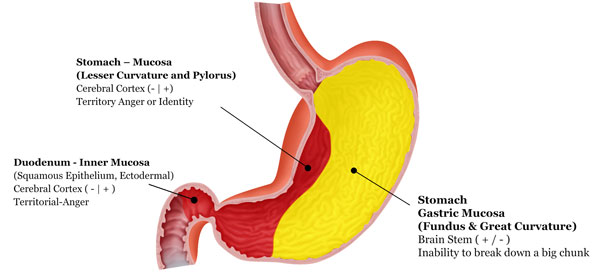
In the lesser curvature, as well as the pylorus, the gastric mucosa is covered by a thin sensitive tissue layer of squamous epithelium governed by the cerebral cortex.
The pylorus sphincter limits the stomach from the duodenum and regulates the passage of chyme into the intestine. It is normally closed, and opens upon a signal of the vagus nerve when chyme enters. This pylorus reflex is induced by visceral sensitivity: the muscle closes when the chyme in the duodenum is alcaline, and it opens when the chyme is acid or fatty.
Brain
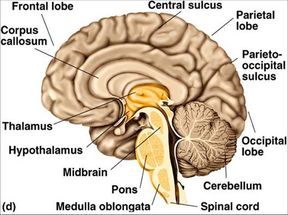
Relay:
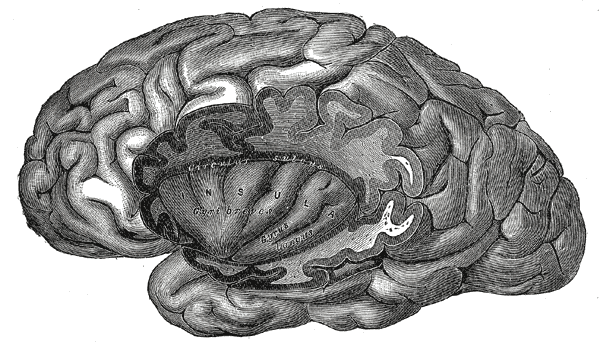
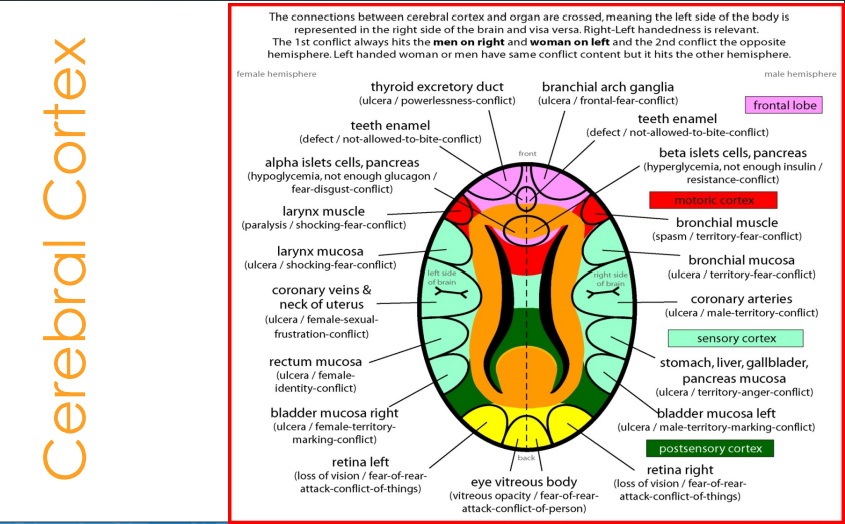
Cerebral Cortex (-/+) insular region mediolateral right “4 o’clock-relay”
Midbrain (+/0) dorso-lateral right, for Pylorus sphincter
compare Brain Stem
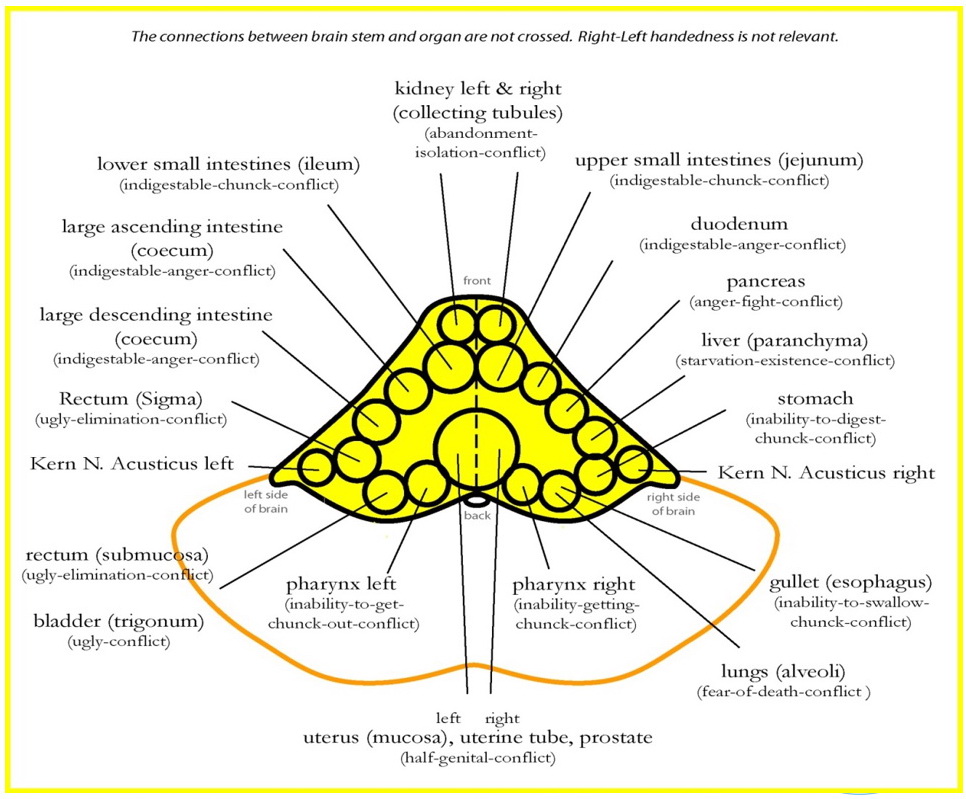
Mind:
Theme:
1. Territorial Anger (male perception)
2. Identity-conflict (female perception)
depending on sex, side dominance, hormone levels & subjective association
Emotions and Thoughts:
1. Anger and aggression related to one’s territory or property, often around a dispute with neighbors, boss, partner or mate:
- My woman has been unfaithful!
- He/she/it is mine, how could he/she/it do that!
- Leave it to me!
- What are they doing here?
- You’ve got no right to say/do that!
2. Uncertainty about one’s position in the group: - Where do I belong?
- What opinion do I subscribe to?
- What defines me? Who am I really?
- Which function and position do I have here?
META-Meaning:
- Now, I feel where I belong.
- I respect and I am respected.
- I am clear and open about my truth.
Organ:
Sensitivity change according to the “Inner Skin Pattern” with hyperesthesia in stress phase & Healing Peak.
Stress Phase Symptoms:
Hyperesthesia and irritability, superficial substance loss and ulceration of the stomach mucosa along the small curvature of the stomach ectodermal squamous epithelium tissue, (even the pylorus and the bulbus duodeni can be affected). Typical symptoms are nausea, pain, vomiting and stomach colic, particularly when gastric muscles are also involved. The lower esophagus sphincter opens in stress phase, which creates acid reflux and heartburn. Possible diagnoses are irritable stomach or stomach ulcer. The lowering of testosterone levels in stress phase can create depressive states.
Pylorus: When the sphincter doesn’t open, stasis happens and stomach acid accumulates, which promotes ulceration.
Regeneration Phase A:
Inflammatory replenishment, possibly bleeding of gastroduodenal ulcers, which can be diagnosed as gastritis. Normally the patient does not feel any pain nor colics in this phase but may have an occasional blood vomiting, hematemesis, and also occult blood in the stool.
When the repair is excessive, it can be diagnosed as a tumorous condition, stomach carcinoma.
Chronic processes that do not reach regeneration phase B can lead to ulcus-carcinoma.
In connection to stomach ulcers, the bacterium helicobacter pylori is often found.
Healing Peak:
Painful gastric colic, gastric spasms, blood vomiting, unconsciousness and dizziness can appear.
Regeneration Phase B:
Normalising and scarring in the concerned area. The sensitivity and functionality decreases after recurrances.
Biological Meaning:
The biological essence is the expansion of the mucosa-lined gastric passageway – especially the gastric outlet, pylorus – through the cell atrophy, ulceration, in stress phase, in order to easily pass the chyme to the duodenum.
Social:
Examples:
1. Territorial Anger/Competition:
- A man had an affair with a married woman and when the husband found out he yelled at him, calling him a cheater.
- The CEO of a company tries to bring innovative technology into the company but the owner aggressively belittles and discredits him resulting in strong territorial politics and feelings of anger .
- A man is constantly quarreling with his neighbours whose children are noisy and play tricks on him.
2. Identity: - A menopausal woman finds a new challenge and inspiration after her children have left home. Her depression ceases.
- A young woman from religious home falls in love, but she is uncertain whether to follow her feelings and adventurousness, or to stick to her career path. She shows mood swings, sometimes nausea and an eating disorder.
Additional Information:
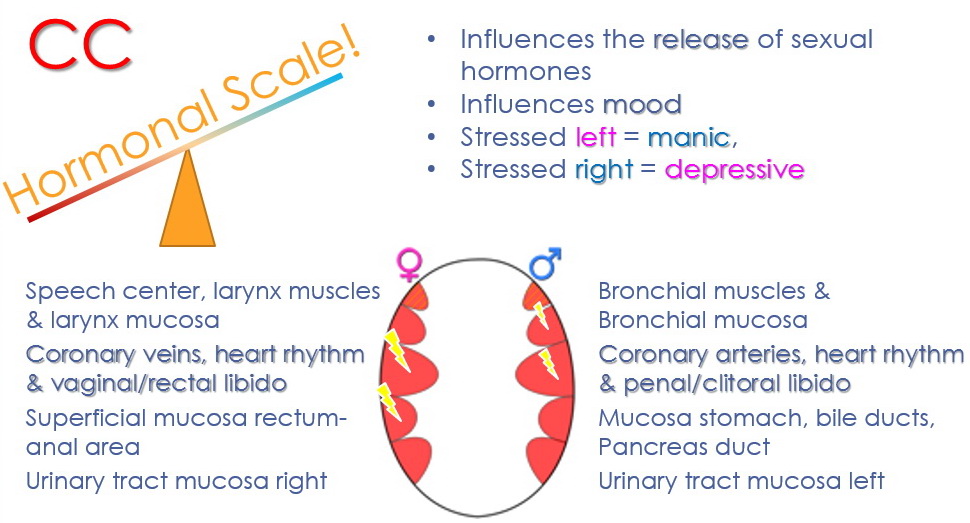
The stomach mucosa in the area of the lesser curvature belongs to the territorial area of the cerebral cortex. There, side dominance does not hint at partner or nest association, but influences the release of sexual hormones, creating manic or depressive states:
Mania is triggered by conflict weight in the left hemisphere or relief in the right hemisphere (enhanced release of testosterone, inhibited release of oestrogen)
Depression is triggered by conflict weight in the right hemisphere or relief in the left hemisphere (enhanced release of oestrogen, inhibited release of testosterone).
Possible Constellations:
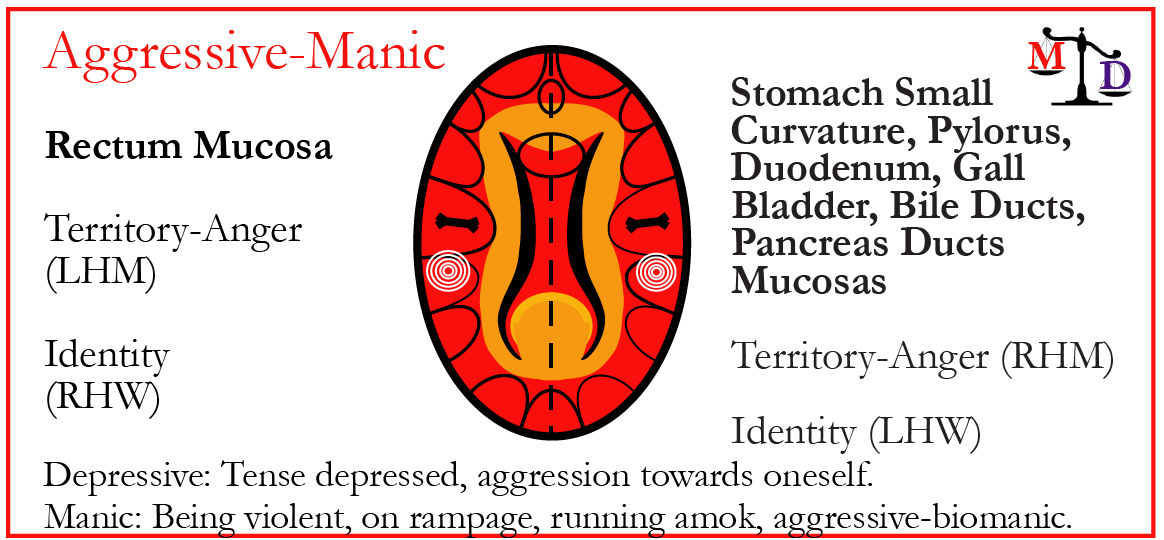
Aggressive: Together with Rectum/Anal Mucosa relay. The person is aggressive and possibly violent against himself or others. Positive: courage and will to resolve the conflict.
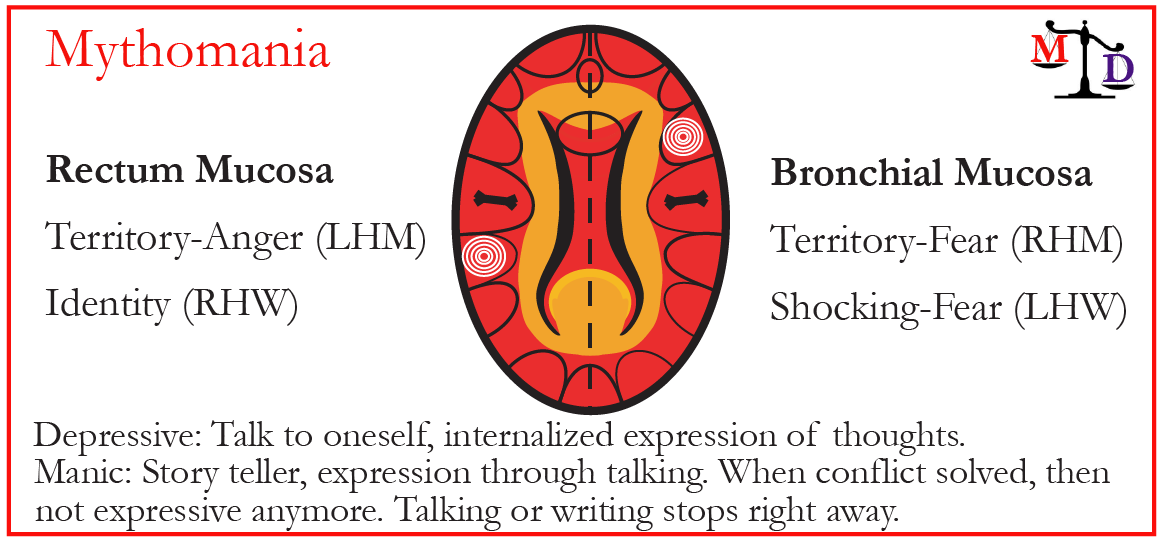
When together with Bronchial Mucosa activation, aggressive mythomania leads to “Paparazzi”- or “Führer” behaviour.
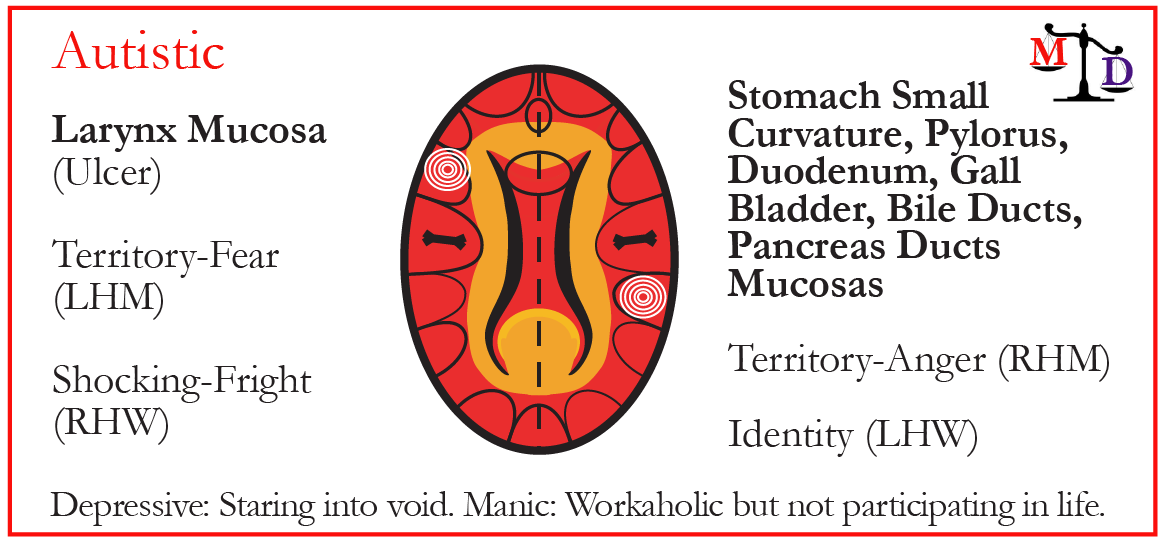
Autistic or Introvert constellation: Together with Larynx Mucosa relay. The person shows an introvert and self-centered personality, distracted and living in their own world. Positive: focus!
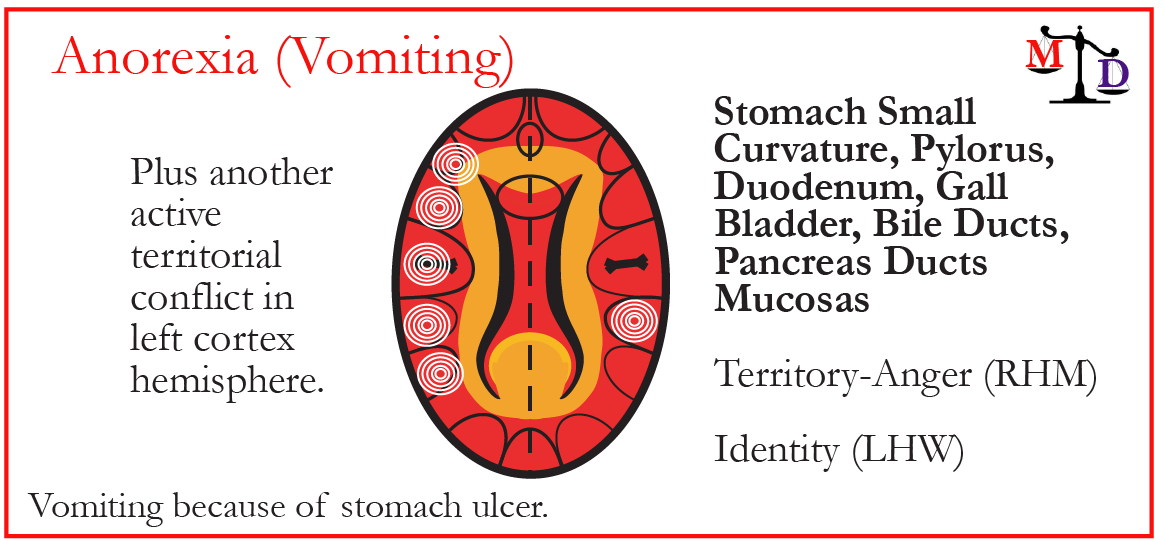
Anorexia: Together with another active periinsular relay in the left hemisphere. The person is unwilling to eat, or throws food up again.
With these 3 constellations mania and/or depression will be present depending on hormonal status and conflict impact.
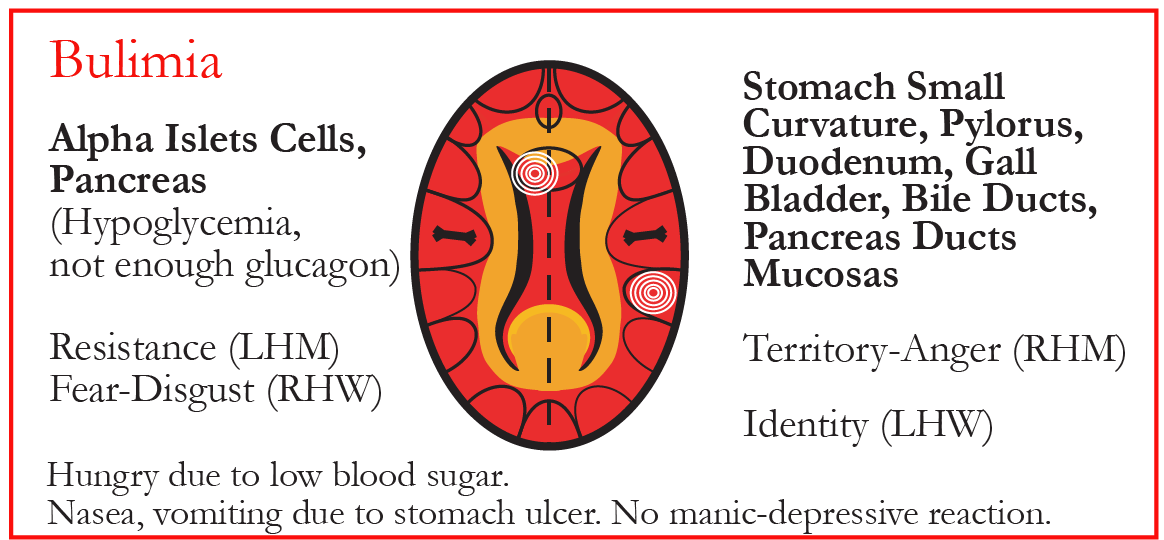
Bulimia: Together with Pancreas Alpha Islet Cells relay. The person is binge-eating (reflects hypoglykemia) and throwing up (reflects irritated stomach mucosa).
Interactions:
Smooth Organ Muscle (Midbrain, +/-) often reacts together with mucosa creating hypertension in the stress phase, spasms during the healing peak, and hyperperistalsis in the regeneration phase.
Stomach Submucosa/Connective Tissue layer with gastro-intestinal lymphatic tissue (Cerebral Medulla -/+) Stress (self-devaluation concerning function): weakening and possibly perforation of the stomach wall; Regeneration phase: lymphoma, inflammatory fibroid polyps
Cardiac or Lower Esophagus Sphincter (Brain stem +/-) often reacts together with the mucosa and opens in the stress phase, leading to release of stomach acid into the gullet which is felt as heartburn.
Pylorus Mucosa (Cerebral Cortex -/+), Stress: painful pyloric ulceration, Regeneration phase: Normalisation, possibly pylorus carcinoma. The same conflict themes & constellations can apply.
Pyloric Sphincter (Midbrain +/-) Stress: Hypertonus, pylorus stenosis, thereby the chyme stays in the stomach and acid concentrates; Regeneration phase/chronic: possibly incomplete closure and reflux.
Differential Diagnosis:
Stomach Mucosa Fundus & Greater Curvature (Brain stem, +/-): Painless polyps, adenoma, or adenocarcinoma in stress phase (chunk overload), gastritis type A or possibly gastric tuberculosis in regeneration phase.