
Mouth – Endodermal Oral & Tongue Mucosa
Anatomy
Mouth and tongue are covered in mucosa to keep them moist. This secretory function is governed by the brain stem, as well as a part of the gustatory sense that checks whether the substance is edible or poisonous for the individual.
Positive olfactory and gustatory perception stimulate the production of digestive juices before and during meals. Unpleasant taste triggers disgust and a gag reflex or vomiting.
Brain
In the Brain Stem, the primeval ring structure is reflected: organ tissue relays with assimilative and digestive functions from oesophagus to small intestines are situated in the right brain stem, while excretory organs from caecum to rectum are relayed in the left brain stem. Medial on both sides are the relays of mouth/pharynx, middle ears and lacrimal glands, as well as the pineal and pituitary glands and the thyroid.
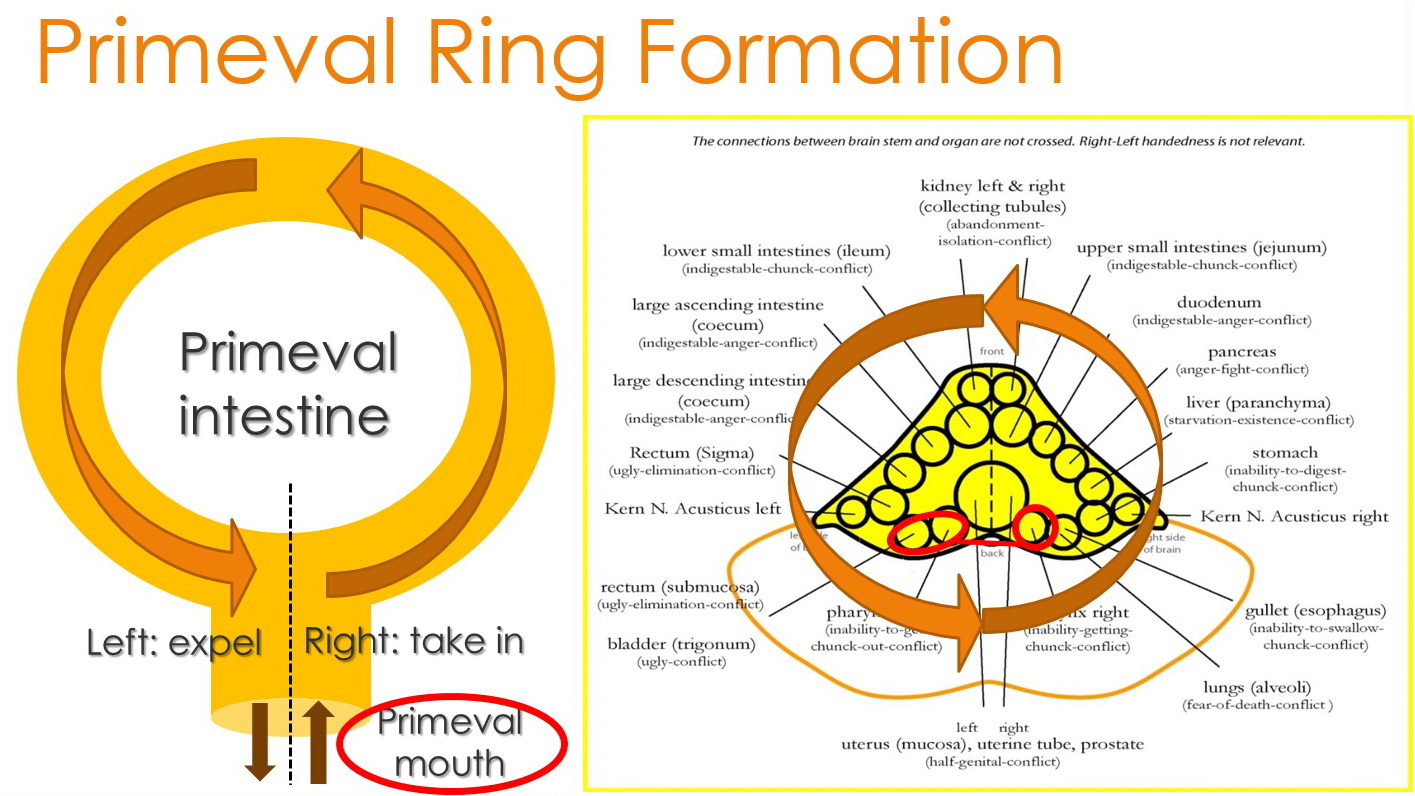
Relay:
Brain Stem ( + / – ) dorso-central, next to uterus endometrium relay
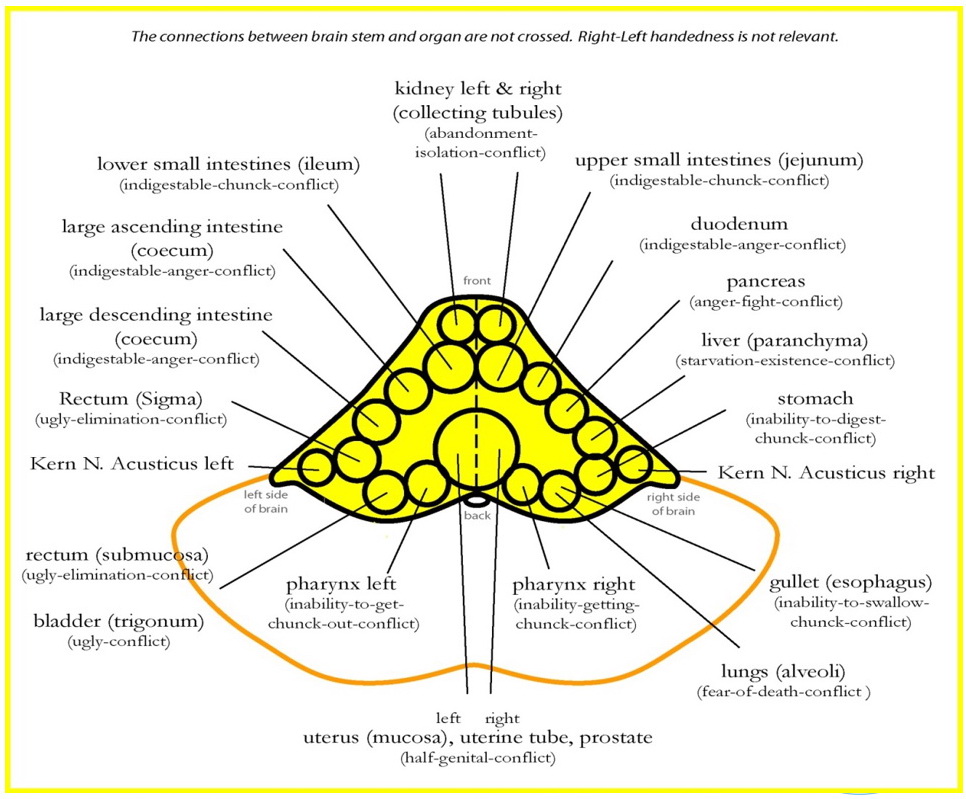
Mind
Theme:
1. Chemical analysis of usability
2. Secretion:
- Right side: Swallowing-Assimilation
- Left side: Getting rid of content
Emotions and Thoughts:
Hunger, greed, disgust
- I must have that!
- It was stuck in my mouth.
- That makes me hungry!
- This is poison!
- I need to spit it out immediately!
META-Meaning:
- I trust my senses of smell and taste.
- I get all that I need, and the rest leaves me calm.
Organ
Issues on the right body side generally refer to “taking in a morsel”, on the left side to “spitting out a morsel” – very basic traumas and stress triggers with a survival meaning. Handedness is not relevant.
Endodermal tissue itself has no sensitive innervation and processes do not create pain unless they affect mouth or tongue mucosa tissue.
Stress Phase Symptoms:
Heightened acuity of gustatory sense, increased function of salivation, cell proliferation which can be seen as growth of a flat-growing hyperplasia of reabsorptive quality below the squamous epithelium mucosa of the mouth.
This can lead to penetration of the sensitive mucosa and will then be felt as canker sores and cracked skin inside the mouth, which are painful only at the borders of the affection.
Regeneration Phase Symptoms:
Degradation of the cell growth under presence of fungi and mycobacteria. The possible symptoms include bad breath because of the caseating degradation of the tumor.
Possible diagnoses are oral candidiasis, (oral) thrush, oropharyngeal candidiasis, moniliasis candidal stomatitis, in pediatrics: muguet.
Often during the regeneration the sensitive Mouth – Mucosa is also affected which would lead to similar symptoms (canker sores) like mentioned in the stress phase.
Biological Meaning:
1. Being able to analyse the substance adequately
2. Being able to properly salivate a morsel to easily take it in or spit it out.
Social
Examples:
- Severely ill, bedridden patient who is no longer able to take food
- Patients with gastric probe who are not able/don’t want to eat on their own.
- Not having been able to rid oneself of someone or something right away when perceived as negative or threatening.
- Having to eat up something unwanted, happens often for children
- Not getting the desired food, happens often for children
Additional Information:
Constellations:
Brain Stem Constellation possible: perplexity, lethargy, passiveness, reduced movement. Purpose: new orientation
Differential Diagnosis:
Mouth – sensitive Mucosa (Cerebral Cortex -/+) stress phase (mouth contact): painful and sensitive aphthea and canker sores.
Salivary Gland Ducts (Cerebral Cortex -/+) Stress (assimilation/spitting prevented): enhanced release of saliva, later ulceration; Regeneration phase: swelling, obstruction, possibly tumor formation
Salivary gland (Brain stem +/-) Stress (assimilation): functional increase and tumor growth; Regeneration phase: abscess, mouth odor, microbial decomposition; Chronic: desiccation, Sjögren-Syndrome.
Lymphoid tissue in tonsils, sublingual tonsils (Cerebral Medulla -/+) Stress (self-definition, choice): weakened detox & immune responses; Regeneration phase: swelling, enhanced immune response; chronic: autoimmune reactions possible
