
Liver – Parenchyma
Anatomy
The liver is the largest and heaviest gland in the human body. It has a roughly triangular shape and is situated in the right upper quadrant of the abdomen, right below the diaphragm. It fulfills functions of digestion, energy management and excretion.
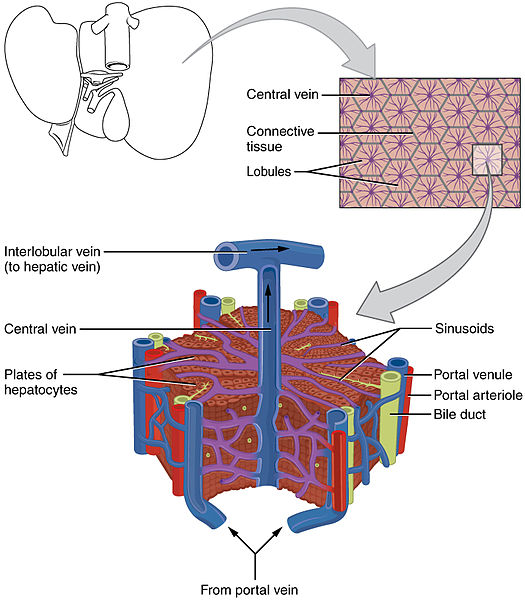
The liver is connected to two large blood vessels: the hepatic artery and the portal vein. The hepatic artery carries oxygen-rich blood from the aorta, whereas the portal vein carries blood rich in digested nutrients from the entire gastrointestinal tract and also from the spleen and pancreas. These blood vessels subdivide into small capillaries known as liver sinusoids, which then lead to a lobule.
Lobules are the functional units of the liver. Each lobule is made up of hepatocytes which are the basic metabolic cells. The lobules are held together by a fine dense connective tissue layer. The whole surface of the liver is covered in a serous coat derived from peritoneum and this has an inner fibrous coat (Glisson’s capsule) to which it is firmly adhered. The fibrous coat is of areolar tissue and follows the vessels and ducts to support them.
The liver plays a major role in metabolism. It’s main functions are:
1. Production of bile for digestion of fat:
Bile is an alkaline compound which consists of water with bile salts and enzymes, produced by the hepatocytes. Lipids are broken down into small drops, and fat-soluble substances can be excreted. The bile is transported via a system of ducts to the gallbladderfor storage.
2. Production of blood proteins:
albumins, globulins and coagulation factors
3. Energy storage:
Glucose from the intestinal blood is stored as glycogen with the help of insulin, and is transformed back with the help of glucagon for to be transported with the blood to the effector organ. Fat is stored as lipoproteins.
4. Transformation of toxic substances:
Especially hemoglobin/bilirubin from old erythrocytes, steroids, alcohol & drugs are decomposed by liver enzymes and macrophages.
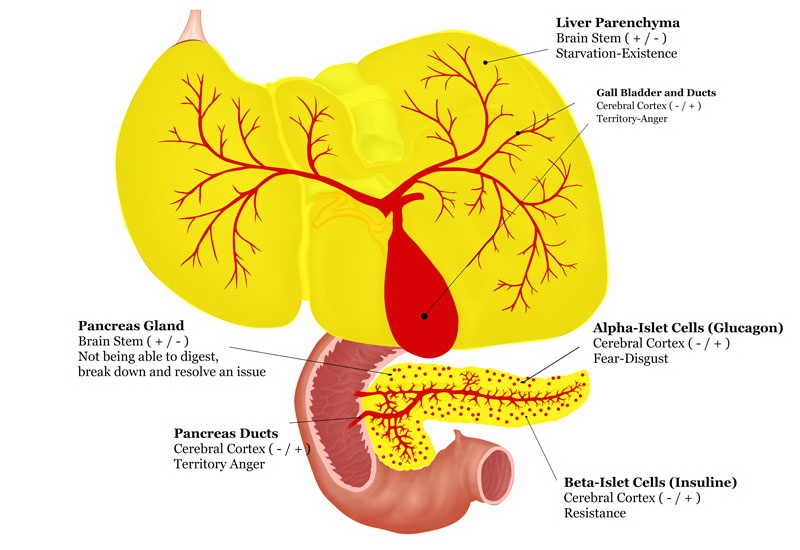
Brain
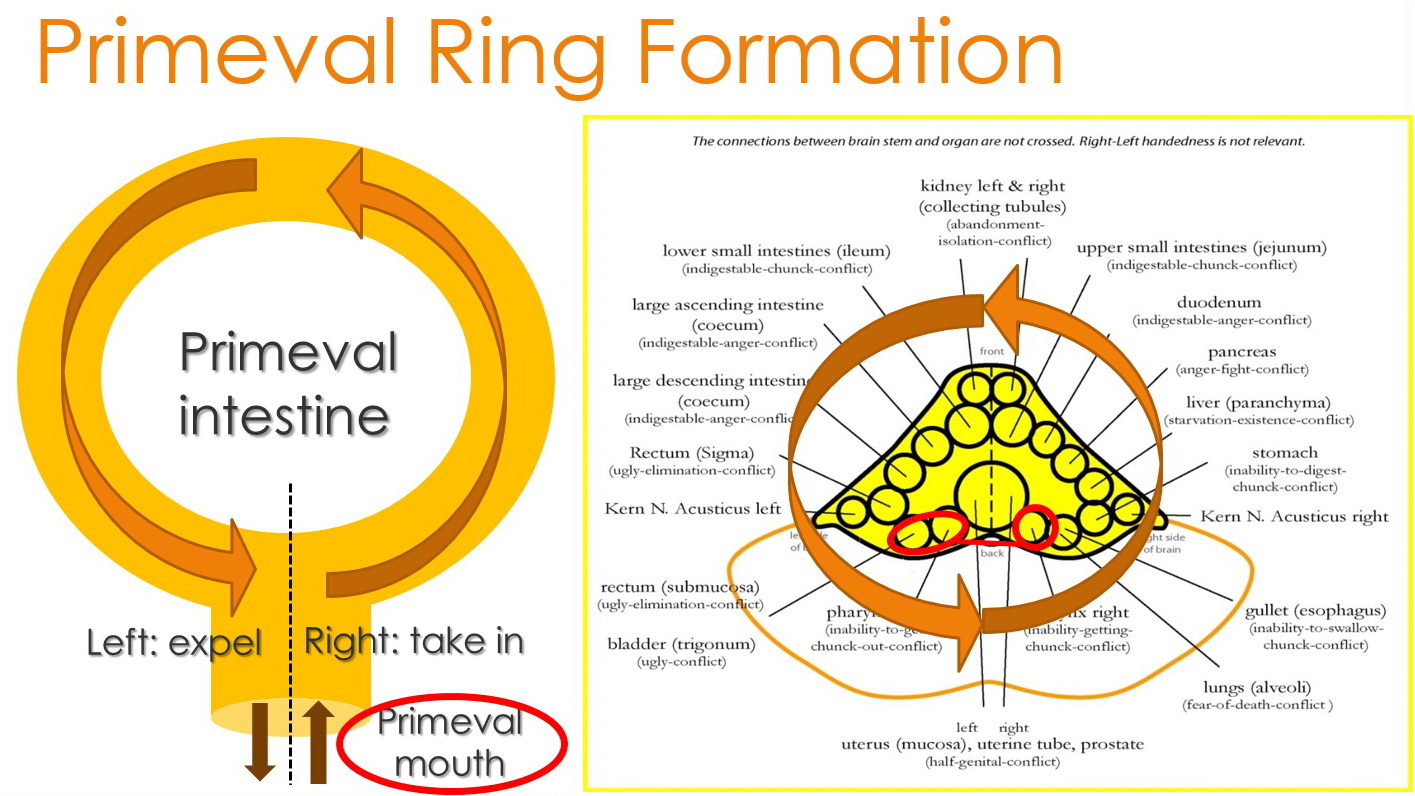
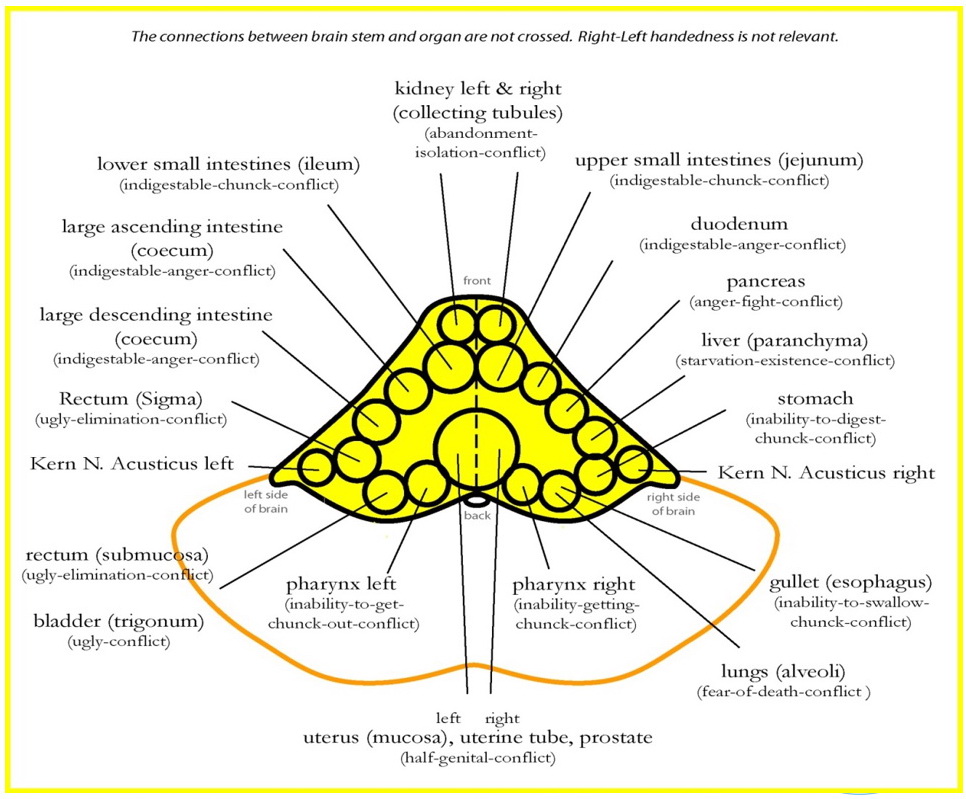
In the Brain Stem, the primeval ring structure is reflected: organ tissue relays with assimilative and digestive functions from oesophagus to small intestines are situated in the right brain stem, while excretory organs from caecum to rectum are relayed in the left brain stem. Medial on both sides are the relays of mouth/pharynx, middle ears and lacrimal glands, as well as the pineal and pituitary glands and the thyroid.
Relay:
Brain Stem (+/-) medio-lateral right
Mind
Theme:
Starvation or threatened existence
Side dominance is not relevant.
Emotions and Thoughts:
Acute fear of starving to death for oneself or a loved one. Often associated with financial worries.
- I am now destitute.
- The money has dried up.
- There will be nothing to eat.
- How can I survive now.
- I am deprived of everything.
META-Meaning:
- I am receiving all the nutrients and the life energy I need.
- The universe is providing me.
- I’m a good improviser in any situation!
Organ
Stress Phase Symptoms:
Increased liver function of the required quality, like production of enzymes, bile, proteins or enhanced energy storage with elevated levels of liver enzymes, especially alkaline phosphatase (AP) and alpha fetoprotein (AFP). Elevated cell proliferation of the liver tissue which may have secretory or reabsorptive qualities. Typical are round foci either as singular solitary foci, associated with starvation conflict about another person or a pet, or several multiple round focuses, in this case associated with starvation conflict for oneself. Tumors appear as dark formations on an abdominal CT.
The most common symptoms are sudden weight loss, upper abdominal pain, pressing pain above the liver and changes in liver function. These tumors are easily palpable, as they are mostly spherical nodules next to the liver capsule. Possible diagnoses are liver tumor, liver carcinoma, liver cell carcinoma, focal nodular hyperplasia or hepatocellular carcinoma.
Regeneration Phase Symptoms:
Regeneration can take different paths:
- Inflammation and decomposition of tumor:
Phase A: Fungi or mycobacteria are present. The liver swells up and night sweats occur. Often diagnosed as hepatitis, tuberculosis or liver abscess. Even here, elevated levels of enzymes (transaminase) are detected in the blood.
Phase B: After the healing peak the swelling recedes. After the degradation of cell growths, liver caverns appear. In the case of a water retention syndrome, the caverns can be filled with water in the regeneration phase which might be diagnosed as a pseudocysts (defined by a lack of epithelial/endothelial lining). Pseudocysts can quickly change their size based on the edema collected inside. - Decomposition, autolysis without bacteria:
Phase A: In contrast to inflammatory degradation of the tumor, the self-dissolution occurs without bacteria and without inflammation.
Phase B: Liver caverns can also be possible during this type of regeneration process. - Encapsulation of the tumor:
Especially Phase B: The tumor encapsulates and possibly become calcified or even transformed to connective tissue, fibroid, which is often diagnosed as a benign liver tumor with little or no cell division.
Even after the regeneration process has completed, we may find liver cirrhosis or caverns in the liver parenchyma.
Healing Peak:
hypoglykemia, drop in gamma GT and unconsciousness/absence during several hours possible.
Biological Meaning:
By improved secretory or reabsorptive function, the organism can easily digest fats, to gain and store more energy.
Social
Examples:
Starvation is experienced due to disasters, famines or severe economic crises. Even thoughts and worries can trigger the program
- A mother develops or feels like she is starving because her son has lost his job.
- A woman with an intestinal tumor gets a shock and is afraid of starvation because she thinks that it could result in an intestinal obstruction.
- Someone has lost their job. They constantly worry about financial needs, about their existence and how to survive in this competitive world.
- A man identifies as provider of hs family since he was a youth. All his life, he brought food to the table and money for the necessities. When he is sent into early retirement, he develops liver cancer. (Barthel)
- An older woman feels existentially threatened due to the terminal disease of her daughter.
Additional Information
Liver Cirrhosis is characterized by replacement of liver tissue by fibrosis (scar tissue) and regenerative nodules (lumps that occur due to attempted repair of damaged tissue). These changes lead to loss of liver function. Traditional Medicine considers these risk factors for cirrhosis: Alcoholism, hepatitis B and C, fatty liver and many others. This seems to match with chronic processes.
A hepatic coma (hepatic encephalopathy) appears due to insufficient detoxification in the liver, possibly due to liver cirrhosis or to the obstruction of bile ducts.
“Autoimmune hepatitis” with degradation of hepatocytes by T-Lymphocytes is a mechanism of sensitization due to identification as “provider”. There are various secondary symptomatics/themes, and appears 4 times as often in women than in men.
Combined Organ Reactions:
If someone experiences a traumatic life event related to starvation or existential fear, often the liver parenchyma, intestines and pancreas are affected at the same time. In this situation we need to evaluate if one stress trigger or trauma is connected to all organ reactions or if different subtle stress triggers, either aspects of the same or a different memory, need to be released.
Fatty liver develops in chronic stress phases of hepatocytes and pancreas alpha cells with enhanced storage and decreased fat reduction in the liver.
Constellations:
Brain Stem Constellation possible: perplexity, lethargy, passiveness, reduced movement. Purpose: new orientation
Differential Diagnosis:
Intrahepatic Bile Ducts, Cerebral Cortex (-/+): stress phase (position/identity): enhanced release of bile, painful ulceration; regeneration phase: obstruction of ducts lead to light swimming stool; hepatitis, cholangitis; chronic: liver cirrhosis can occur
Pancreas Alpha Cells, Cerebral Cortex (-/+): stress phase (aggression prevention): hypoglykemia, hunger, glucagon insufficiency, fat storage in the liver
Pancreas Beta Cells, Cerebral Cortex (-/+): stress phase (aggression prevention): insulin insufficiency, hyperglykemia, fat reduction in the liver
Elevated levels of transaminase can also appear under hard physical training, thyroid over- or underfunction, right heart insufficiency, pericardium effusion, and medication.
und Herzbeutelerguss auf, sowie durch Medikamenteneinwirkung.
