Intestine Smooth Muscle
Anatomy
There are smooth muscle cells both in the mucosa (Lamina muscularis mucosae) and in the gut wall:
- The muscularis mucosae is composed of several thin layers of smooth muscle fibers oriented in different ways which keeps the mucosal surface and underlying glands in a constant state of gentle agitation to expel contents of glandular crypts and enhance contact between epithelium and the contents of the Lumen.
- The muscular layer aids in the action of continued peristalsis along the gut, while the submucosa contains nerves, blood vessels, and elastic fiber with collagen that stretches with increased capacity, but maintains the shape of the intestine.
The gastrointestinal tract generates motility using smooth muscle subunits linked by gap junctions. These subunits fire spontaneously in either a tonic or a phasic fashion. Tonic contractions are those contractions that are maintained from several minutes up to hours at a time. These occur in the sphincters of the tract, as well as in the anterior stomach. The other type of contractions, called phasic contractions, consist of brief periods of both relaxation and contraction, occurring in the posterior stomach and the small intestine, and are carried out by the muscularis externa.
The patterns of GI contraction as a whole can be divided into two distinct patterns, peristalsis and segmentation. - Peristalsis is one of the patterns that occur during and shortly after a meal. The contractions occur in wave patterns traveling down short lengths of the GI tract from one section to the next. The contractions occur directly behind the bolus of food that is in the system, forcing it toward the anus into the next relaxed section of smooth muscle. This relaxed section then contracts, generating smooth forward movement of the bolus at between 2–25 cm per second.
- Segmentation also occurs during and shortly after a meal within short lengths in segmented or random patterns along the intestine. This process is carried out by longitudinal muscles relaxing while circular muscles contract at alternating sections thereby mixing the food. This mixing allows food and digestive enzymes to maintain a uniform composition, as well as to ensure contact with the epithelium for proper absorption.
graphic source: wikipedia
Actin and myosin filaments contract in smooth muscle
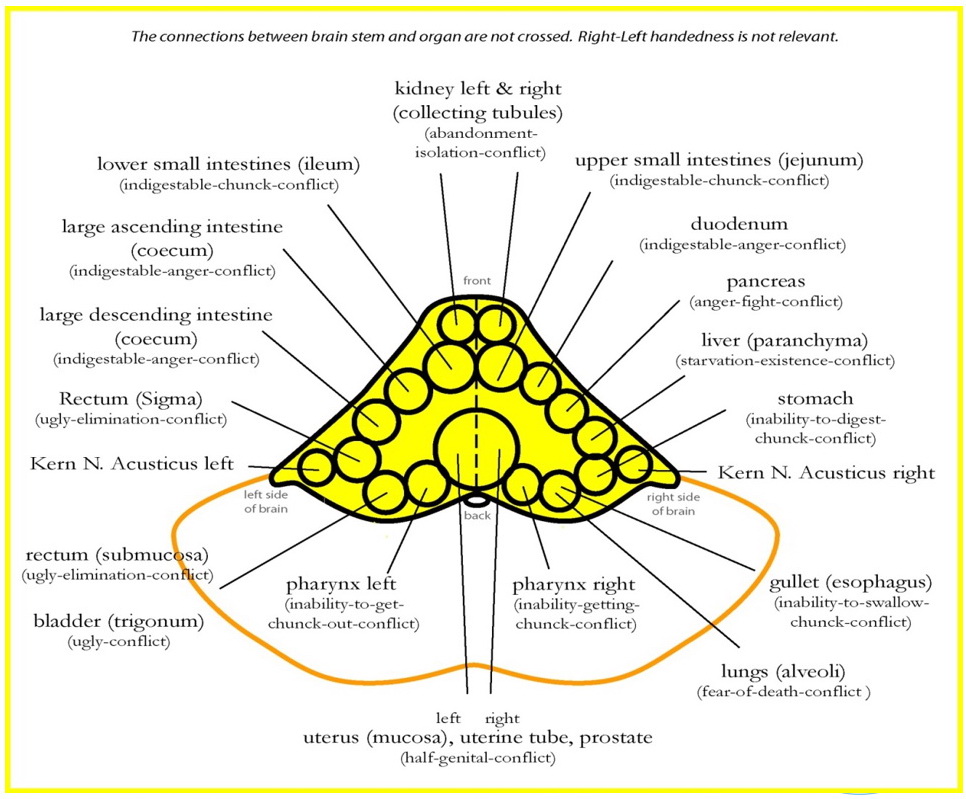
Brain
Relay:
Midbrain (+/-)graphic: Kevin Dufendach, compare Brain Stem
Mind
Theme:
Propulsing or retaining and processing a chunk or information.
Emotions and Thoughts:
Suppressed Anger, Resentment (directed towards self)
- I´m getting nowhere with this.
- It felt like lead in my stomach.
- I´m stuck.
- I can´t work it out.
- My life situation does not improve.
META-Meaning:
- All that I´m taking in, I can digest and forward automatically and fluently.
- I move through any situation with ease and transparency.
Organ
Handedness is not relevant for analysis here.
Stress Phase Symptoms:
Locally increased peristalsis around the location of the stuck morsel, while the rest of the intestine reacts with a reduced peristalsis. This may be diagnosed as diminished or absent peristalsis, as paralytic ileus or as enteroparesis (bowel occlusion). Local cell proliferation (myoma) in the smooth muscles of the intestine can develop and may or may not be accompanied pain.
Alternating constipation and diarrhea is also common, due to the slower peristalsis involving the major part of the intestinal tract. Diarrhea is a normal vagotonic response in regeneration phase of the gut, but it even appears in general stress situations (nervous diarrhea).
Regeneration Phase Symptoms:
Increased peristalsis in intestinal muscles that can lead to intestinal colic. Among the possible symptoms are: diarrhea, colic, digestive problems and nausea. These symptoms are often diagnosed as infectious gastroenteritis, so-called gastric flu.
Healing Peak:
First repetition of the local hypertension and overall immobilization of the peristalsis, followed by clonic increased peristalsis of the gut.
Biological Meaning:
The local hypertension and -peristalsis in stress phase helps managing the chunk in the place where it is, by mixing it thoroughly with secrete or absorbing nutrients, water and information, before it is pushed on.
The increase in peristalsis without segmentation in “nervous diarrhea” means to get rid of ballast quickly.
Social
Examples:
- A candidate can´t finish her dissertation but needs the title to apply for a desired job.
- An unemployed father of a disabled child is hopeless to find work.
- A person is highly concerned about the inappropriate behaviour of their partner. This problem interferes with their relationship. This cannot go on. The relationship is stuck.
- A man gave in and was ordered around to do things he doesn’t approve of. He felt a grudge (also about his own reaction) and his body reacted with a “fast passage” of the food. As he plans to clarify the situation the next day, his gut calms down.
Additional Information
The same functional theme of holding back or forwarding the content of the organ is given for all smooth organ muscles like those of the esophagus, intestine, bladder, uterus, blood vessels, and heart atrium). The motoric organ functions and muscles often react together with the secretory functions.
Differential Diagnosis:
Intestinal Mucosa (Brain Stem +/-), with polyps or adenocarcinoma in the stress phase (indigestion), inflammatory decomposition in the regeneration phase.
Submucosa/Connective Tissue Layer, Lymphatic tissue (Cerebral Medulla -/+) Symptoms in regeneration phase (self-devaluation, choice): Inflammatory and edematous in the first phase. Diagnoses may be lymphoma, inflammatory fibroid polyps, perineurioma and leiomyoma.
Striated sphincter muscles (C. Cortex, C. Medulla -/+) stress phase (identity, position): paresis, paralysis, weakening; Healing Peak: spasms
Neural lesions (Cerebral Cortex -/+)