
Digestive – Esophagus Mucosa (Lower 1/3) & LES
Anatomy
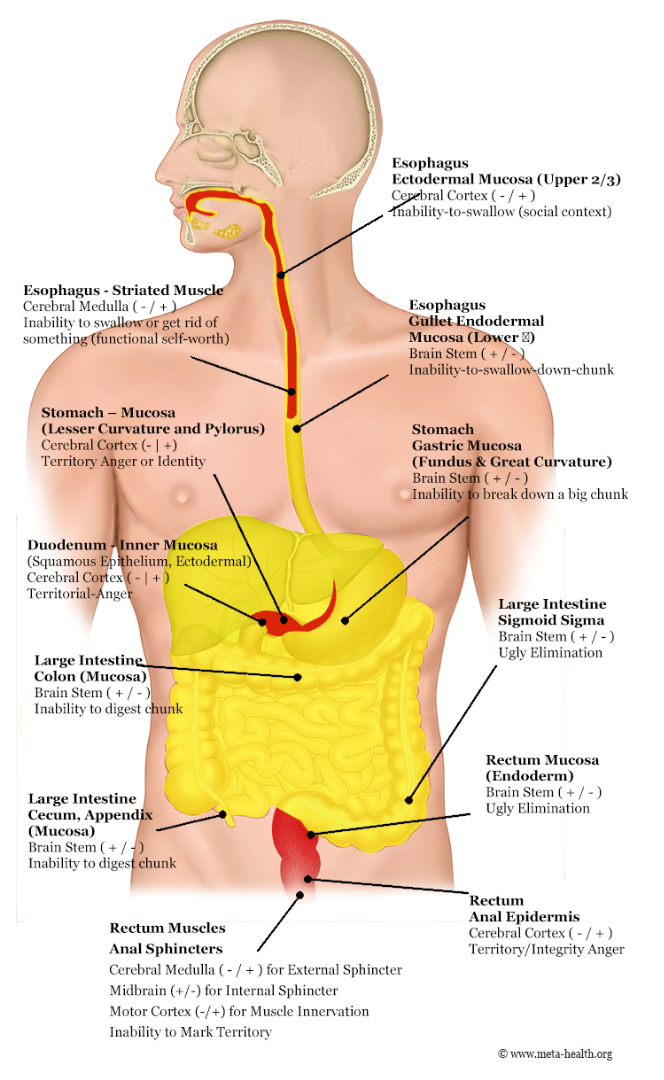
The lower third of the esophagus is lined with epithelium stemming from the embryonic foregut, with secretory function to produce fluid for easy transport of the bolus, and reabsorptive function to nourish the organ wall. This mucosa can even be present in upper parts of the gullet but is covered by ectodermal squamous epitheliumthere.
The connection from the lower esophagus to the stomach is the LES or cardiac sphincter, which is no muscle but an anatomical sphincter which prevents stomach juice and contents to travel back up into the esophagus.
Brain
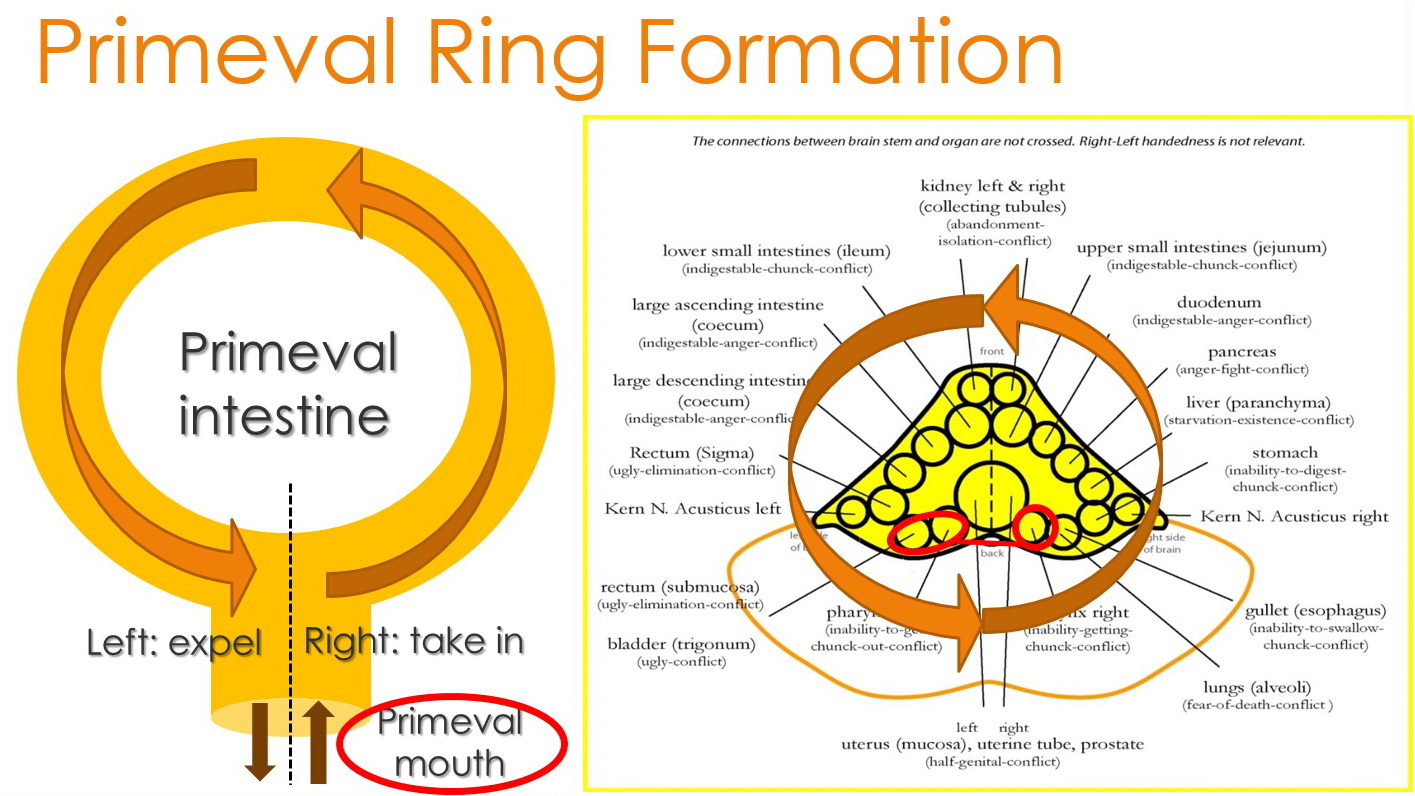
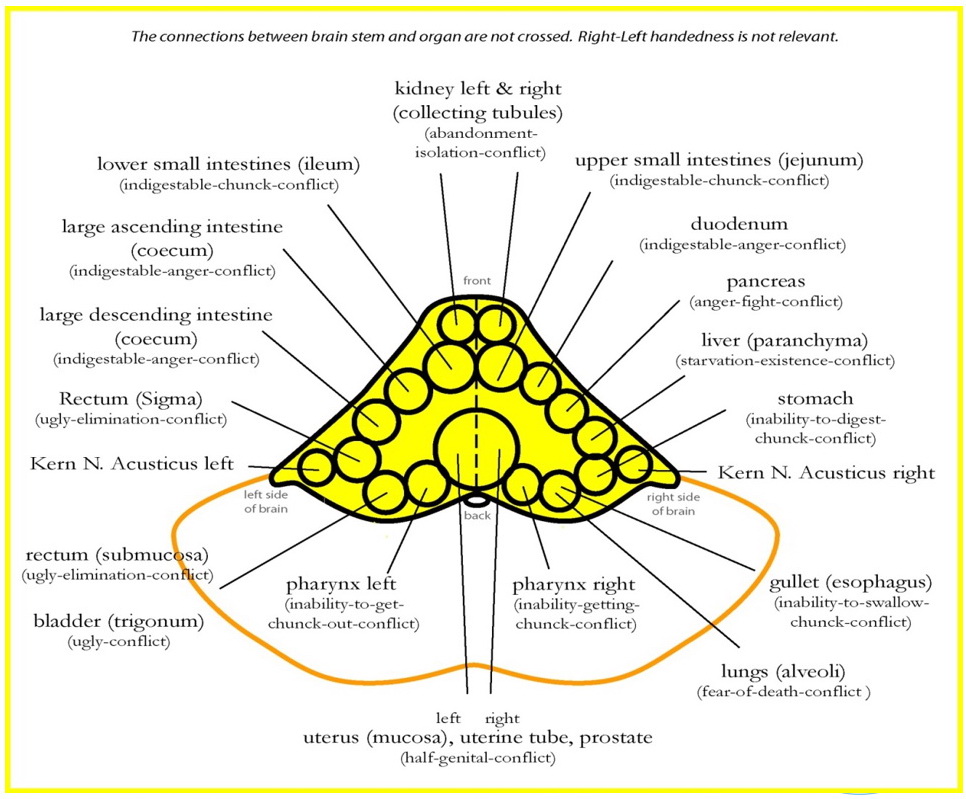
In the Brain Stem, the primeval ring structure is reflected: organ tissue relays with assimilative and digestive functions from oesophagus to small intestines are situated in the right brain stem, while excretory organs from caecum to rectum are relayed in the left brain stem. Medial on both sides are the relays of mouth/pharynx, middle ears and lacrimal glands, as well as the pineal and pituitary glands and the thyroid.
Relay:
Brain Stem ( + / – )
Dorsal right between pharynx & stomach relays
Mind
Theme:
Assimilation: ingestion or expulsion
Side dominance/handedness is not relevant in this relay.
Emotions and Thoughts:
Greed, resistance
- I must get this down!
- I need to incorporate this.
- I can’t swallow that!
- This is too big for me.
META-Meaning:
- I am open to everything I experience in my life and trust that I can handle it.
- I can process my experiences and pass them on.
- Every day brings new opportunities and benefits
Organ
Stress Phase Symptoms:
In the stress phase the secretory function of the mucosa, as well as the smooth muscle peristalsis increase. Later, a compact secretory adenocarcinoma or a flat-growing adenocarcinoma with reabsorptive properties can grow in the lower third of the esophagus. In the upper two thirds of the esophagus there are also residual isles of the old intestinal mucosa (secrete-producing goblet cells) that can form a submucous adenocarcinoma. These tumors do not create pain but can lead to dysphagia.
The LES or cardiac sphincter opens in the stress phase of poisoning via food (throwing up), allowing the stomach content to be expelled. It can even open up during the stress phase of stomach endo- or ectodermal mucosa, creating acid reflux/”heartburn”. (Pain in stress phase, because the ectodermal mucosae of esophagus and stomach belong to the “Inner Skin Pattern”)
Remaining acid leads to painless Non-Erosive Reflux Disease (NERD) in the endodermal mucosa, while the sensitive ectodermal mucosa shows painful Gastro-Esophageal Reflux Disease (GERD) and ulceration. In Barrett-Syndrome, stratified squamous epithelium is replaced by simple columnar epithelium.
Regeneration Phase Symptoms:
Most esophagus tumors (in the lower third) heal spontaneously. Otherwise there can be esophagitis with microbial activty and nightly sweating. The healed residuals are frequently diagnosed as varices of the esophagus. Chronic processes can lead to formation of diverticles (bulging of the mucosa connected to weakened muscle layer).
Healing Peak:
Chills, swallowing, belching, vomiting
Biological Meaning:
The increased secretion , peristalsis & reabsorption help to swallow, use & forward the bolus..
Social
Mostly about material things: money, real estate, stocks, etc. In a figurative sense this can also refer to a morsel that cannot be swallowed, in contrast to the conflict by the squamous epithelium of the gullet – when the person should swallow something that he would prefer to spit out.
Examples:
- A mother of 3 kids who live in the countryside takes on great responsibility to support and manage the whole family, while her husband works till late. She has a “problem kid” that makes her swallow a lot regarding temper, frustration and anger fits. She develops a pressure feeling on the esophagus and dysphagia.
- The client is threatened to lose his job because the company is sold. He fears for his existence, but is irritated by being bossed around by younger bosses whom he can’t accept. He suffers from nausea, belching and reflux.
- An elderly female has experienced many traumatic events throughout her life which she was used to close in and deal with all by herself. During exploring and processing, often belching and yawning is triggered. (Klapp)
Additional Information
Constellations:
Brain Stem Constellation possible: perplexity, lethargy, passiveness, reduced movement. Purpose: new orientation
Differential Diagnosis:
Esophagus Mucosa Upper 2/3(Cerebral Cortex -/+)stress (swallowing/spitting prevented): Hyperesthesia, gag reflex, ulceration; Regeneration phase: viral esophagitis, repair, Barrett-Syndrome
Esophagus Sphincter and Striated Muscle (Cerebral Medulla -/+)stress phase (swallowing/spitting prevented): functional loss, swallowing paralysis; regeneration phase: myositis, bacterial infection, later strengthening.
Esophagus Smooth Muscle Layer (Midbrain +/-): smooth muscle often reacts together with mucosa, theme being to forward the bolus by peristalsis. Stress phase: hypercontractility or increased tonus, contributes to development of diverticles. Long stress periods can result in achalasia.
Esophagus Submucosa – connective tissue layer (Cerebral Medulla -/+) Stress (self-devaluation regarding function): functional loss and necrosis contributes to development of diverticles. Regeneration phase: inflammation, bacterial infection; chronic: can lead to varices of the esophagus.
