
Esophagus – Muscle layer
Anatomy
The gullet´s external muscle layer has a unique composition, varying over the length of the esophagus. The upper third consists of striated muscle, the middle third has both smooth muscle and striated muscle, and the lower third predominantly smooth muscles. The muscle runs in 2 layers: the inner longitudinal and the outer circular fibres. Together they create peristalsis, the wavelike transportation of the bolus.
The upper sphincter is also striated muscle which relaxes during swallowing. The lower esophagus sphincter/LES is no in-built muscle but a passive closure preventing reflux of stomach juice into the gullet.
The muscle is innervated by the vagus nerve (cranial nerve X)
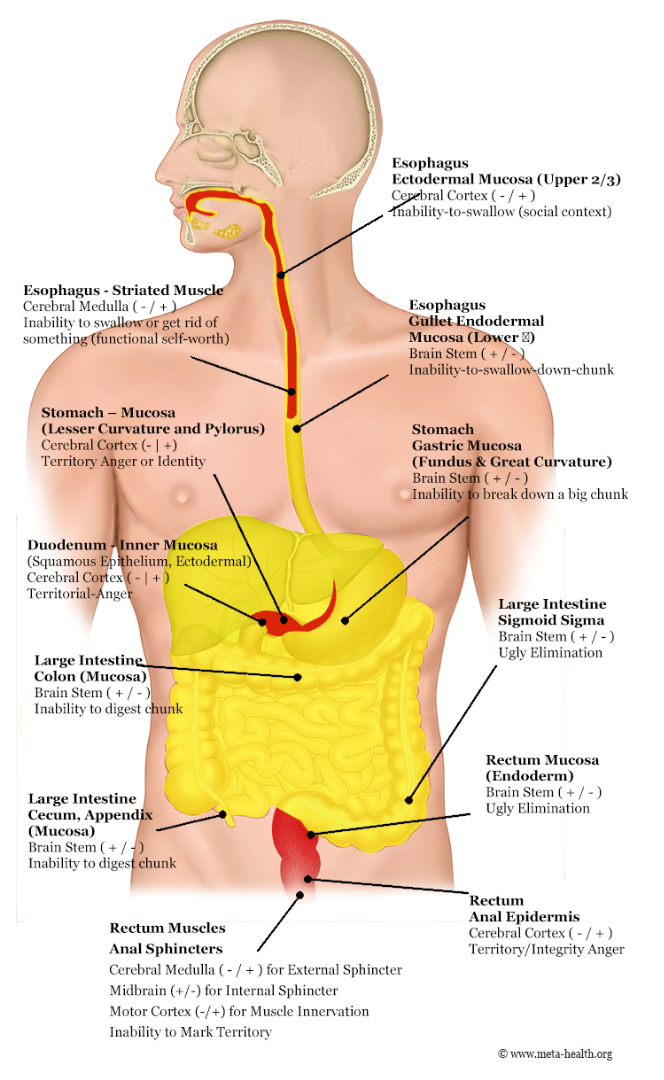
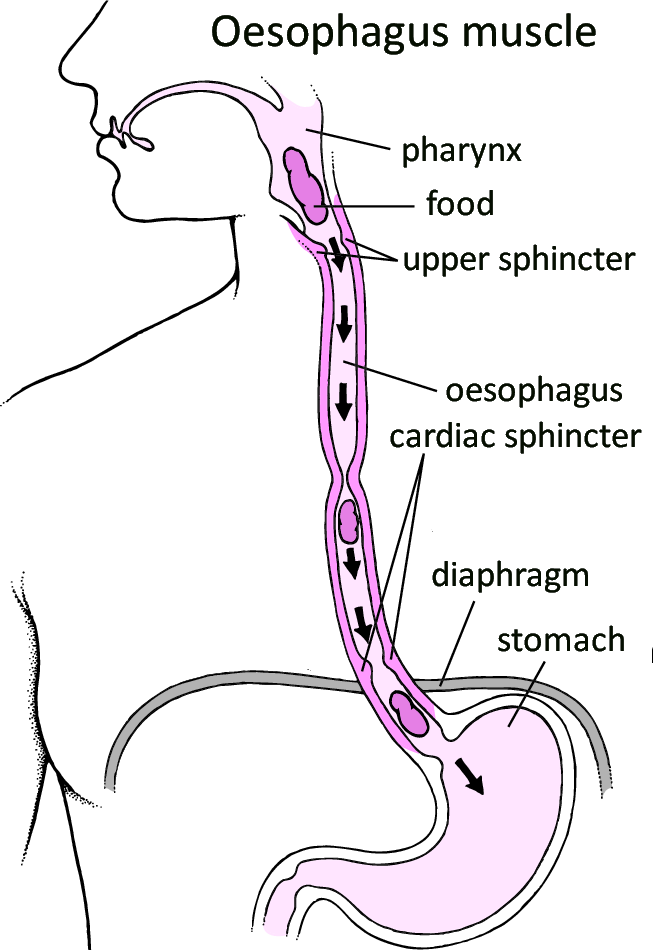
Brain
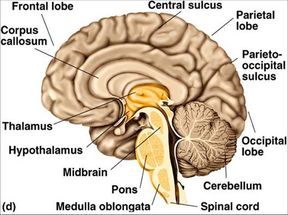
Relay
1. Cerebral Medulla (-/+) “thoracic area”, for striated muscle
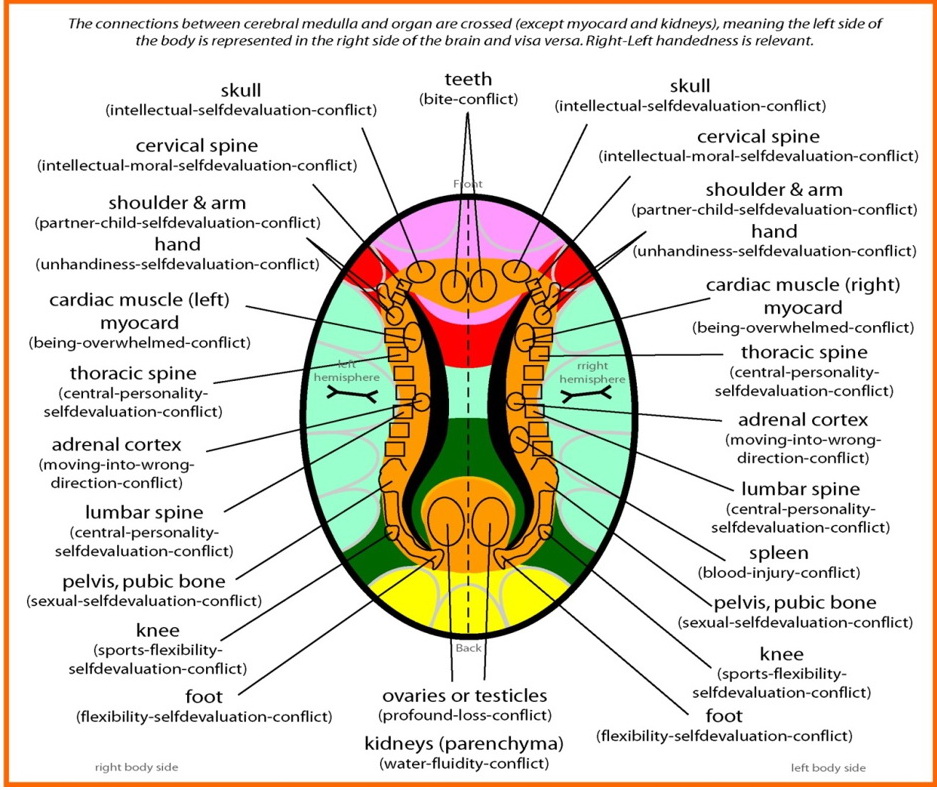
2. Midbrain (+/-) dorsal right, for smooth muscle
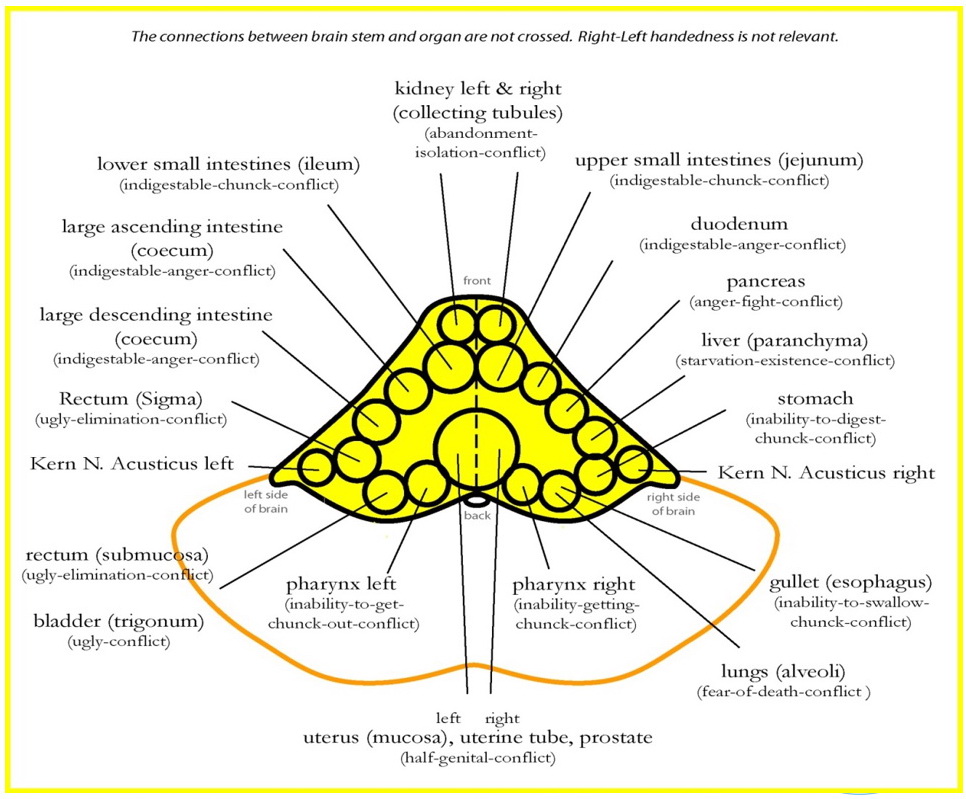
compare Brain Stem:
Mind
Theme:
1. (CM) Inability to swallow or get rid of something (functional self-worth)
2. (MB) Assimilation, need to forward to digestion
Emotions and Thoughts:
Inhibition, remorse, incapability, anger
- Why couldn´t I swallow/assimilate this?
- Why couldn´t I spit this out?
- I should have been able to deal with this.
META-Meaning:
Based on what I learned, I am now perfectly able to handle all the chunks, informations and emotions properly.
Organ
The innervation of the gullet is divided and crosses over from left to right.
Stress Phase Symptoms:
1. (CM) Functional loss and necrosis of the muscle layer, muscular dystrophy. Possible diagnoses: dysphagia, swallowing paralysis
2. (MB) Hyperperistalsis or locally increased tonus & thickening of the muscle. Possible diagnoses: hypercontractile esophagus, “nutcracker-esophagus”
Sphincters: in heartburn, the LES opens or does not close sufficiently, often simultaneously with stress-active stomach mucosa ( territorial anger or indigestible chunk ). Vomiting is a stress symptom with acute toxication: here both sphincters open and the peristalsis runs backwards.
Long stress phases can lead to achalasia (chronic hypertonus in the lower sphincter creating dysphagia and leading to extension of the gullet).
Regeneration Phase Symptoms:
Inflammatory repair, myositis. In chronic processes the muscle layer gets thicker and more rigid, which can lead to esophageal varices.
Healing Peak:
Spasms, gag, belching as a sign of a neuro-muscular process, sometimes vomiting.
Biological Meaning:
Swallowing- and vomiting reflexes are meaningful functions connected to the sensitive mucosa, to secure food assimilation and to prevent toxication. By completed regeneration phase, the muscle gets stronger than before.
Social
Examples
- A man loses his driving license after losing his temper and disputing with policemen performing an alcohol control.
- A nursery home inhabitant hates to eat after having lost his sense of taste, and regrets memories connected to eating.
- The client suffers from chronic dysphagia. She could not swallow that her partner had cheated her for years, and that all other women seemed to get pregnant. After META-coaching she gets aware of her “spiritual family”, and the swallowing impairment decreases. (Gedye, MHU archive)
- The client is giving herself up for her belief, she had to do everything for her family. She makes herself act against her own will. She gets heartburn and spasms of the esophagus muscles. After Renegotiation, the symptoms recede. (Maggi, MHU archive)
Additional Information
Differential Diagnosis:
The Lower Esophagus Sphincter opens also in stress phase of the stomach mucosa which creates acid reflux and heartburn.
Endodermal lower Esophagus Mucosa (BS +/-) Stress phase (assimilation): enhanced secretion and tumor growth, chronic: Barret-esophagus.
Ectodermal upper Esophagus Mucosa (CC -/+) Stress phase (swallowing/spitting out prevented): hyperesthesia and ulceration; Regeneration phase: scarring, carcinoma growth possible
