
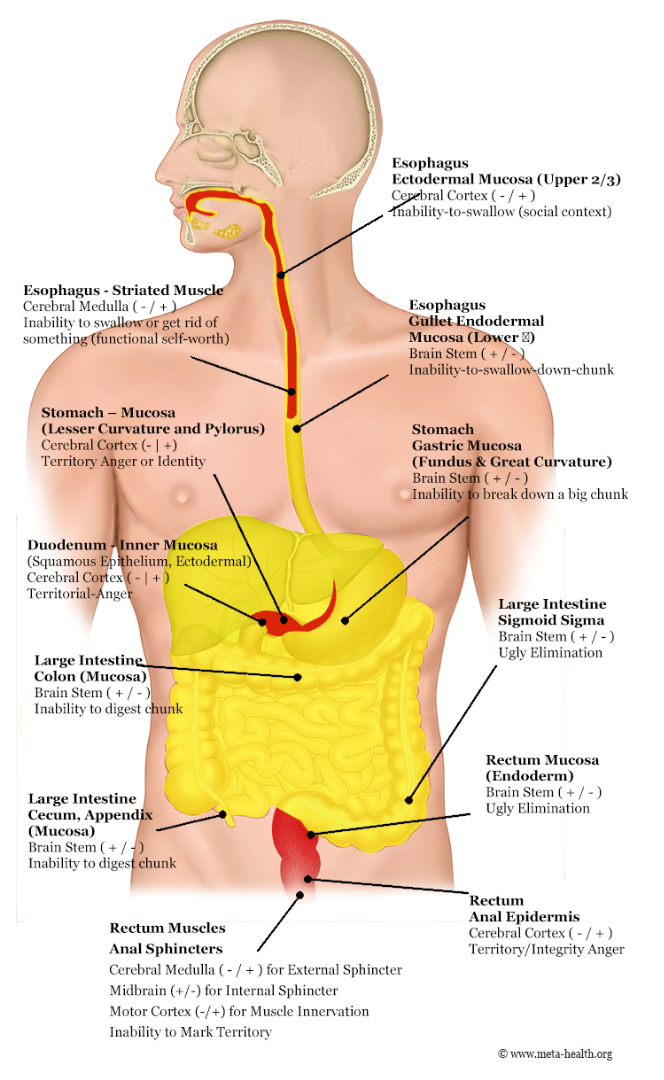
Esophagus – Ectodermal Mucosa (Upper 2/3)
Anatomy
In the upper two-thirds of the esophagus, the inner mucous layer consists of non-stratified squamous epithelium. It forms a smooth and robust sliding surface that helps the process of swallowing and spitting out.
Brain
Relay:
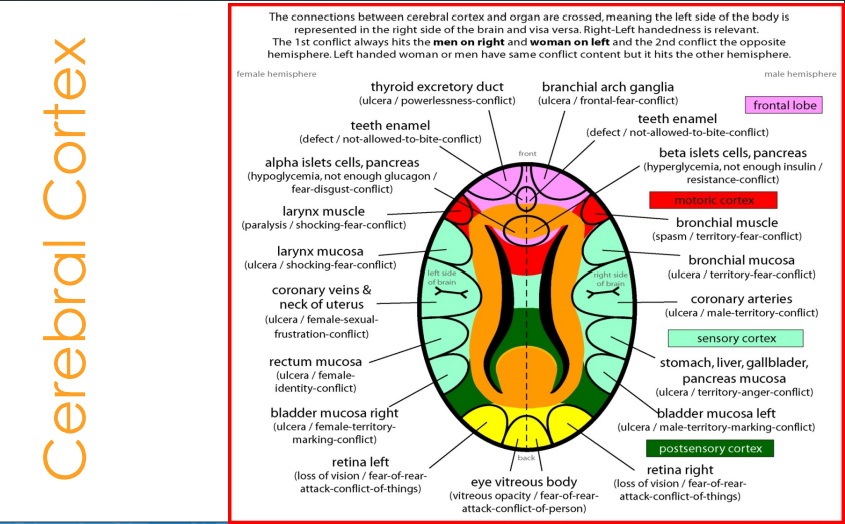
Cerebral Cortex ( – / + ) postsensory insular area left & right, next to coronary relays
Mind
Theme:
Not wanting, being able or being allowed to swallow or to spit out (social context)
Emotions and Thoughts:
Resistance, suppressed rage
- I won’t swallow that!
- I can not accept what they did to me.
- Why do they make me eat that?
- I want to spit this out again!
META-Meaning:
Now, I express my needs, capabilities and boundaries clearly and respectfully.
Organ
Sensitivity change according to Inner Skin /Stomach mucosa Pattern with hyperesthesia in stress phase
Stress Phase Symptoms:
In the stress phase ulcers appear in the upper two thirds of the esophagus. Since the squamous epithelia is very thick in this area it may take 6-10 months before a deep ulcer can be diagnosed by gastroscopy. The typical symptoms are swallowing spasms, hyperesthesia and pain that may result from swallowing impairments.
Regeneration Phase Symptoms:
Repair of the affected part of esophagus, possibly accompanied by high fever. Symptoms are bleeding and a mucosal swelling with no more pain (because of mucosa hypesthesia in regeneration phase). In a longer lasting conflict or a strong conflict intensity the swelling can cause swallowing disorders (dysphagia) – frequently diagnosed as a mash-swallowing stenosis that could be remedied with a temporary nasogastric tube. Under unfavourable circumstances, an esophageal carcinoma may also occur.
Healing Peak:
Strong pain, frequently accompanied by spasms of the esophageal muscle.
Biological Meaning:
Hyperesthesia and improvement of the esophageal diameter in stress phase facilitate transmission or ejection of the bolus, together with increased peristalsis or triggering the vomiting reflex.
Social
Examples:
- Stress Trigger related to something we want to spit out but have to swallow. Common stress triggers for children forced to eat something they don´t want.
- Not wanting to swallow or to spit out something, such as an inability to accept advice or criticism or to enunciate judgements or beliefs.
Additional Information
The sensitive innervation of the gullet is divided and crosses over from left to right. Handedness is relevant in diagnosis.
Differential Diagnosis:
Esophagus Sphincter and Striated Muscle(Cerebral Medulla -/+): often reacts together with ectodermal mucosa; in stress phase with functional loss and with strengthening in and after regeneration phase.
Esophagus Endodermal Mucosa(Brain Stem +/-): partly overlapping location, secretion and tumor in stress phase (assimilation). No sensitivity in this tissue.
Smooth Muscle layer (Midbrain +/-): stress phase (assimilation): higher tonus and decreased peristalsis with possibly achalasia, theme being to hold back the bolus for better processing or preparation to spit it out.
Esophagus Submucosa (Cerebral Medulla -/+): connective tissue layer which may react together with the ectodermal mucosa and striated muscle in the same sense, producing functional loss and necrosis in the stress phase (self-devaluation regarding function) and proliferation in the regeneration phase.
