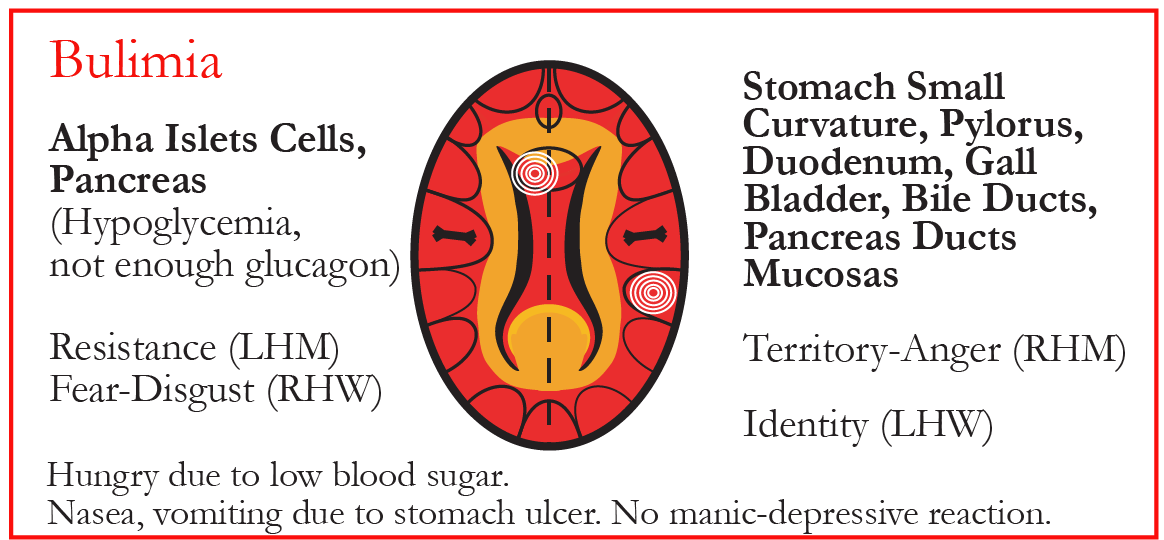
Duodenum – Squamous Epithelium in Bulbus
Anatomy
The duodenum is the first section of the small intestine, which follows the pylorus. The beginning section of the duodenum is widened into an “onion shape” (bulbus duodeni) and is lined by sensitive squamous epithelium derived from the ectoderm. The mucosa of the following part consists of ciliated epithelium of endodermal origin.
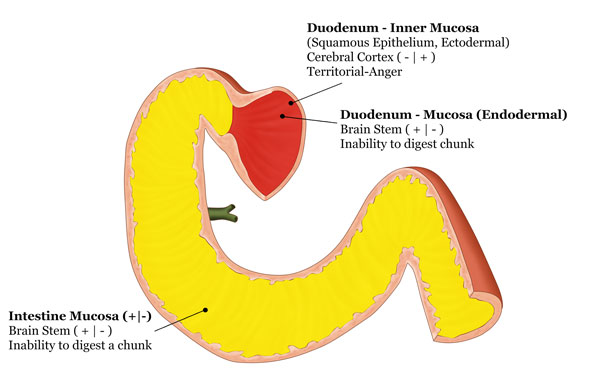
Brain
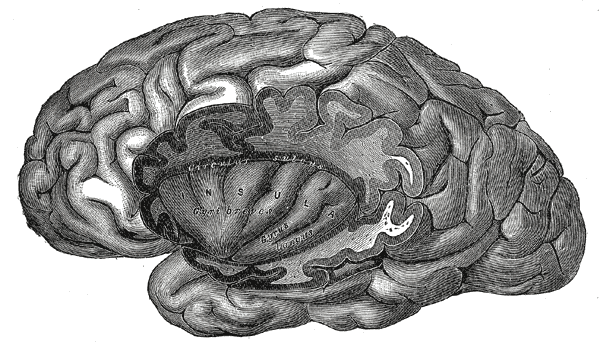
Relay:
Cerebral Cortex (-/+) insular region medio-lateral right hemisphere “4 o’clock”
Mind
Theme:
1.Territorial Anger/Competitiveness
2. Identity/Belonging
Depending on client’s gender, handedness, hormonal situation, age and subjective associations.
Emotions and Thoughts:
1. Anger, indignation
- I need to defend my territory/family/relation.
- My borders have been violated.
- My partner betrayed me.
2. Indecision, longing - I can´t find my place here.
- I need to have a function here.
- I need to belong.
META-Meaning:
- I am now able to find my true place.
- I respect and feel respected.
Organ
Sensitivity change according to Inner Skin-Pattern with hyperesthesia and pain in stress phase.
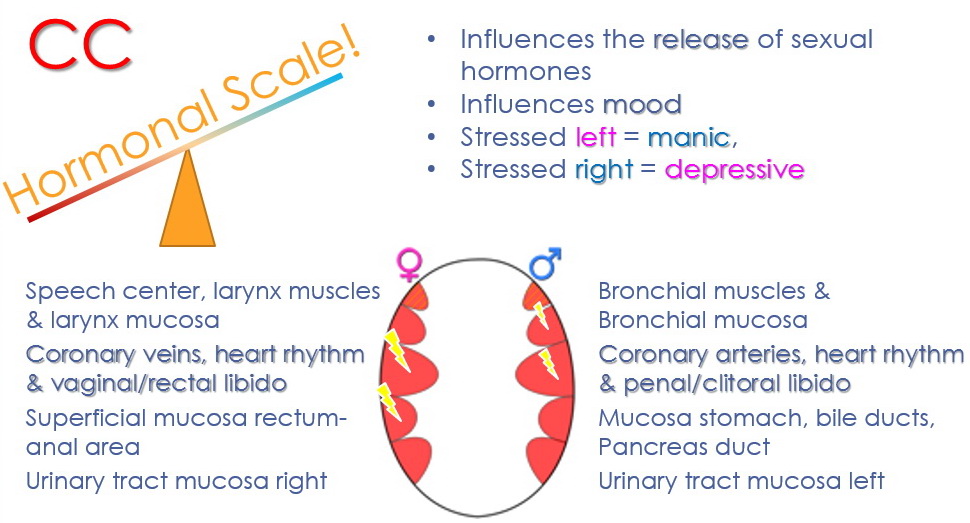
Stress-activity inhibits the release of testosterone.
Stress Phase Symptoms:
Typical stress phase symptoms are hyperesthesia and ulceration of the squamous epithelium. This is usually diagnosed as duodenal ulcer (ulcus duodeni, peptic ulcer disease) and shows gnawing or burning pain, which typically occurs when the stomach is empty (90 minutes to 3 hours after a meal), between meals, and in the early morning hours. Eating relieves the pain.
In extensive stress phase (or a chronic healing process), more tissue will be damaged. Perforation is possible and dangerous, as the contents are released into the abdominal cavity.
Regeneration Phase Symptoms:
Main symptoms are the bleeding of healing ulcer and the presence of digested blood in stool (black “tar stool“). Viral infection can happen, but the presence of helicobacter pylori is often seen in connection with ulcerations of the duodenum. Possible diagnoses: gastroenteritis, duodenal cancer (ulcus carcinoma). No pain in regeneration phase except for healing crisis.
Healing Peak:
Strong bleeding, colic pain, chills and fainting.
Biological Meaning:
Widening of the gastro-intestinal tract to easier release / let information pass.
Social
Examples:
1. Territorial anger/Competitiveness
- A man is upset about a property dispute with his neighbor which triggers the indigestion of the duodenum. Only after he found a real-life situation did his symptoms disappear.
- Wife is flirting with other men and husband is extremely jealous and upset when he notices her flirting. They got a divorce but never really solved the underlying emotions and beliefs which caused the duodenum (twelve finger) to react.
- A co-worker is accusing a man of wrong-doing which makes him extremely angry up to the point where all he can do is think about how to fight back. Using META-Health Therapy he released the anger and had a transformational talk with his colleagues.
2. Identity/Belonging - Employee feels unaccepted by her boss and the staff in her workplace.
- A woman follows her husband to a foreign country where she doesn’t feel at home. She finds it difficult to integrate, and develops various food intolerances.
Additional Information
This relay belongs to the “territorial relays” in the peri-insular cerebral cortex, with the theme of social position and affiliation. Special rules apply for the meaning of side dominance. Conflicts affect the sexual and social “hormonal scale” and can promote manic or depressive episodes (see “territorial constellations” related to the function of the neurohypophysis).
Possible Constellations:
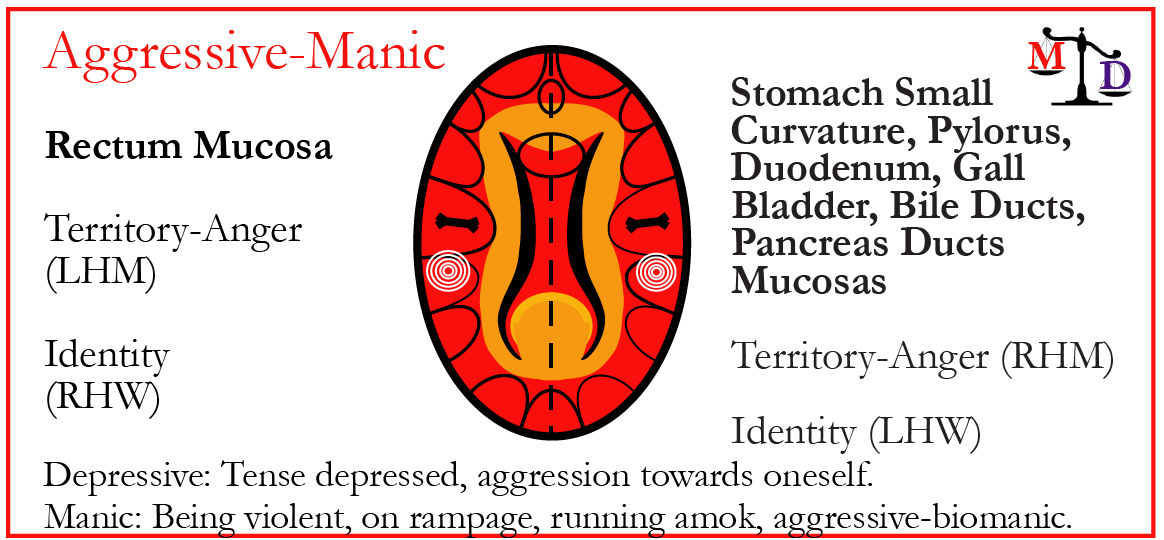
Aggressive: Together with Rectum/Anal Mucosa relay. The person is aggressive and possibly violent against himself or others. Positive: courage and will to resolve the conflict.
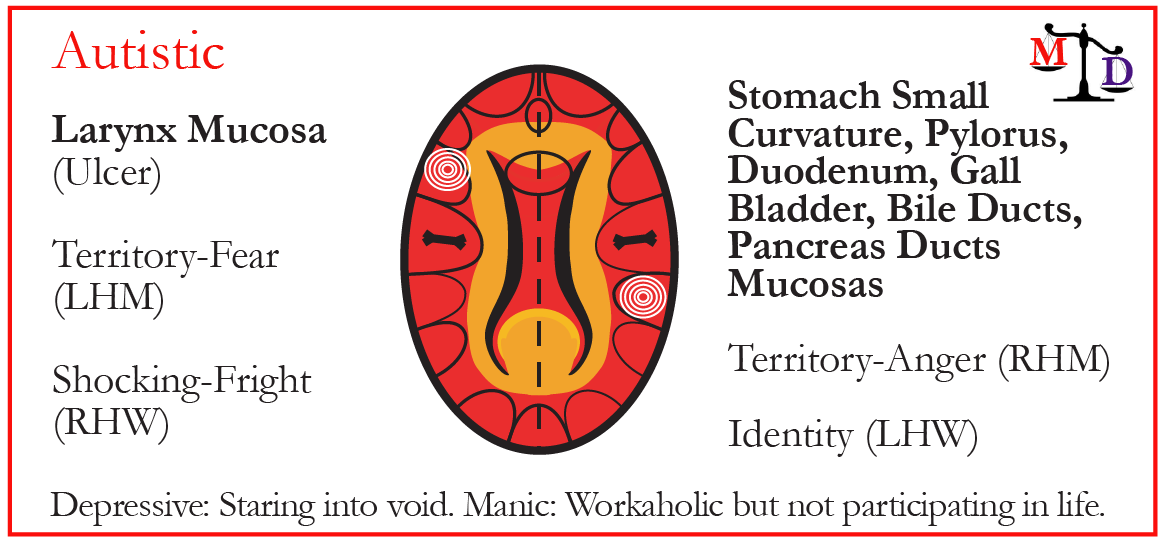
Autistic or Introvert constellation: Together with Larynx Mucosa relay. The person shows an introvert and self-centered personality, distracted and living in their own world. Positive: focus!
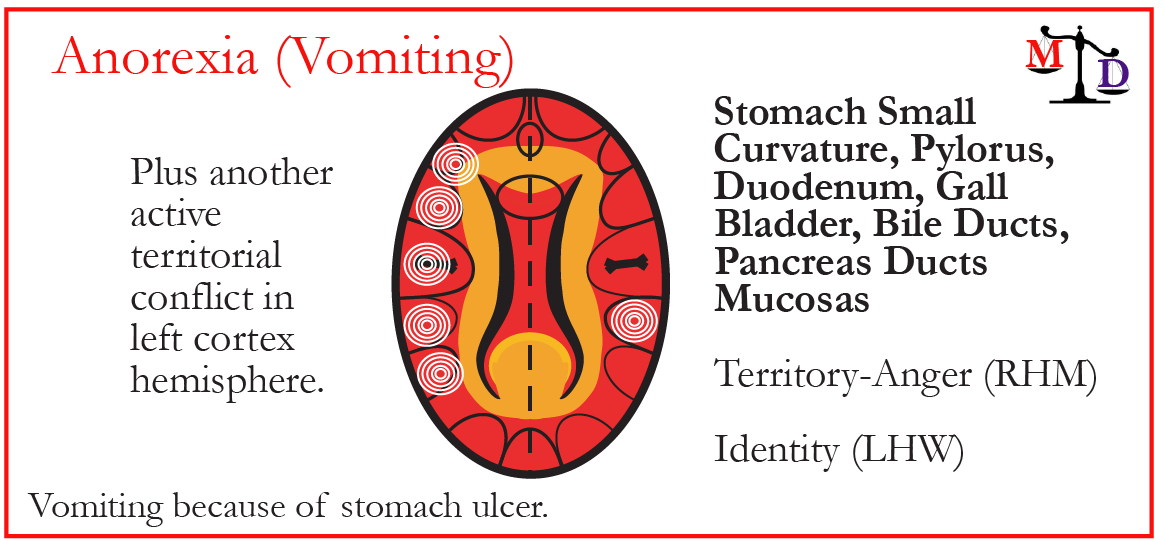
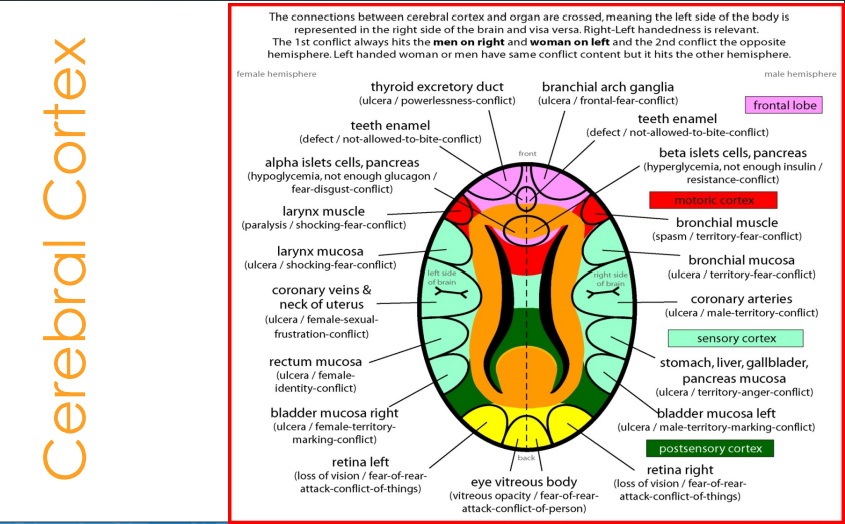
Anorexia: Together with another active periinsular relay in the left hemisphere. The person is unwilling to eat, or throws food up again.
With these 3 constellations mania and/or depression will be present depending on hormonal status and conflict impact.
Bulimia: Together with Pancreas Alpha Islet Cells relay. The person is binge-eating (reflects hypoglykemia) and throwing up (reflects stomach pain).
Differential Diagnosis:
Duodenum Mucosa /Villi(Brain Stem, +/-), with polyps or adenocarcinoma in the stress phase (fight for values), inflammatory decomposition in the regeneration phase.
Pylorus squamous epithelium (Cerebral Cortex -/+), with pyloric ulcer in stress phase (rank/identity), pyloric cancer in regeneration phase.
Pylorus Sphincter muscle (midbrain +/-) stress phase (suppressed anger) with hypertonus leaving chyme and acid in the stomach, creating an environment for ulceration. Regeneration phase infection with helicobacter pylori.
Submucosa/ lymphatic tissue (Cerebral Medulla -/+) stress (choice, decision): immune insufficiency, leaky gut; regeneration phase: Inflammatory and edematous in the first phase. Diagnoses may be lymphoma, inflammatory fibroid polyps, perineurioma and leiomyoma.
Smooth Muscle Layer (Midbrain +/-): smooth muscle often co-reacts with mucosa, theme being to forward the chyme by peristalsis. In stress phase (processing anger) we see a functional increase and possibly leiomyoma.