Large Intestine – Colon Mucosa
Anatomy
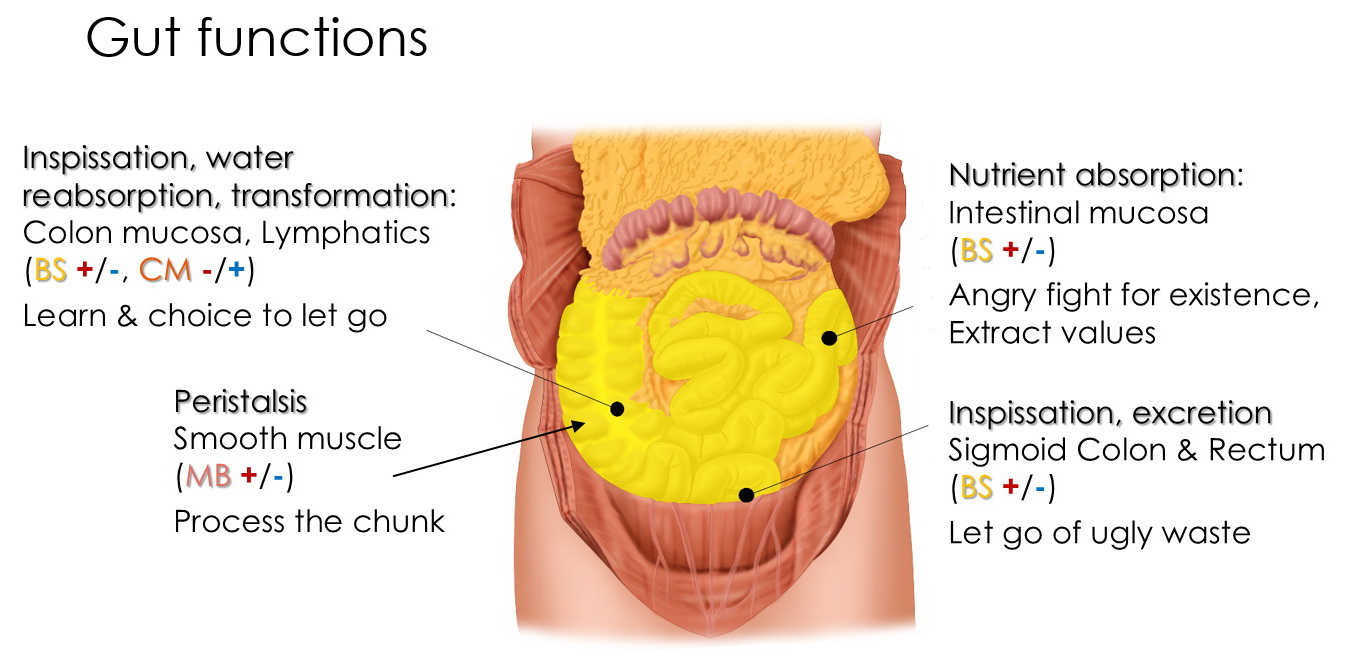
The large intestine takes about 16 hours to finish the digestion of the food. It´s main function is not breaking down the food but to remove water and any remaining absorbable nutrients from it, before passing on the indigestible matter to the rectum. However, certain carbohydrates (like in fibres) are digested here with the help of microbes. The colon absorbs vitamins which are created by the colonic bacteria – such as vitamin K (especially important as the daily ingestion of vitamin K is not normally enough to maintain adequate blood coagulation), vitamin B12, thiamine and riboflavin. It also compacts feces, and stores fecal matter in the rectum until it can be discharged via the anus. The colon mucosa contains goblet cells producing secrete to support moving and expelling the chunk.
Brain
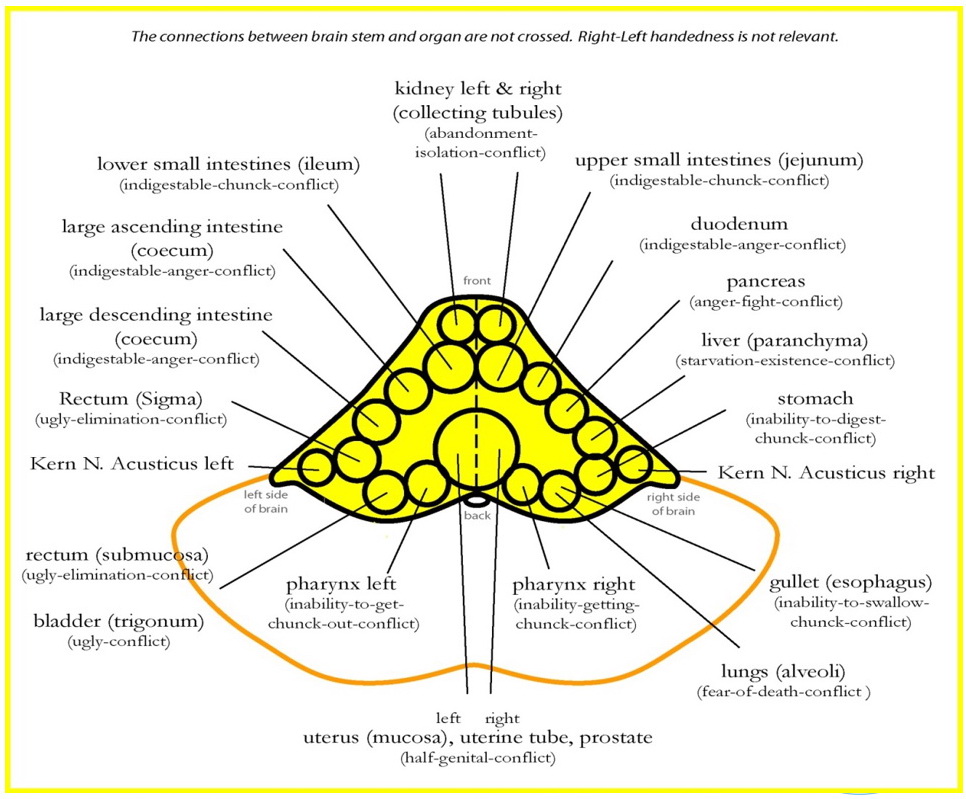
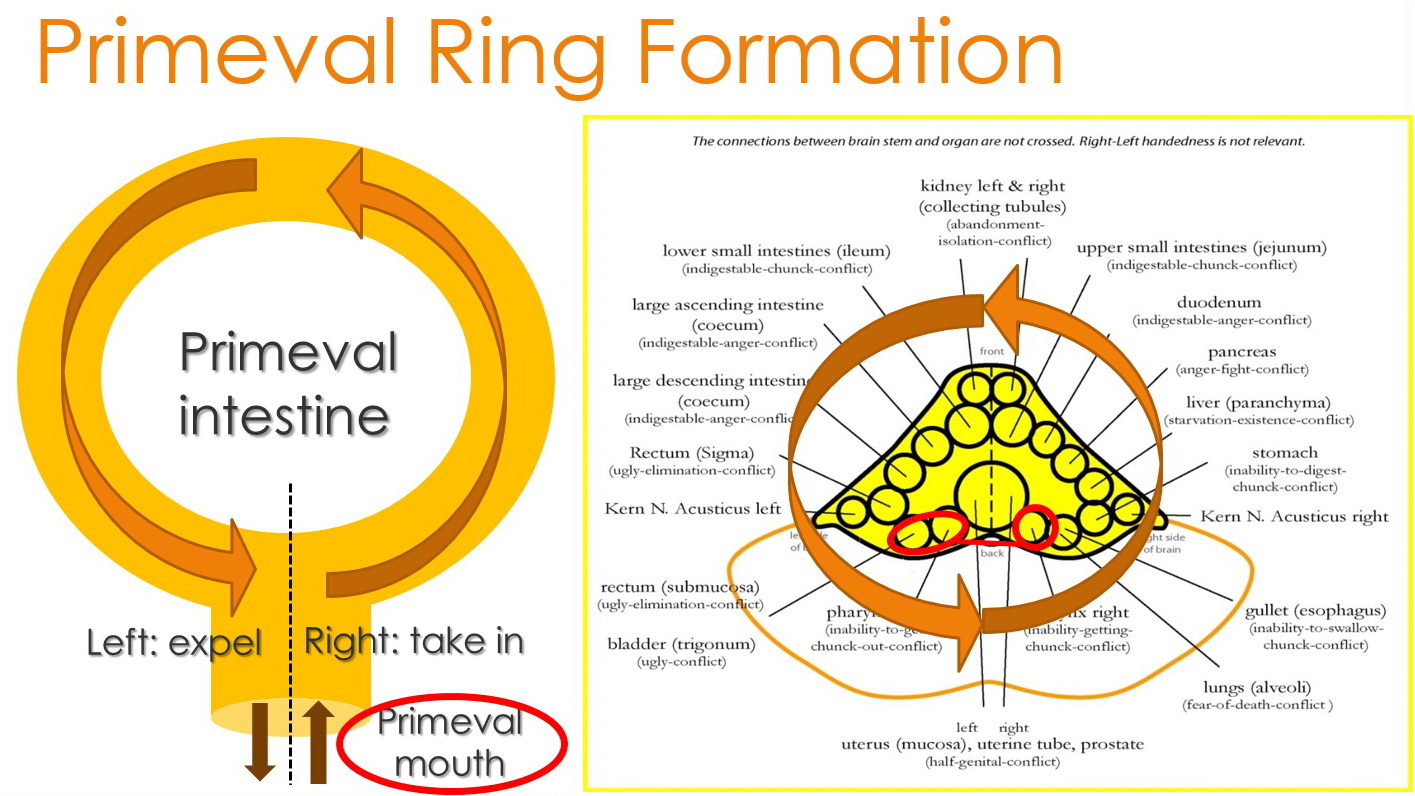
In the Brain Stem, the primeval ring structure is reflected: organ tissue relays with assimilative and digestive functions from oesophagus to small intestines are situated in the right brain stem, while excretory organs from caecum to rectum are relayed in the left brain stem. Medial on both sides are the relays of mouth/pharynx, middle ears and lacrimal glands, as well as the pineal and pituitary glands and the thyroid.
Relay:
- Brain Stem ( + / – ) lateral left, for mucosa
- Midbrain (+/-) lateral left, for smooth muscle
graphic: Kevin Dufendach, compare Brain Stem
Mind
Theme:
- Digestion, nutrient production, absorption
- Inability to eliminate or to get rid of indigestible feelings, thoughts, experiences.
Side dominance is irrelevant here
Emotions and Thoughts:
Hurt, resentful, sad
- I can’t let go of what happened.
- My insides have been ripped out.
- This is a big pile of muck.
Synonyms: Repugnant, unbecoming, repulsive, hideous issue/behaviour. Underlying deep sadness of not being able to overcome and let go.
META-Meaning:
I can now process that and let go of it.
Organ
Stress Phase Symptoms:
Increase of nutrient and water absorption leads to weight gain. In longer processes a proliferation grows, which can be of compact secretory type, or as a wall thickening with absorptive function. Digestive troubles, changes in bowel habits, alternating constipation and diarrhea can appear and lead to weight loss. Even colorectal polyps (polyposis coli) can appear, which usually are asymptomatic, but could cause bowel obstruction.
Possible diagnoses are gut wall hyperplasia, large intestine carcinoma, colon carcinoma, adeno-carcinoma
Regeneration Phase Symptoms:
Function normalization and stop of proliferation. In decomposition of a tumor by lymphatic cells, often fungus or mycobacteria (candida, tubercles) are present. Bleeding occurs (mostly occult, but fresh blood when the blood vessels are affected) and can lead to anemia (danger!). Other symptoms are mucous diarrhea and irritable colon. Ppotential diagnoses are colon tuberculosis or ulcerative colitis (a chronic recurring elimination of flat parts of the tumor). Tumors can also become encapsulated and remain inactive.
Biological Meaning:
Enhanced secretion prepares sticky chymes for elimination. Increased reabsorption of water (and remnant nutrients) in colon ensures better inspissation of stool and taking out all values before expulsion.
Social
Examples:
- A man is unjustly convicted in court and his defense speech was not to be heard. He can´t let go of the resentment. He has colon polyps.
- The client had a grudge against his former boss who mistreated him. Although he moves to a new place, he passes by the places bearing is memories regularly, and suffers from colitis ulcerosa.
- A politician’s past is revealed and his whole family suffers from the bashing. He develops colon cancer.
Additional Information
Handedness is irrelevant in this relay.
Constellations:
Brain Stem Constellation possible: perplexity, lethargy, passiveness, reduced movement. Purpose: new orientation
Differential Diagnosis:
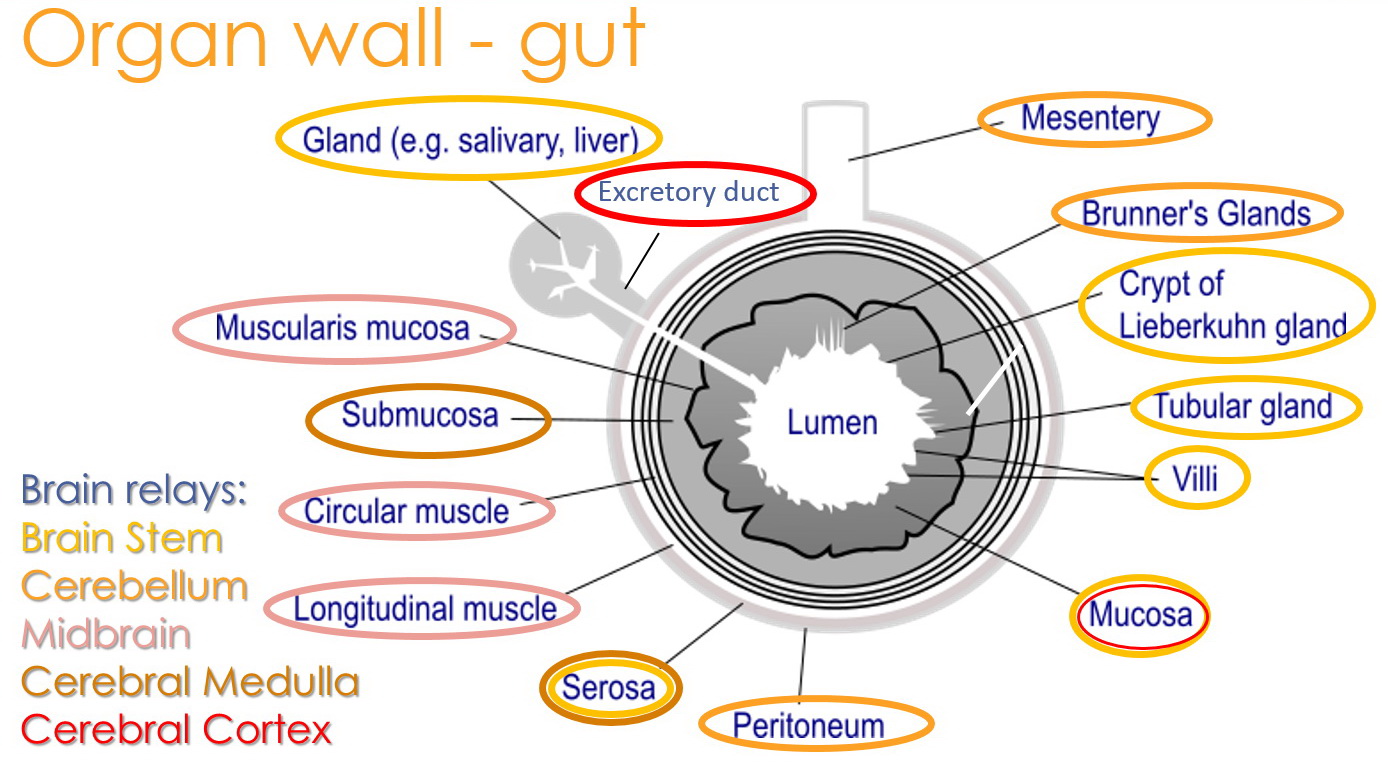
Submucosa/ lymphatic tissue (Cerebral Medulla -/+) stress (choice, decision): immune insufficiency, leaky gut; regeneration phase: Inflammatory and edematous in the first phase. Diagnoses may be lymphoma, inflammatory fibroid polyps, perineurioma and leiomyoma.
Smooth Muscle Layer (Midbrain +/-): smooth muscle often co-reacts with mucosa, theme being to forward the chyme by peristalsis. In stress phase (processing anger) we see a functional increase and possibly leiomyoma.
Peritoneum & Greater Omentum (Cerebellum +/-), stress phase (protection of the gut) possibly with adenoidal mesothelioma, and tuberculous decomposition in regeneration phase, possibly ascites.
Adipose and Lymphatic Tissues of the Greater Omentum (Cerebral Medulla -/+), with necrosis in stress phase (Resources to protect Self) and possibly lipoma, lipoedema or lymphoma in regeneration phase.