
Blood Vessels – Veins
Anatomy
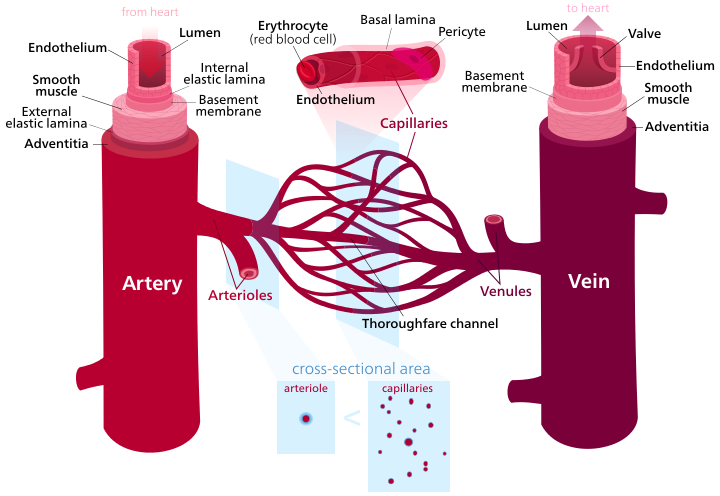
Veins are part of the circulatory system. In general, veins function to return deoxygenated blood to the heart, and are essentially tubes that collapse when their lumens are not filled with blood. The thick outermost layer of a vein is made of connective tissue, called tunica adventitia or tunica externa. There is a middle layer of bands of smooth muscle called tunica media, which are, in general, thin, as veins do not function primarily in a contractile manner. The interior is lined with endothelial cells called tunica intima.
Veins differ from arteries in structure and function; for example, arteries are more muscular than veins, veins are often closer to the skin and contain valves to help keep blood flowing toward the heart. Veins are also called “capacitance vessels” because most of the blood volume (60%) is contained within veins.
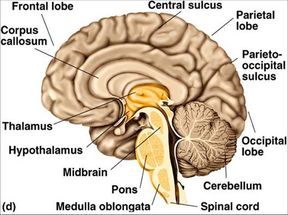
Brain
Relay
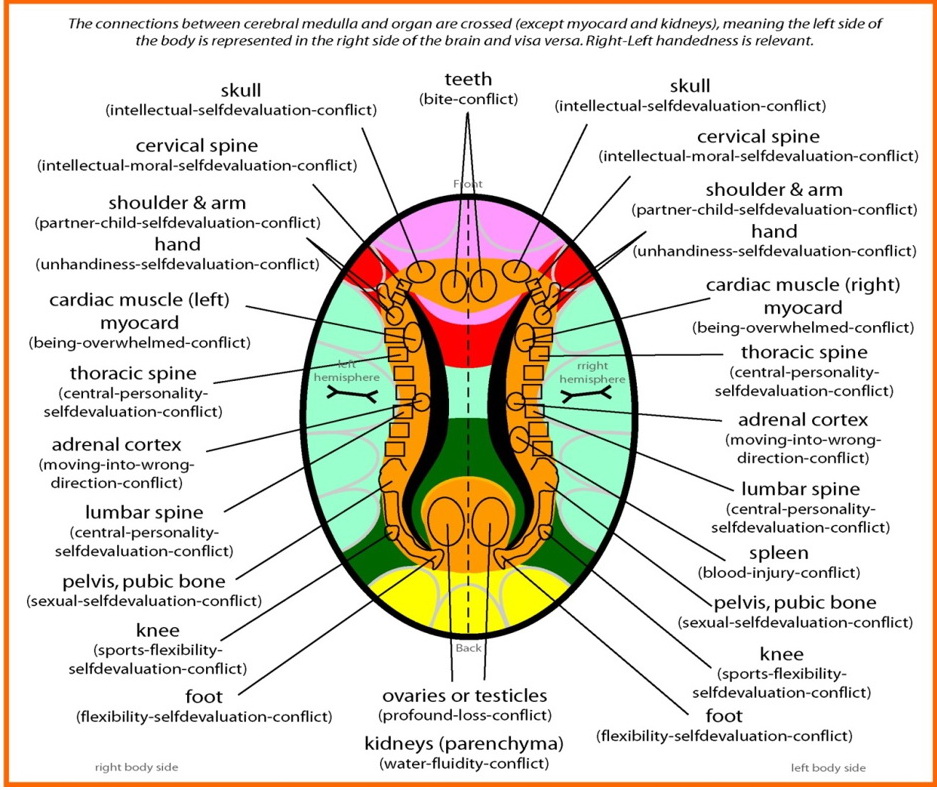
Cerebral Medulla ( – / + ) for adventitia, intima and valves, relay according to location in the body
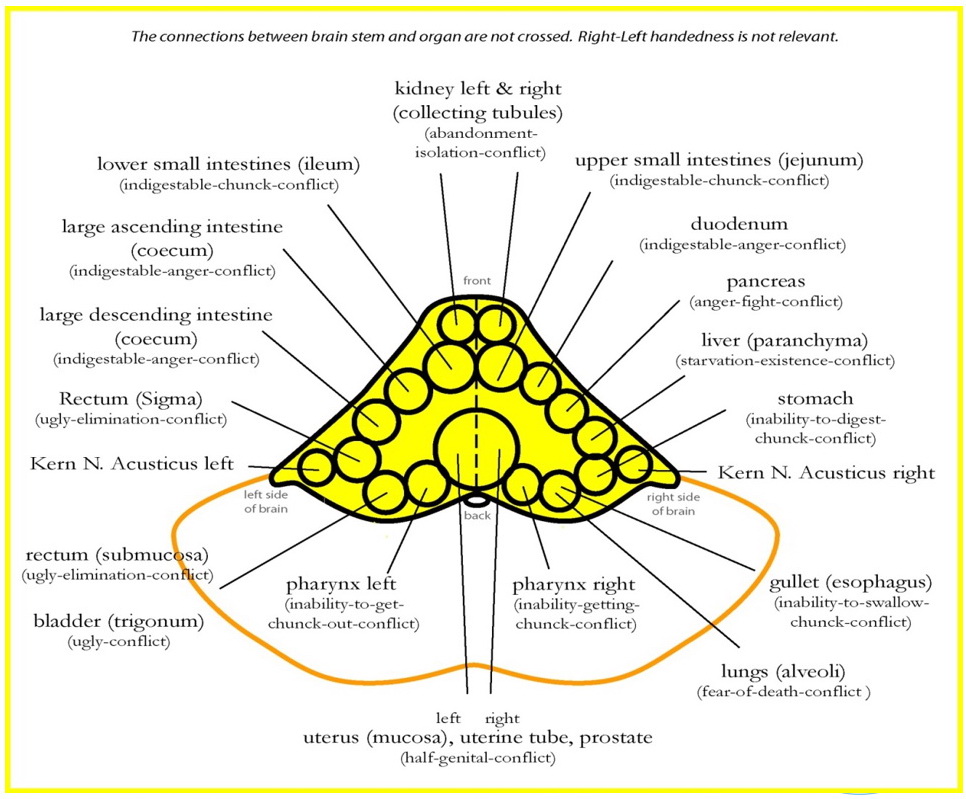
Midbrain (+/-) for smooth muscle layer
compare Brain Stem
Mind
Theme
Functional self-worth regarding “internal logistics” (transport, communication and support capacity) and movement (moving on). Conflict according to the corresponding localization.
Emotions, Thoughts
Frustration, heaviness, desparation
- This is too much of a burden.
- I feel tied and unfree.
- I feel de-energized and can´t help myself.
- I can´t move out of this situation.
- Why can´t I manage this?
- I should have been able to handle that.
META-Meaning
- I move easily and with grace.
- Now, I can decide to dance through life!
- I am worth to accept help.
Organ
Stress Phase Symptoms
Functional loss especially in the collagen and elastic fibres and the vein valves. Especially after several relapses this can appear as varicose veins on the legs, or as vein insufficiency..
Regeneration Phase Symptoms
Swelling of the vein wall, accompanied by inflammation and repair with help of cholesterol.. In case of a kidney collecting tubules syndrome the swelling of the veins (stenosis) may intensify up to an occlusion. Thrombophlebitis of the legs, leg vein obstruction, venous thrombosis of the legs and phlebothrombosis are possible diagnoses. Under certain circumstances a ulcus cruris (venous ulcer) on the leg develops. In case of a recurring conflict varicose veins can become visible, depending on which veins are affected.
As a residual condition, we then see dilated and thickened (visible) veins (varices). Varicose veins are asymptomatic, unless in healing peaks of recurrent conflicts.
Healing Peak
During the healing peak, the patient experiences a painful varicosity of leg veins.
Biological Meaning
The biological meaning in the cerebral medulla´s relays lies in the end of the regeneration phase, when the affected structures are stronger/harder as before to prevent the same conflict type happening again. Nevertheless, the process leads to more rigidity and less flexibility.
Social
Examples
- A woman unexpectedly becomes pregnant with her third child, thereby she feels restricted in her activities and she feels overworked, so she suffers a self-devaluation conflict, affecting the leg veins and heart muscle.
- A woman being a strong believer of alternative-naturopathic medicine, was persuaded by her physician to get vaccinated. Moreover, the undesired injection was given too deep in her buttock, causing pain. Shortly thereafter, she experienced a venous thrombosis in the iliac veins.
- An entrepreneur has several businesses. Some of them are small projects with limited success. These projects have become a millstone around his neck, because he must pay much attention to them. He develops depression and varicosis.
- A young woman follows her heart and joins an intentional community. There she feels overworked, too slow and a burden for the others. During this time she gets edema in her lower legs, connected to weakened vein and heart function and stress-active kidney tubuli. (Klapp)
Additional Information
For heart region, see also Coronary Veins – Intima (Cerebral Cortex,-/+)
Differential Diagnosis
Periosteum(connected to trophic innervation of blood vessels) (Cerebral Cortex, -/+): hyperesthesia and hypoperfusion (cold extremities) in stress phase (irritating painful contact), possibly flowing pain in regeneration phase.
Arteries (Cerebral Medulla, -/+): possible stenosis or occlusion in the peripherical arteries and capillaries by swelling during regeneration phase, or by arteriosclerosis after recurring healing processes.
