
META-Wiki (english)
The META-Wiki is a living compendium of the psycho-bio-sociological connections.
It gives an anatomical and physiological introduction to the organ systems, single organs and specific tissues, as well as the brain layers and relays concerned.
The biological function of these tissues defines the conflict theme they react upon with typical symptoms that change throughout the cycle of trauma, conflictive (stress) phase, regeneration, healing peak, and the body’s warning mechanism. Examples of these symptoms are given, as well as possible medical diagnoses for them. Of course, with ongoing experience and case studies in our database, this information is extended.
The affected organs have typical qualities of emotions attached when stressed, and thoughts that prompt these emotions. From this perspective, META-meanings can be deducted: insights and guiding principles that help to heal bodymind.
The named emotions, thoughts and META-meanings are examples to translate the biological function of our organs for the individual human mind. We added shortened client examples for illustration. The "differential diagnoses" give various tissues, themes and symptoms to compare similar affections to each other.
This compendium does NOT claim that the human bodymind will heal completely by resolving conflicts. Health and disease are multifactorial, and we find that dispositions are created already at an early age or even before birth. However, our understanding gives valuable directions in which to find the key for holistic healing.
In that, META-Health professionals wish to collaborate with scientific and alternative health care providers to boost efficiency by an integrative approach that suits the individual.
Organism Overview
The body is the physical expression of our being, and a microcosm of our world. It consists of up to 10 trillion cells, which are surrounded by the extracellular matrix(or the connective tissue built from it). The whole is structured in functional tissues, organs and organ systems.
The whole body is covered in skin – the integumentary system.
It’s form and maneuverability is created by the musculoskeletal system. We distinguish the trunk including head and neck, and the extremities i e arms and legs.
Association areas of skin and musculoskeletal system are divided by body halves and by in- and outsides of the extremities:
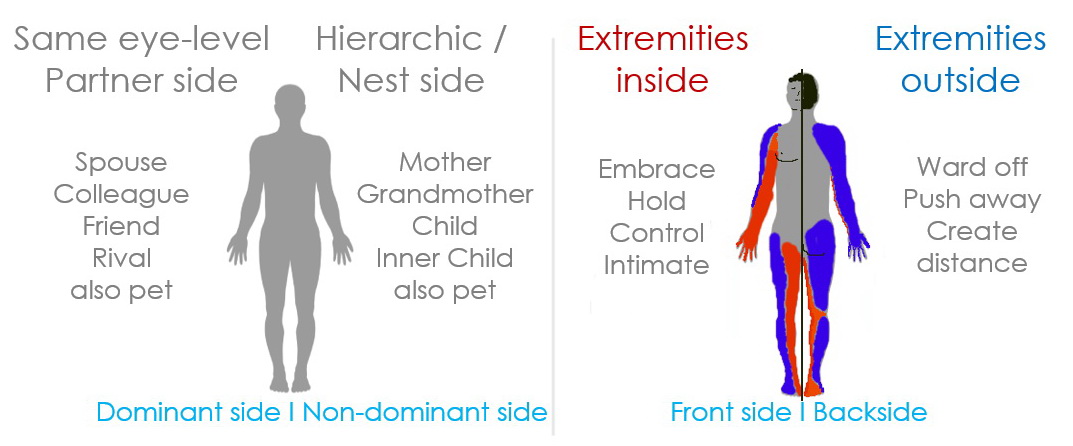
To live, the organism depends on metabolization of food into energy. This happens in the digestive system from the mouth, stomach, intestines, to the anus.
To burn and use the energy, cells need oxygen provided by the respiratory system.
The tissues and organs are supplied via the circulatory system. Disposal and excretion are managed by the lymphatic system (part of circulatory system) and the urinary tract with kidneys, bladder and urinary vessels.
The male and female reproductive organs ascertain the survival of the kind.
Microbes belong to the organism and have functions of composition and decomposition in the ongoing renewal of tissues.
The cooperation of all organs, cells and microbes is coordinated by the brain and nervous system and by the endocrine system with it’s hormonal glands.
The sensory organs convey information about the environment, so that the body can adjust and interact.
Organ Systems
Circulatory System
Digestive System
- Anal Mucosa (squamous epithelium)
- Anal Sphincter Muscles
- Cecum and Appendix Mucosa
- Colon Mucosa
- Duodenum
- Esophagus
- Gallbladder and Bile Ducts
- Intestinal Lymphatic Tissue
- Intestine Smooth Muscle
- Large Intestine Overview
- Liver
- Liver, Gallbladder, Pancreas Overview
- Mouth
- Mouth, Tongue
- Pancreas Ducts
- Pancreas Gland
- Pancreas Overview
- Pharynx
- Rectum
- Sigmoid Colon
- Small Intestine
- Stomach
- System Overview
- Teeth
- Tonsils
- Visceral Fascia
Endocrine System
- Adrenal Gland
- Pancreas
- Pineal Gland
- Pituitary Gland
- System Overview
- Thymus
- Thyroid
Integumentary System
Musculoskeletal System
Nervous System
Reproductive System
Respiratory System
- Branchial Arches Pharyngeal Ducts
- Bronchial Mucosa and Muscle
- Diaphragm
- Larynx
- Lungs
- Nasopharyngeal Mucosa
- System Overview
- Visceral Fascia
Sensory System
- Ear
- Ear Inner
- Ear Middle
- Ears
- Eye Muscles
- Eyelid Muscles
- Eyelid Skin
- Eyelids
- Eyes
- Nasal
- Nose Overview
- Olfactory System
- System Overview
Urinary System
- Bladder
- Kidneys
- System Overview
License

The META-Wiki by Kora Klapp is licensed under a Creative Commons Attribution-NonCommercial-ShareAlike 4.0 International License.
Sources & Thanks
In composing the organ chapters and pictures, information from following resources and authors were used, reviewed, and adapted:
Wikipedia – the free encyclopedia
Doccheck Flexikon – die Medizin-Community
Dr Ryke Geerd Hamer – Die Neue Medizin/Germanische Heilkunde
Björn Eybl – Die seelischen Ursachen der Krankheiten
David Münnich – Das System der 5 biologischen Naturgesetze
Nicolas Barro – Ideologiefreie, verantwortungsvolle Anwendung der fünf biologischen Naturgesetze nach Hamer
Caroline Markolin PhD – The five biological laws – biological special programs
Besides those, many internet forums for medicine, health care, and the biological laws of nature.
Special thanks goes to the META-Health Community, professionals and Master Trainers, who contribute with their experience and research to expand our knowledge-base and understanding of health.
