Connective Tissue
Anatomy
Connective tissue supports, connects, or separates different types of tissues and organs of the body. It´s characteristics are:
- Cells are spread through an extracellular fluid.
- Ground substanceextracellular matrix) – A clear, colorless, and viscous fluid containing glycosaminoglycans and proteoglycans to fix the bodywater and the collagen fibers in the intercellular spaces. Ground substance slows the spread of pathogens.
- Fibers – Not all types of connective tissue are fibrous. Examples of non-fibrous connective tissue include adipose tissue and blood. Adipose tissue gives “mechanical cushioning” to our body, among other functions. Although there is no dense collagen network in adipose tissue, groups of adipose cells are kept together by collagen fibers and collagen sheets in order to keep fat tissue under compression in place (for example, the sole of the foot). The matrix of blood is plasma. The cells responsible for the production of fibers are called fibroblasts.
- Both the ground substance and proteins (fibers) create the matrix for connective tissue.
picture: wikipedia (OpenStax College)
The functions of connective tissue are: - Storage of energy
- Protection of organs
- Provision of structural framework for the body
- Connection of body tissues
- Connection of epithelial tissues to muscle tissues
Brain
brain parts
Relay:
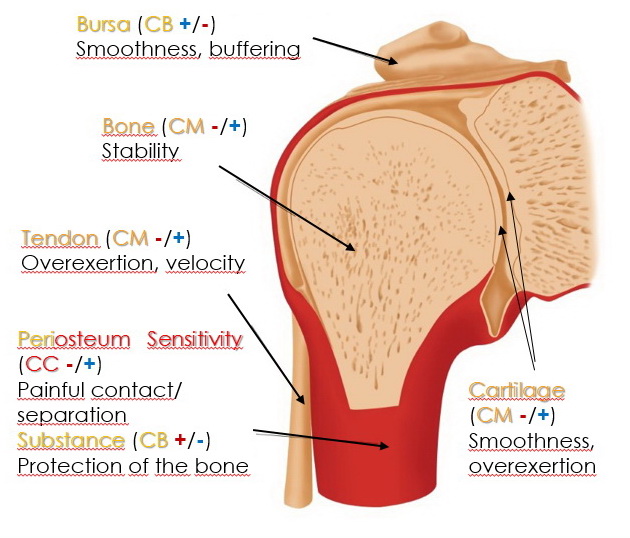
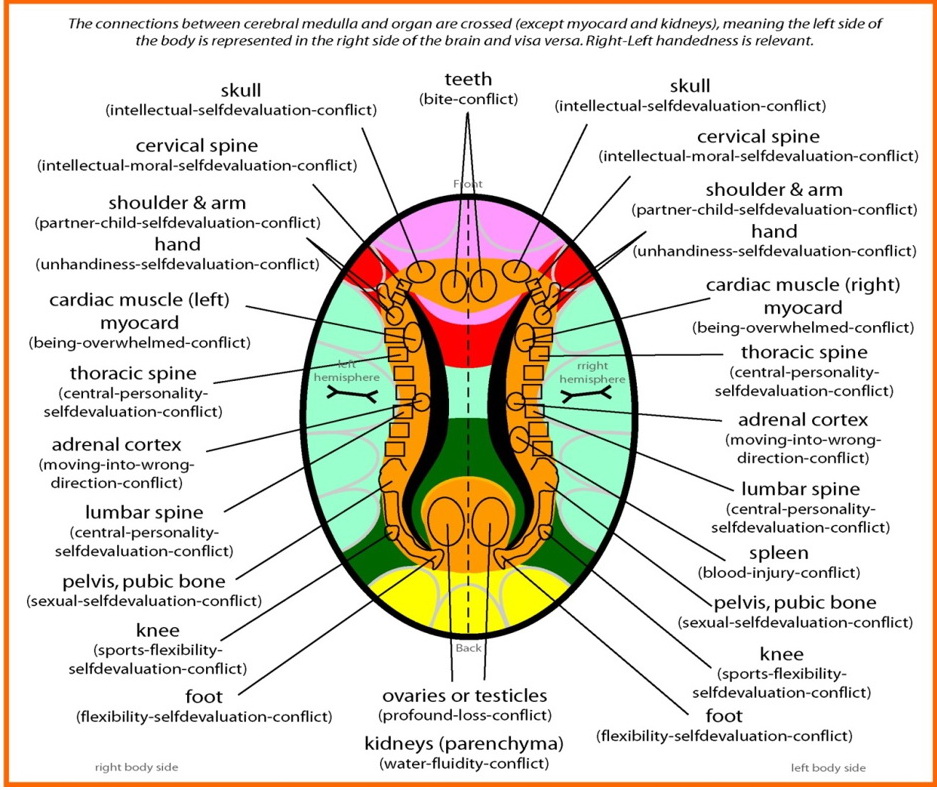
1. Cerebral Medulla ( – / + ) “New Brain mesoderm” for fatty tissue, cartilage, ligaments, submucosa layer in organ walls
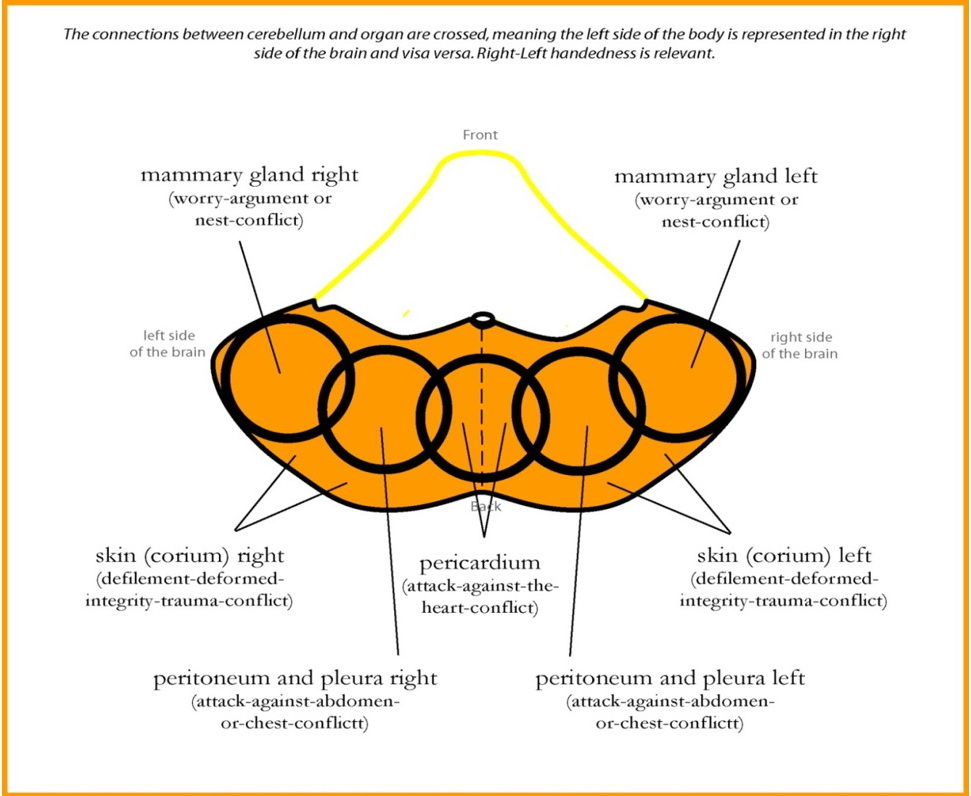
2. Cerebellum (+ / – ) “Old Brain mesoderm” for periosteum, meninges, muscle– & visceral fascia, joint capsules and bursae
Mind
Theme:
Self devaluation concerning the function of the tissue in the affected localization (connection, protection, provision) or it´s associations.
Association to locality:
For special associations according to locality see “Musculoskeletal System – Overview“!
Emotions and Thoughts:
Frustration, self-doubt, overload
General: I am worthless. I am not strong and good enough. They are better than me. I can’t live up to my own expectations.
Discs, fibrous cartilage: I cannot buffer it. This is too much pressure/weight.
Ligaments: I am not feeling strong enough holding this together. I am unstable.
Adipose tissue: I am not beautiful. I need more protection.
META-Meaning:
- I am enough.
- Now, I can feel safe and protected.
- I love myself connecting with the world.
Organ
Stress Phase Symptoms:
1. (CM tissue) Weakening and reduction of the connective tissue, often a loss of elasticity. Under heavy strain, structures that consist of connective tissue (like e g ligaments) are then more prone to rupture. Stretch marks (striae cutis distensae) develop in the stress phase of a self-devaluation concerning the body shape. Instability through weakened ligaments can lead to displacement of vertebrae or joint parts, and to pain especially through “wrong movements”. A lumbago can be the result.
2. (CB tissue) Reinforcement of the tissue, hyperplasia. Included smooth muscle cells (MB +/-) e g in muscle fascia and dermis increase tension or activity in order to protect the underlying organs.
Regeneration Phase Symptoms:
1. (CM tissue) The organism repairs itself with swelling, heat and building of scar tissue.
Regeneration Phase A can show strong oedema which creates pressure and possibly lasting pain, especially when nerves get compressed (e g in lumbago). Even now, the weak fibres can rupture. Bacterial infection with staph or mixed flora can be present. Diagnoses can be arthritis, periarthritis (refers to joints), fibromyalgia (refers to fascia, muscles, tendons), dermatomyositis, lupus erythematosus (refers to skin/subcutis). Processes especially in toe and finger joints in connection with accumulation of uric acid (e g through stress-active renal tubuli ) are called gout (hyperuricemia, podagra)
During Healing Peak, the fibres are prone to rupture, but otherwise it can go unnoticed.
In Regeneration Phase B the affection heals with scars. Typical symptoms are keloids. Deformations can appear. After completed repair the connective tissue becomes more rigid and less functional, as found in sclerosis, scleroderma, and fibrosis. Cellulite appears after repeating processes of subcutaneous fatty tissue (attractivity/resource self-devaluation)
2. (CB tissue) Slow normalization in tension, decomposition of excess tissue often in presence of bacteria, fungi or mycobacteria accompanied by local nightly sweating. Inflammation and fever up to 38,5°C/101.3F are possible.
Chronic patterns in both types of connective tissue can lead to systemic inflammatory diseases of the connective tissue (previously used to describe systemic autoimmune diseases) For example rheumatoid arthritis, progressive systemic sclerosis, CREST syndrome, systemic lupus erythematosus, dermatomyositis, Sharp syndrome, periarteritis nodosa, Sjögren’s syndrome and fibromyalgia. In these diagnoses, reactions of different other tissues can also be involved.
Biological Meaning:
1. (CM tissue) After finished regeneration, there is a gain in quantity of connective tissue to better fulfill the function.
2. (CB tissue) The reinforcement in stress phase is to better protect the underlying structures and organs.
Social
Examples:
The intensity of self-devaluation conflict depends on which body parts’ connective tissue is involved. These are mostly local conflicts, due to the loss of bodily (biological) functions, impairments and requirements.
*
An athlete has a recurrent adductor strain from football. He developed an inguinal hernia. Possibly he had suffered a localized self-devaluation conflict due to the repetitive strain that has weakened the connective tissue of the groin.
*
A young woman is concerned about her body´s capability to bear a child, and develops striae distensae.
*
A woman worries constantly about the looks of her legs and behind, developing cellulite (which biologically means a resource for water and energy, “fat = resourceful”)
Additional Information
Connective tissue is a part in all organs. Thus, the qualities of connective tissue can be differentiated from, or inside, all other organ tissues. Any scar tissue in healing processes consists of connective tissue.
Constellations:
Megalomania, Motivational Constellation (both hemispheres affected in Cerebral Medulla): the turnaround of self-devaluation, belief in one’s abilities and achievements in spite of handicaps. This constellation remains through the whole cycle until regeneration is finished in one of the hemispheres.
- Skull: Intellectual megalomania
- Cervical spine: Justice (rebel-)megalomania
- Thoracic spine: Honesty megalomania
- Lumbar spine: Passion megalomania
- Shoulder: Responsibility megalomania
- Arms: Manager megalomania
- Hands: Dexterity megalomania
- Pelvis: Sexual megalomania
- Hip: Patience megalomania
- Legs: Stability megalomania
- Feet, knees: Stability or mobility megalomania
Differential Diagnosis:
Dermis (CB +/-) stress (vulnerability): painless reinforcement/thickening of the skin; Regeneration phase: purulent inflammation
Bones (CM -/+) stress (insecurity, self-devaluation): softening and weakening, osteoporosis; Regeneration phase: excessive repair, painful when periosteum is stretched.