Branchial Arches / Pharyngeal Ducts
Anatomy
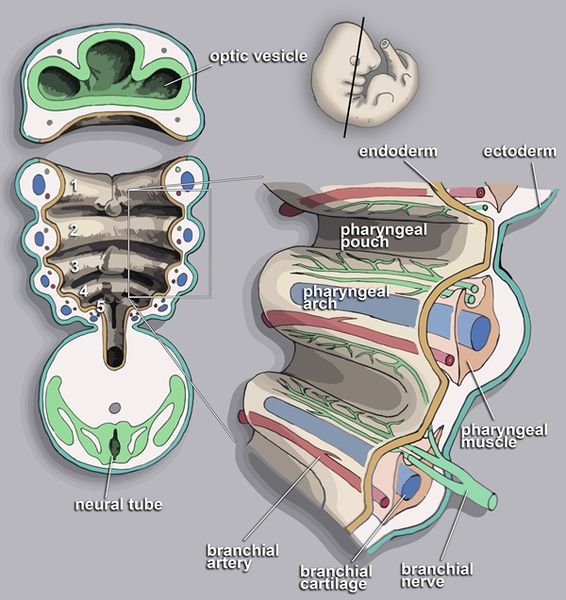
In the fetal development of vertebrate animals 5-6 pharyngeal arches develop during the fourth and fifth week in utero on the left and right sides of the developing pharynx. In fish the branchial arches give rise to gills and the “head gut” for filtering and predigestion of nutrients from the water.
Each pharyngeal arch has a mesodermal core (from which structures out of cartilage and muscle develop), as well as a nerve from the ectodermal neural crest, and own blood transport. The human ossicles, jaws, palate, hyoid and temporal bone, facial muscles and larynx develop from these embrionic structures. The branchial arteries become the carotis, aortic arch, subclavicular and pulmonal arteries. Also endocrine glands in neck and breast area derive from the pharyngeal arches. The branchial nerves are the cranial nerves trigeminus, facialis, glossopharyngeus and parts of the vagus.
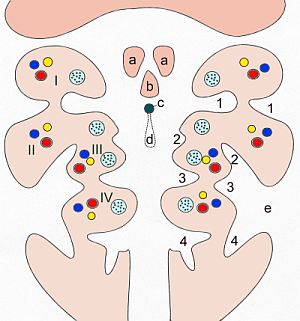
Pattern of the branchial arches. I-IV branchial arches, 1-4 Pharyngeal pouches (inside) and/or pharyngeal grooves (outside), a Tuberculum laterale, b Tuberculum impar, c Foramen cecum, d Ductus thyreoglossus, e Sinus cervicalis
Brain
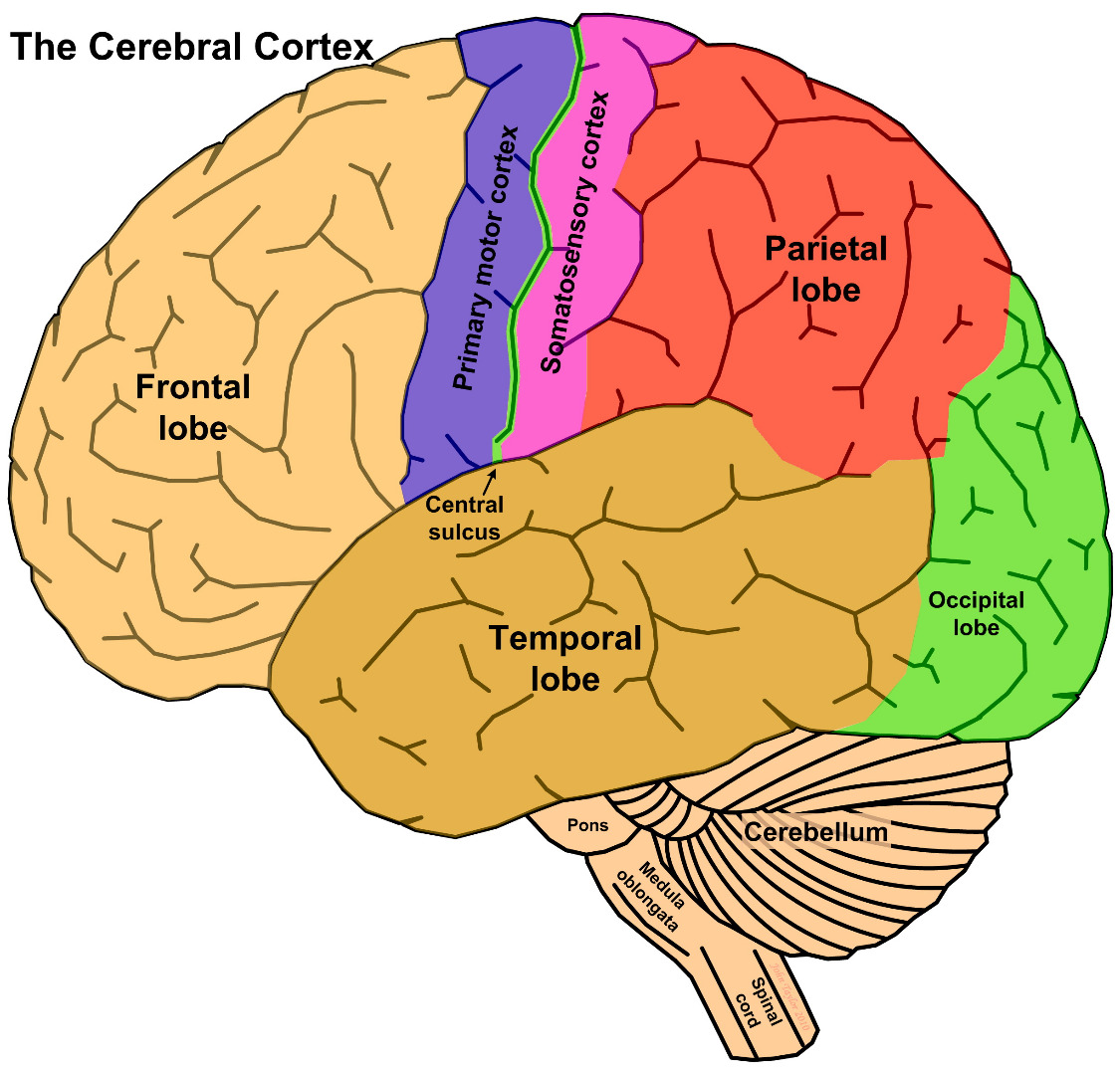
Relay:
Cerebral Cortex ( – / + ) prefrontal sensory area both sides
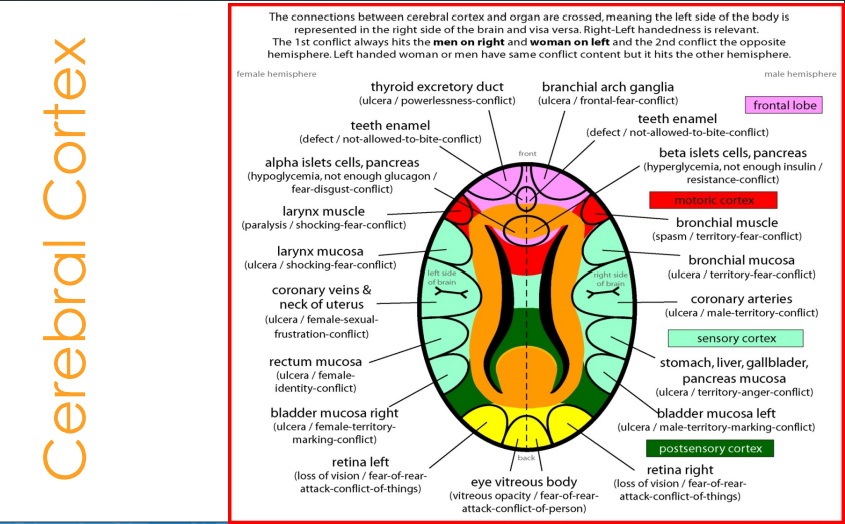
Mind
Theme
1. Frontal fear – Fear or shock from something or someone coming right at us without the possibility of protection.
2. Power- or helplessness
Emotions, Thoughts:
1. Fear, inescapability
- I can´t bypass it!
- I see it coming!
- No way out!
- Help!!
2. Frustration, dependence - My hands are tied!
- Won’t anybody do anything?
- If I only could do something!
- I’m just too little.
META-Meaning:
- Now, I can decide to release what happened, to let it fade out and to leave it behind.
- I claim and re-gain my power with every step I am taking towards life.
Organ
Sensitivity changes according to Inner-Skin/Stomach Mucosa pattern with hyperesthesia in stress phase
Stress Phase Symptoms:
Ulceration of the remnant cells of the pharyngeal arches. The patients possibly have a slightly dragging or stinging pain in the neck region. The person is in shock and is prone to go into an anxiety or paralytic constellation if the conflict /stress can´t be released timely.
Regeneration Phase A
Mucosal swelling in the remnants of the pharyngeal arches throughout the mediastinum. Cysts can develop which cover the mediastinum down to the diaphragm. If the area of cervical lymph nodes is affected, Pfeiffer’s disease (Mononucleosis infectiosa) or Non-Hodgkin lymphoma can be diagnosed (with unchanged lymphocyte count). In the lung region a small cell bronchial/lung cancer (from neuroendocrine cells) may be found. The regeneration phase is not painful (Inner Skin pattern), but swelling can cause compression in other structures which can cause pain.
Healing Peak:
In the healing peak, a stinging or dragging pain occurs in the neck or in the breast region. A feeling of pressure or spasm can occur depending on whether muscle tissue is involved. Unconsciousness and drop of blood sugar because of intense brain activity.
Regeneration Phase B
After the healing peak, the cysts recede.
After recurrent processes, or as warning signal, coughing is common.
Biological Meaning:
Primeval meaning of relieving uptake and filtration by widening the gill structure in stress phase.
Social
Examples:
1. Frontal fear
So called ramp fever, exam nerves, existential angst by own imagination, and diagnosis shocks are typical frontal fear conflicts. - A man gets the information that he is HIV positive and develops a Non-Hodgkin Lymphoma in the left neck.
- A young boy gets scared on the way to home from school. Screaming in fright, he runs against a housewall.
- A woman has an accident on the motorway. She sees the car moving from the side lane to the middle of the road and knows that she can’t brake or bypass as he is being overtaken herself.
2. Helplessness: - The 45-year-old daughter wants to help her mother with getting a chance to try some alternative medical treatments. However, the mother agrees to have a surgery, contrary to the will of her daughter. The daughter feels herself powerless to help her mother and she is worried that everything will go wrong and she will lose her mother.
- The client was not notified by her family when her mother died after an accident. She still feels indignation and powerlessness.
- A girl witnesses how her mother is violated.
- The client administrates groups in social media. Reading the articles about politics, environment etc confirms her powerlessness. She suffers with chronic deep cough (Klapp)
Additional Information
When tissue of the pharyngeal arches remains, a lateral cervical cyst develops besides the SCM muscle with soft and relocatable swelling. These cysts manifest usually between 15 to 35 years of age. Whether a lateral cervical cyst is connected to inherited conflict patterns needs to be researched.
Constellations:
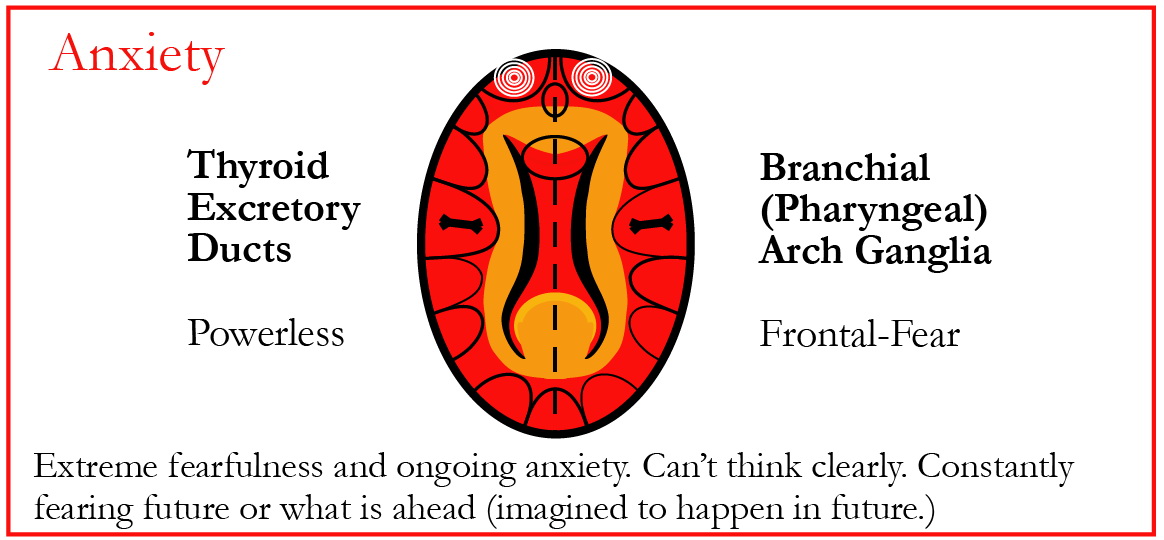
Anxiety: Together with Thyroid ductal pattern. Powerlessness together with frontal fear puts a person in constant anxiety, retreating to a safe place and unable to expose themselves to the social and outer world. No hormonal suppression in this constellation because the relays don´t belong to the territorial/sexual area.
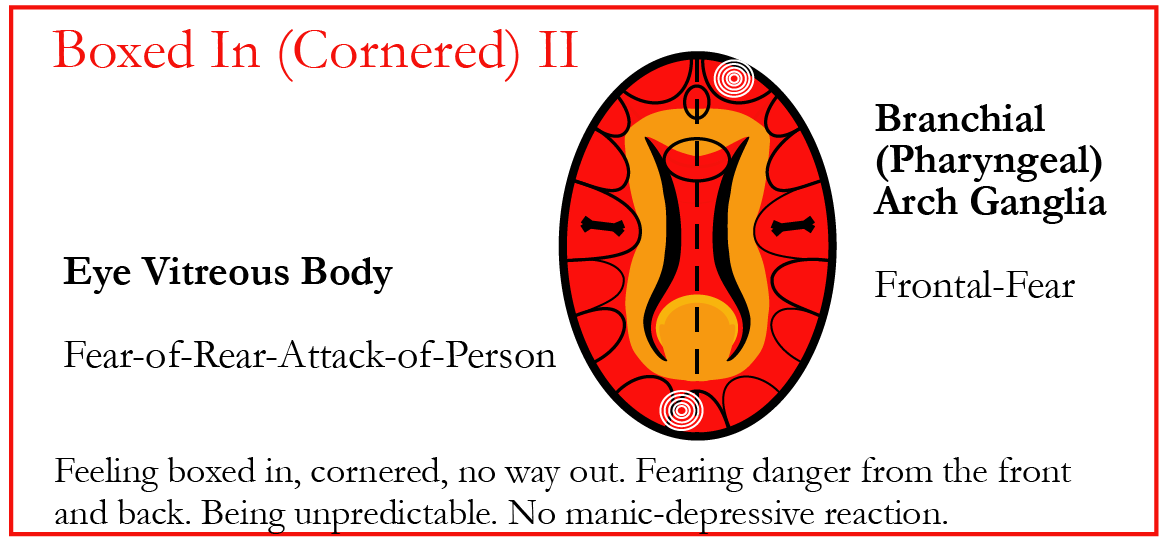
Unpredictable: Together with Retina or vitreous body relay. Powerlessness or frontal fear together with “fear of attack from behind” results in that the person fears attack from all sides, which leads to paranoia and (mental) paralysis, as a freeze reaction, or to unpredictable bursts of action.
No hormonal suppression in this constellation because the relays don´t belong to the territorial/sexual area.
These constellations dissolve as soon as one of the conflicts is resolved!
Differential Diagnosis:
Lymph Nodes swell in any wound healing or tissue degradation of another tissue in the same region.
Lymph Nodes and Vessels of the Neck and Mediastinum (Cerebral Medulla, -/+) stress phase (self-doubt): immune deficiency; regeneration phase: swelling of the lymph nodes by mitosis and possibly (Hodgkin) lymphoma
Lung Alveoli(Brain Stem, +/-) stress phase (death fright): lung cancer; regeneration phase: pneumonia or tuberculosis with night sweat, cough with coagulated blood and broken down tissue.
Bronchial Mucosa(Cerebral Cortex, -/+) with painful bronchitis (non-purulent) or bronchial carcinoma in the regeneration phase (after competition fear or social fear)
Larynx Mucosa(Cerebral Cortex, -/+) Regeneration phase (after fright or speechlessness): Hypersensitivity and dry cough from the voice box area, often depressive states
Bronchial Goblet Cells (Brain Stem, +/-) with tumor (adenoma) in the stress phase (suffocation fear), bloody cough in regeneration phase and lung fibrosis after recurring conflicts. Genetic: cystic fibrosis/mucoviscidosis.