
Thyroid Gland – Follicular Epithelium
Anatomy
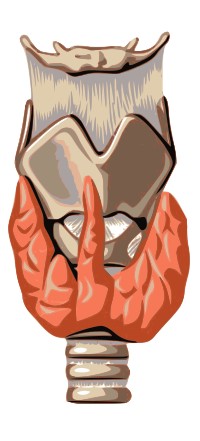
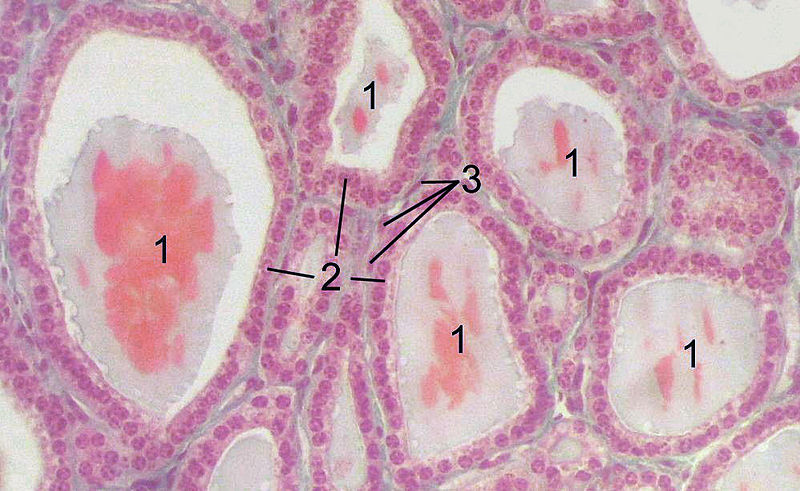
The thyroid gland belongs to the endocrine system regulating organ functions in the body. The thyroid epithelial cells consist of cuboidal epithelium and are arranged in spherical follicles surrounding colloid. They take up iodine and amino acids from the blood circulation, synthesize thyroglobulin and thyroperoxidase from amino acids and secrete these into the thyroid follicles together with iodine. The thyroid epithelial cells can subsequently take up iodinated thyroglobulin from the follicles, extract thyroid hormones (T3 & T4) from it with the help of proteases and subsequently release thyroid hormones to the blood. They have thyrotropin receptors on their surface, which respond to thyroid-stimulating hormone.
Thyroid hormones speed up the heart frequency, increase blood pressure, dilate blood vessels in the extremities, as well as increasing energy supply and metabolism, so that body temperature rises. Nerves are excitable and highly reactive.
Thyrocytes are stimulated by TSH from the pituitary. The epithelial cells are higher and the follicles smaller in shape when activated, while much colloid and flat epithelial cells represent an inactive state.
Brain
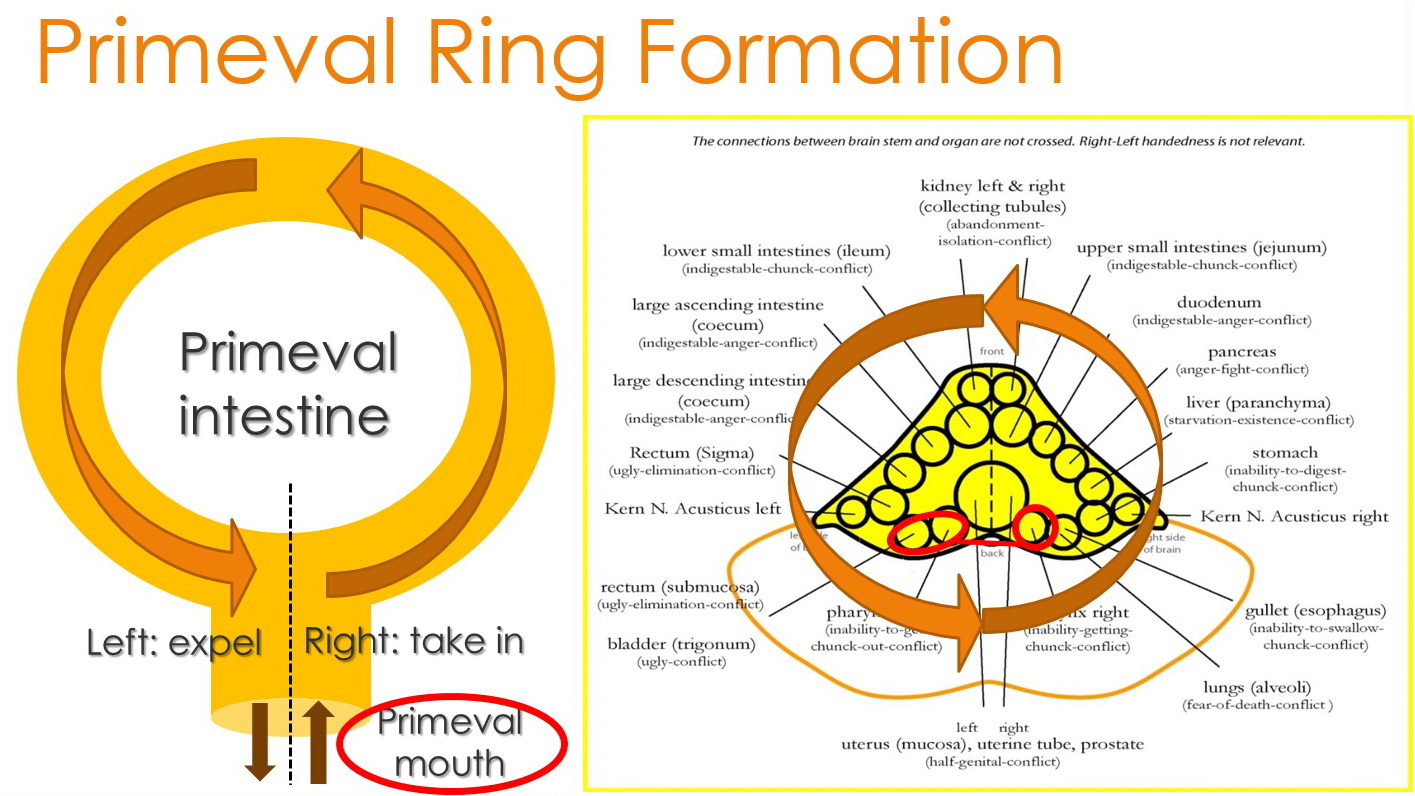
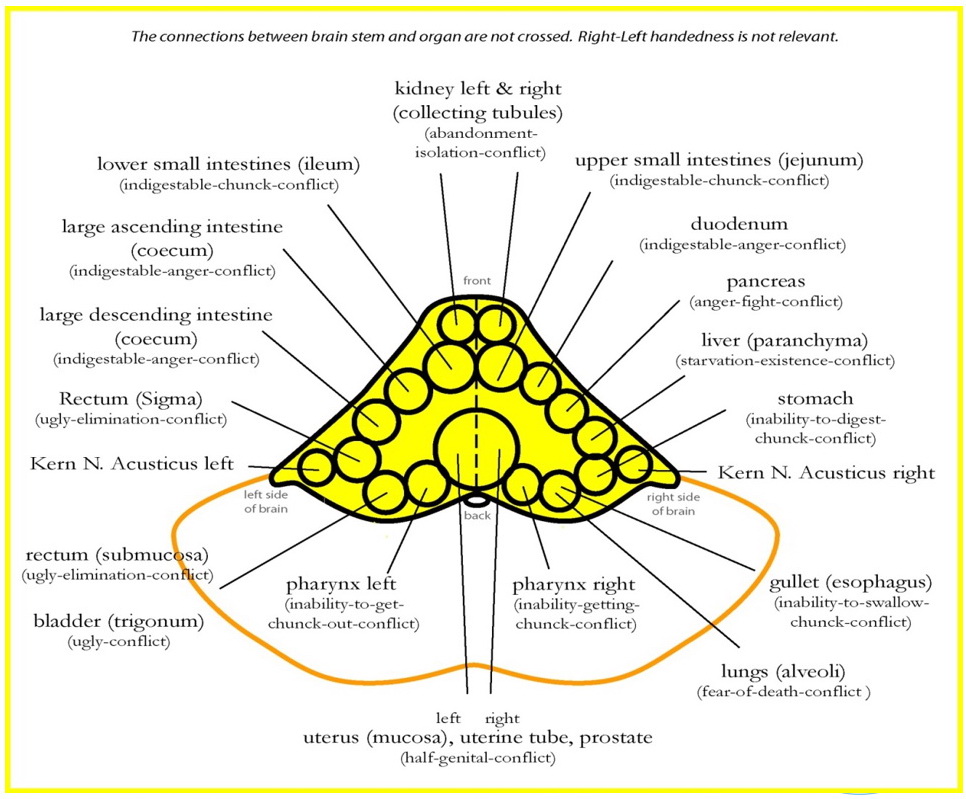
In the Brain Stem, the primeval ring structure is reflected: organ tissue relays with assimilative and digestive functions from oesophagus to small intestines are situated in the right brain stem, while excretory organs from caecum to rectum are relayed in the left brain stem. Medial on both sides are the relays of mouth/pharynx, middle ears and lacrimal glands, as well as the pineal and pituitary glands and the thyroid.
Relay:
Brain Stem ( + / – ) posterior medial left & right
Mind
Theme:
Inability to reach or rid oneself of a chunk/aim
Right lobe of the thyroid gland: Not being able to reach or catch a chunk, because of being too slow;
Left lobe of the thyroid gland: Not being able to get rid of (to carry further) a chunk, because of not being fast enough.
Emotions and Thoughts:
Feeling can refer to food, money or other existential values. Typical emotions include impatience about getting what one wants, and regret about not being fast enough.
- If only I had been faster, I would have succeeded.
- My pace doesn´t fill the needs.
- I can’t keep up!
- I’m not effective enough!
This can trigger a conflict of helplessness (see thyroid "ductal pattern").
META-Meaning:
- My timing and rhythm is perfect for me and my world.
- New occasions open up every day.
Organ
Stress Phase Symptoms:
Functional increase by hyperplasia of the affected cells, which is felt by tachycardia, nervousness, hyperreflexia, tremor, sweating and weight loss. Tumor can cause difficulty swallowing.
Possible diagnoses: hyperthyreosis, thyroid enlargement, goiter, autonomous adenoma, toxic adenoma, thyroid carcinoma, thyrotoxicosis, hot nodules
Extended stress phases and unfavourable environmental factors, as well as chronic repetitions of the process, can lead to depletion of the gland and to underfunction.
Regeneration Phase Symptoms:
Normalization of hormone production after temporary underfunctioning; often purulent inflammatory degradation of the cell growth, accompanied by night sweat and hyperactive lymphatic system. Alternatively, encapsulation of the nodule, resulting in “cold nodules” as non-active remnants of the process.
Lasting underfunction (hypothyreosis) may occur through recurrent stress patterns with degradation of functional tissue. Symptoms are weight gain without appetite, constipation, fatigue, bradycardia, freezing, avolition, memory disorders, and depressive states. In children, it leads to impaired growth and development.
Possible diagnoses: - Purulent thyroiditis
- subacute thyroiditis de Quervain (giant cells through water retention/active KCT
- Hashimoto-thyroiditis (developing goiter/struma) in chronic reactivation or long lasting stress phases. First hyper-, later hypothyroidism. Enlarged thyroid gland is due to the increased secretion of TSH
- Ord-thyroiditis (shrunken, fibrotized thyroid) after scarring processes from repeated regeneration phases.
- Graves´ disease (with bulging eyes/exophtalmus) is described as an autoimmune disease in which the TSH receptors are blocked by gamma globulins. This causes the thyrocytes to secrete hormones. This hints at heightened sensitivity for stress triggers of the thyroid after conflict cycles.
Biological Meaning:
The functional increase of thyrocytes improves the person’s agility and quickness to reach the chunk/value (right thyroid), or to pass it on/avoid it (left thyroid).
Social
Examples:
- A woman participates in a coaching education and has the impression of not keeping the pace and to never be good enough to take the roll of practitioner. This marks the turning point from stress activity to hopelessness, and she develops hypothyroidism. In her emotional background are also situations of helplessness. (Wiggins-Hay, MHU archive)
- A young woman can’t complete her university education when her father dies. Also money is an issue, and she has to marry instead. Her hopelessness is reflected in hypothyroidism with weight gain and fatigue. (Maggi, MHU archive)
- A student is a thorough and slow worker and feels that he can´t hold the pace necessary to fulfill the expected requirements in field work. He develops Graves’ disease with hyperthyroidism and tremor. When he decides to leave and let go, the symptoms recede. (Klapp)
Additional Information
The thyroid is activated in every stress phase to enable the fight-or-flight response. However this can be inhibited by the freeze response of the UDIN moment.
Altered levels of thyroid hormones can be perceived in combination with other organ processes e g leading to hair loss, myasthenia or changes in the menstrual cycle.
Both hypertrophy (in stress phase) and swelling (in regeneration phase) of the thyroid gland can cause difficulty swallowing and speaking.
Constellations:
Brain Stem Constellation possible: perplexity, lethargy, passiveness, reduced movement. Purpose: new orientation
Differential Diagnosis:
Parathyroid Glands (Brain Stem +/-) Stress (conflict of muscle function): hypercalcaemia (elevated calcium level in the blood) for contractility, if simultaneously self-worth issue: bone decalcification; adenoma growth possible. Chronic: artherosclerosis
Thyroid Gland "Ductal pattern” (Cerebral Cortex -/+) Stress (helplessness/frontal fear): Elevation of hormone release by augmented transport (not secretion), dragging pain (Inner Skins sensitivity pattern); euthyroid goiter; Regeneration phase: cold nodules, hypothyreosis.
Pituitary anterior lobe TSH production (BS +/-) Stress: secondary hyperthyreosis
Larynx Mucosa (Cerebral Cortex -/+) regeneration phase (after speechlesness or territorial fear): swelling, hyperaesthesia, coughing
Pharyngeal tonsils (BS +/-, CM -/+) Stress (assimilation and self-definition): swelling and difficulty swallowing.
Adrenal Cortex ( CM -/+) Stress (orientation, intuition): stressed fatigue, energylessness.
Other causes of hypothyreosis are surgery, radiation, intoxication and energy deficiency
