
Spleen
Anatomy:
The spleen is located in the left upper quadrant of the abdomen. Similar in structure to a large lymph node, it acts primarily as a blood filter. The spleen plays important roles in regard to red blood cells and the immune system. It removes old red blood cells and holds a reserve of blood, which can be valuable in case of hemorrhagic shock, and also recycles iron. As a part of the mononuclear phagocyte system, it metabolizes hemoglobin removed from senescent erythrocytes.
The spleen synthesizes antibodies in its white pulp and removes antibody-coated bacteria and antibody-coated blood cells by way of blood and lymph node circulation. A study published in 2009 using mice found that the spleen contains, in its reserve, half of the body’s monocytes within the red pulp.These monocytes, upon moving to injured tissue (such as the heart), turn into dendritic cells and macrophages while promoting tissue healing. (source: wikipedia)
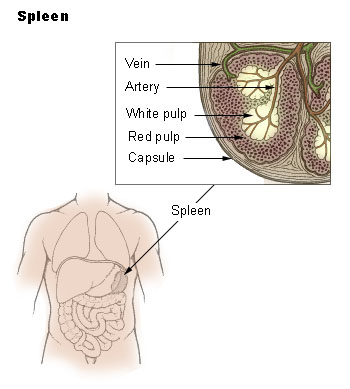
The spleen contains two different tissues, white pulp (A) and red pulp (B). The white pulp functions in producing and growing immune and blood cells. The red pulp functions in filtering blood of antigens, microorganisms, and defective or worn-out red blood cells.
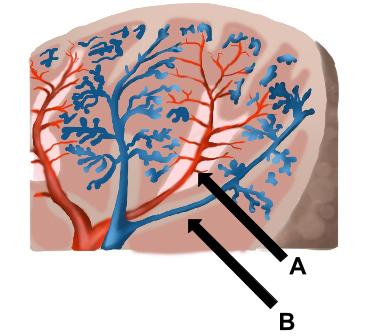
graphics: wikipedia
Brain
Relay
Cerebral Medulla ( – / + ) right hemisphere in lumbar area
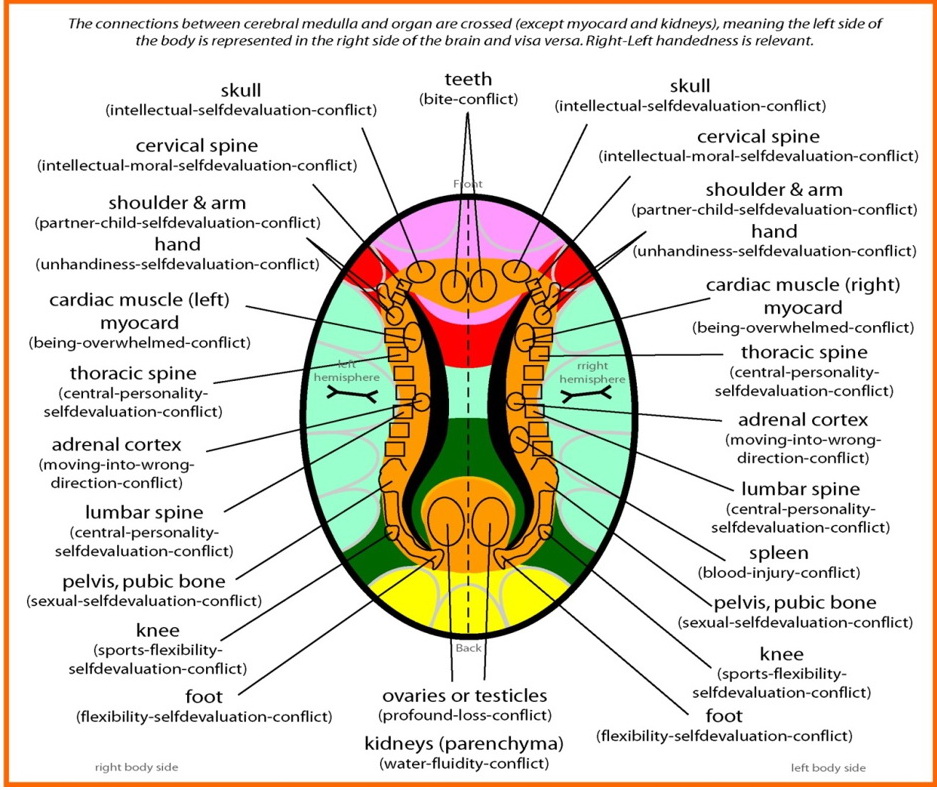
Mind:
Theme
- Conflict regarding blood
- Self devaluation concerning healing and integrity
- Own identity
- Lack of unconditional love
Emotions and Thoughts
Anxiety, panic, self-abandonment
- I´m bleeding to death!
- I can´t see all that blood (accident, surgery).
- I´m too weak for to heal that.
- This wound is too big!
META-Meaning
- My healing capacity is infinite.
- I trust in the universe (God, angels…) watching over us.
- Everything happens for a reason.
Organ:
Stress Phase Symptoms
A) Big wound: thrombocytes & monocytes from the spleen and the peripheral blood-stream travel to the location of the perceived injury for wound-healing,thereby thrombocytopenia, dizziness & nausea.
B ) Spleen/Blood UDIN: necroses in the spleen (cavities) and gathering of thrombocytes in the spleen, thereby increased tendency to bleed (nosebleeds). At the same time, a thromboembolism in the blood vessels through activation of fibrin and other coagulation factors, is avoided.
Production and maturation of immune bodies such as monocytes is reduced (immune deficiency).
Hemophilia refers to a “hanging stress phase” or a passed-on UDIN concerning blood.
Regeneration Phase A
Inflammation (splenitis) and swelling or the enlargement of the spleen (primary hypersplenism, splenomegalia). Other possible diagnoses are spleen cysts and spleen tumors.
Healing Peak
Short-termed fluctuations in the platelet count.
Spleen infarction is possible.
Regeneration Phase B
Proliferation of blood- and immune cells, possibly diagnosed as lymphoid leukemia /leukaemia. In most cases, the thrombocyte level returns to the normal range in peripheral blood.
After finished regeneration, the enlargement of the spleen (splenomegaly) can remain.
Biological Meaning
Stress phase: Improved migration of platelets to the spleen in order to avoid blood clot-formation
Regeneration phase: Enlargement of the spleen in order to become more powerful than before. An enlarged spleen can store up to 30% of the entire red blood cell population and the 90% of the entire platelet mass!
Social
Examples:
- Husband witnessed that his wife almost bled to death during pregnancy. After that he felt sick and almost fainted.
- A nurse trainee was assisting by a hip operation. She felt sick as she saw blood.
- Female patient was shocked by the diagnosis of leukemia. She had a highly elevated white blood cell count.
- A hemophilic has several ancestors who bleeded to death during wars.
Additional Information
A blood conflict is often following a traumatic diagnosis, dramatic symptoms including bleeding, and blood transfusions.
Other splenic diseases
- Ruptured spleen: in case of normal spleen, it’s often caused by some kind of trauma, but an acutely enlarged spleen may also cause rupture…
- Splenic infarction: common by acutely enlarged spleen (silent infarctions or severe pain in the left-upper abdomen, occasionally radiating to the left shoulder)
- Splenic abscess: usually develops in the context of bacteremia (endocarditis) or after a splenic infarction
- Splenic artery aneurysms: most frequent in older people
- Splenic cysts: after trauma or parasitic
- Splenic tumors (seldom): lymphangiomas, hemangiomas, lymphangiosarcomas, hemangiosarcomas and from a conventional medicine perspective, metastases of lymphomas and malign melanomas.
- Mononucleosis
Differential Diagnosis
Bone marrow (Cerebral medulla, -/+), with leukemia or pseudo-anemia in regeneration phase (after self-devaluation).
Blood vessels (Cerebral medulla, -/+), with bleeding and hematomas by weak vessel walls in stress phase (self-doubt).
Immune deficiency can be caused by functional loss or overexertion in any lymphoid tissue, as well as by medication, malnutrition, and radiation.
Bleeding tendency can also be caused by medication, vitamin-K-deficiency, alcoholism, chemo- and radiotherapy.
