
Breast – Mammary Glands
Anatomy
Mammary glands produce milk for the sustenance of the young. The basic components are the alveoli (hollow cavities a few millimeters large) lined with milk-secreting cuboidal cells and surrounded by myoepithelial cells. These alveoli join up to form groups known as lobules and each lobule has a lactiferous duct that drains into openings in the nipple. The myoepithelial cells can contract similar to muscle cells and thereby push the milk from the alveoli through the lactiferous ducts toward the nipple where it collects in widening’s (sinuses) of the ducts. As the baby begins to suckle, the hormonally mediated let down reflex ensues and the mother’s milk is secreted into – not sucked from the gland by – the baby’s mouth. Secretion is stimulated by prolactin, the milk ducts’ action by oxytocin from the pituitary.
The mammary glands are specialized glands that embryologically derived from sweat glands of the skin (source).
Brain:
Relay:
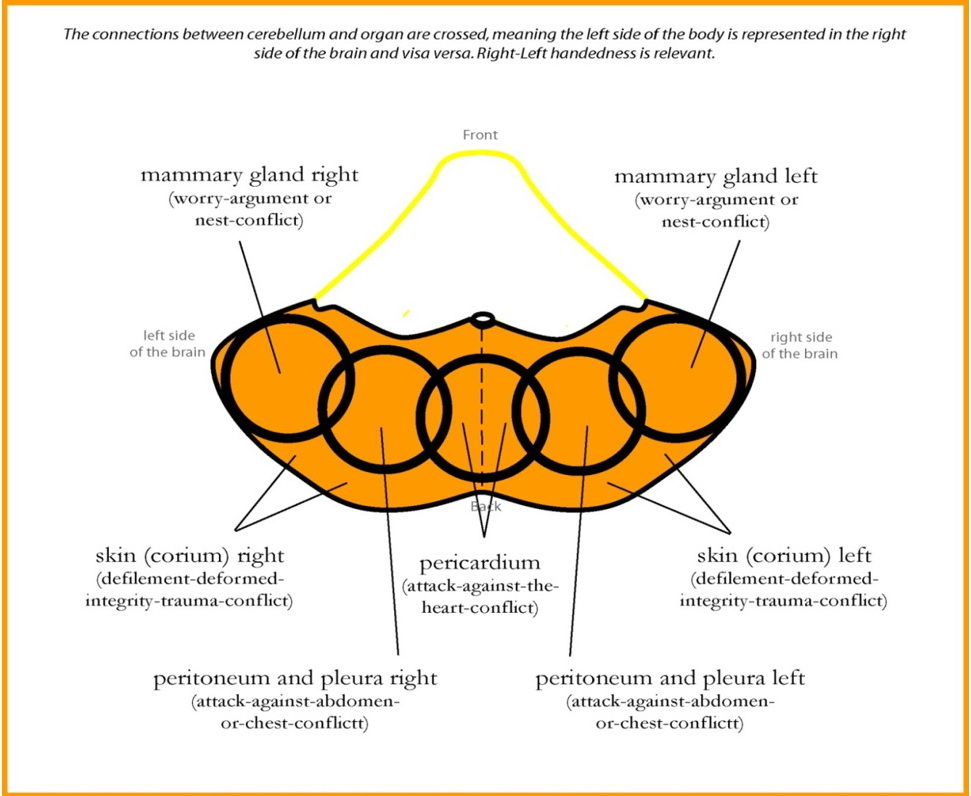
Cerebellum ( + / – ) both lateral zones
Mind:
Theme:
Worry or fight for the offspring (non-dominant side) or partner (dominant side)
Emotions, Thoughts:
Unrest, worry, anger
- I worry to death!
- I need to defend my home!
- I must save my children!
- Where is my child?
- Where is my partner?
- They could have died!
- I know best what is right for them!
META-Meaning:
- I am a good mother. I am provided and can provide my family with everything needed.
- Now, I let love be our protection.
- Don’t worry, be happy!
Organ
Stress Phase Symptoms:
Enhanced secretion and slow proliferation of mammary glands cells – compact nodes with or without lactation.
Possible diagnoses: benign fibro-adenoma, lobular neoplasia, lobular carcinoma in situ (LCIS), lobular breast cancer, mamma-carcinoma, adeno-carcinoma.
Regeneration Phase A:
Decrease of milk production and degradation of the tumor. Inflammatory breakdown with bacteria or mycobacteria, mild fever and nightly sweating. Degraded material is led away and recycled by lymph vessels, activity leading to swellings in axillary and terminal lymph nodes.
By adversary circumstances, possibly also puncturing, the breast can exulcerate and open up the smelly degeneration processes. Autolysis (tumor dissolves without inflammation) is also possible
Possible diagnoses: mastitis, ulcerating mamma-carcinoma, mamma-tuberculosis
Regeneration Phase B:
Regeneration with scar-building, or encapsulation of the tumor. Dragging pain occurs by cicatricial shrinkage of tissues. Caverns remain as a remnant, which can fill up with liquid and would then be diagnosed as cysts.
Calcification can occur, facilitated by acid secretion which contributes to the formation of calcium salts by inflammatory response.
Chronic processes, as well as epigenetic/genetic inheritance, can lead to an underfunction in milk secretion.
Biological Meaning:
In the stress phase, concerned mothers can provide more milk for their infants, which is needed for their survival or recovery.
Social
Examples:
- A woman´s son has left home to go on a vacation alone and has a dramatic accident. The mother develops breast cancer.
- The client’s working place, a hospital, shuts down, and she worries about her and her family’s financial security. Lobular cancer is diagnosed. After resolving the financial situation, and mindfulness exercises for herself, the tumor shrinks. (Lippert, MHU archive)
- A young woman has painful lumpy glands soon after giving birth. She is worrying about her children “I can’t be sick now”. After EFT treatment of her fears, Cool cabbage leaves / cool cloths to breast, and homeopathic Phytolacca, the symptoms are gone in two days. (Hansen, MHU archive)
Additional Information
Lactation is induced and steered by prolactin and oxytocin hormones from the pituitary gland.
By now, many scientists agree that smaller tumor processes in the breast are a usual phenomenon that does not necessarily call for conventional cancer therapy. Even double amputations are not meaningful: http://www.news-medical.net/news/20140522/Double-mastectomies-are-unnecessary-in-women-with-breast-cancer-says-study.aspx
Possible Constellations:
Altruism: Mammary Glands active in both breasts: selfless behaviour. Giving ourselves up for the good of the family, flock, society or nation.
Cerebellum Constellation: reduced sensitivity (physical and emotional), “emotional burnout”
Differential Diagnosis:
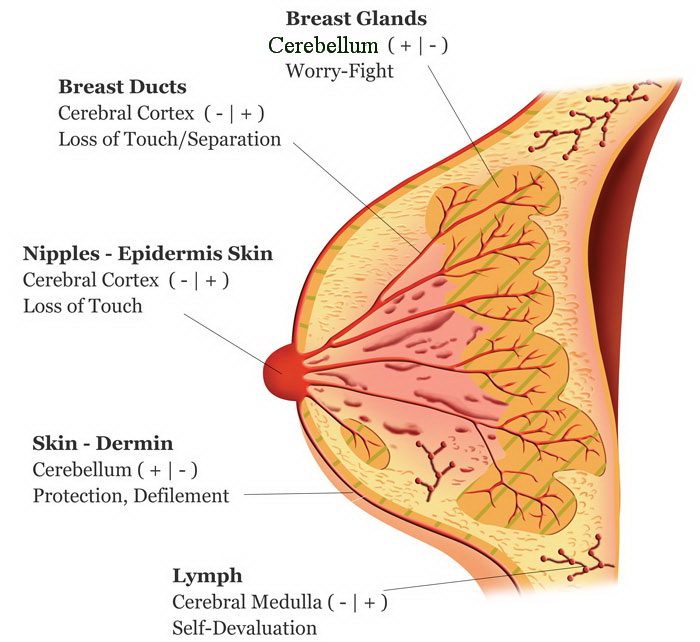
Breast – Milk Ducts (Cerebral Cortex, -/+) with enhanced lactation in stress phase of contact loss, mastitis and possibly ductal tumor in regeneration phase, and possibly residual calcifications.
Lymphatic drainage of the breast (Cerebral Medulla, -/+) with swelling and inflammation of lymph vessels and axillary lymph nodes. This tissue reacts physiologically in inflammatory or degrading processes of any tissue in the breast, but overexertion can even lead to a conflict theme of self-devaluation.
Adipose or Connective Tissue in the breast (Cerebral Medulla, -/+) with mastopathy in regeneration phase and possibly lipoma after finished process.
Dermis of breast & mamilla (Cerebellum +/-) Stress by vulnerability: inforcement of glandular activity and the protecting connective tissue and pigmentation, melanoma; Regeneration phase: purulent degradation, skin tuberculosis
Epidermis of breast & mamilla (Cerebral Cortex -/+) Stress by unwanted or loss of contact: hypesthesia; Regeneration phase: heat, superficial redness, itch = eczema
Pituitary anterior/prolactin (Brain Stem +/-) Stress by wish for child: Galactorroe, reduced libido, menstrual disturbances
Pituitary posterior/oxytocin (Cerebral Cortex -/+) Stress in bonding & reproduction: reduced production of oxytocin, anxiety, decreased lactation
