
Nasal and Sinus Submucosa / Endodermal origin
Anatomy
The nasal cavity, it’s vestibule and the air-filled sinuses are lined with a mucosa. This membrane consists of squamous epithelium which transitions into columnar respiratory epithelium, a ciliated (lash-like) tissue with abundant seromucinous glands, which maintains the nasal moisture and protects the respiratory tract from foreign objects.
The mucosa of the upper nasal cavity contains the smell receptors. With our nose we smell and sense people, our environment, moods or situations and get a ‘feel of what is in the air’. Smelling is one of the deepest biological and essential survival skill.
The nasal mucosa has two tissue layers: underneath and built into the ectodermal layer there is endodermal tissue with a relay in the brain stem which is described in this chapter.
Brain
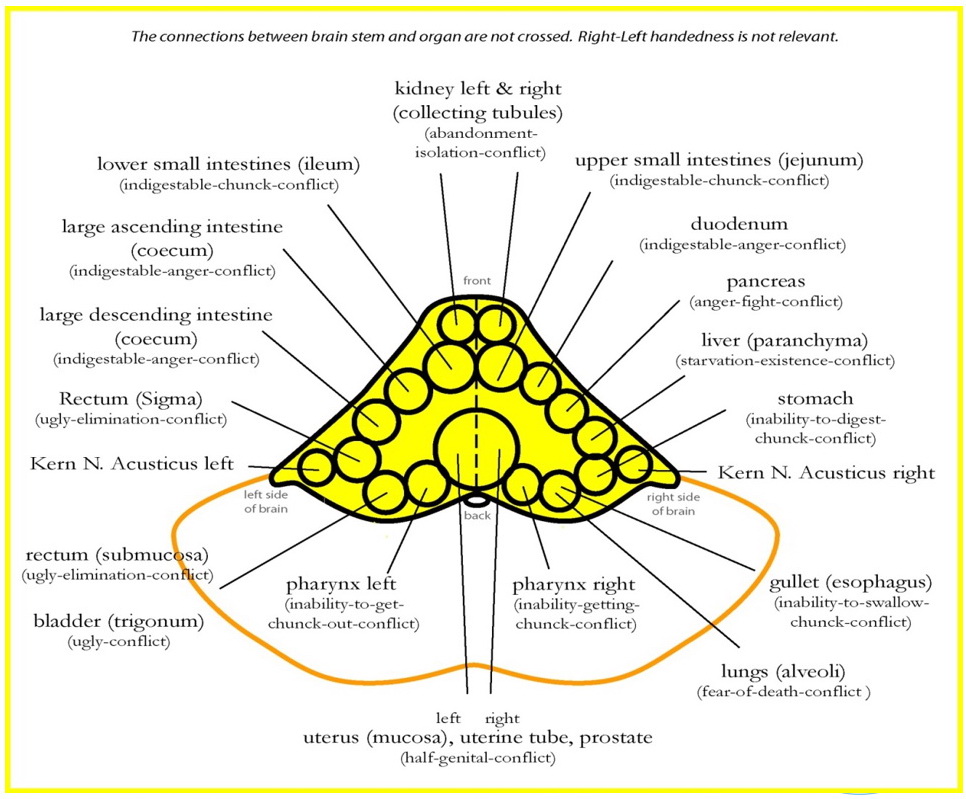
In the Brain Stem, the primeval ring structure is reflected: organ tissue relays with assimilative and digestive functions from oesophagus to small intestines are situated in the right brain stem, while excretory organs from caecum to rectum are relayed in the left brain stem. Medial on both sides are the relays of mouth/pharynx, middle ears and lacrimal glands, as well as the pineal and pituitary glands and the thyroid.
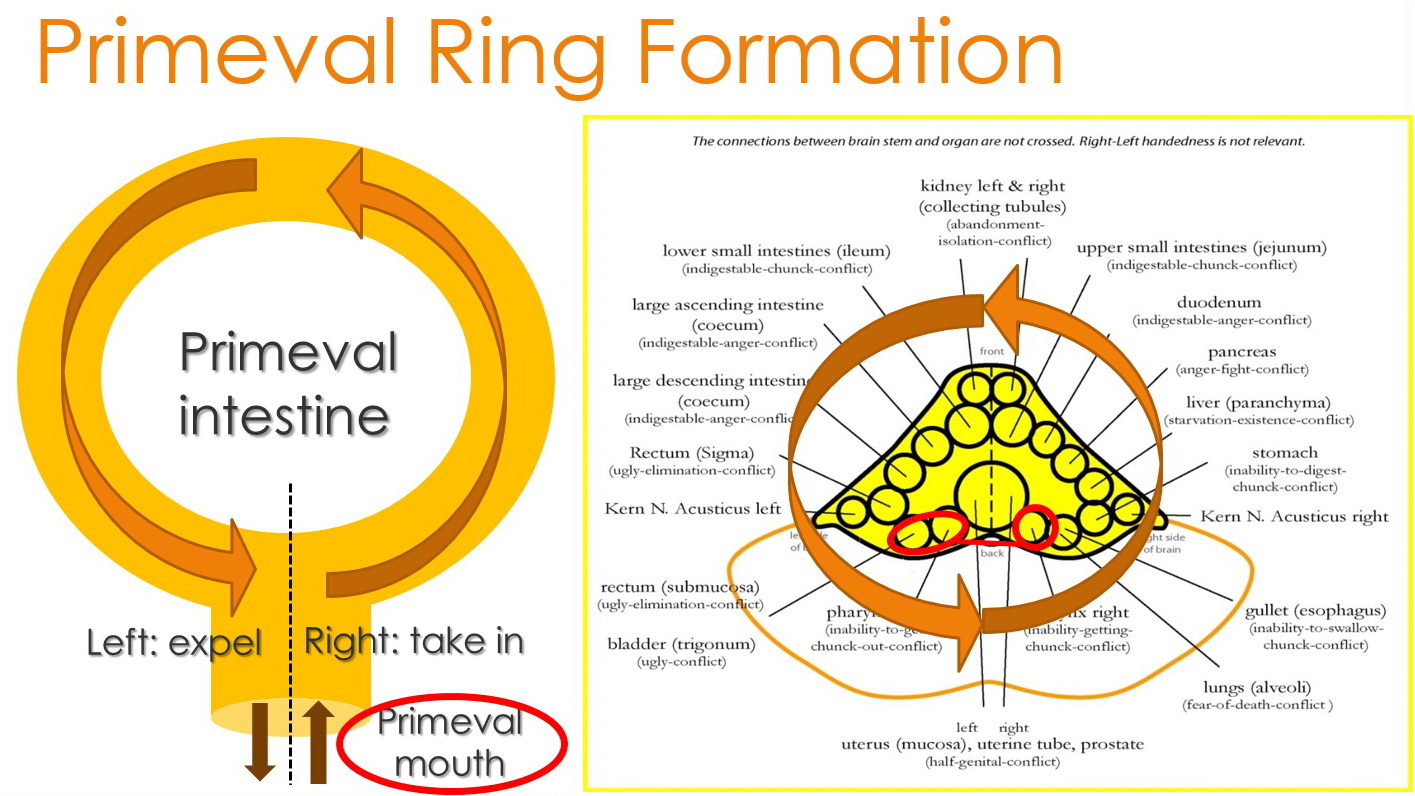
Relay
Brain Stem (+/-) posterior medial
Mind
Theme
Smelling, scent (survival, chunk), intuition, assimilation & lubrication
In Brain Stem relays, the side dominance is irrelevant: if the right body side is mainly affected, theme was assimilation; on the left body side theme is avoidance or rejection.
Emotions, Thoughts
Attention, Focus, Pressure
- I lost track!
- I need to find this out!
- I need more air!
- I couldn’t trust my instincts here.
- This is bad for me!
META-Meaning
- My nose provides me with all the air and information I need.
- When I don´t like what I smell, I now can change it or create a distance.
- Now I find it easy to distinguish what I really need from the rest.
Organ
Stress Phase Symptoms:
The olfactory sense for vital things (perceived as chunks, prey) is enhanced and the nose is cool and runny. Later in the process, there can be a cell proliferation diagnosed as nose polyps or adenoma with absorptive or secretory qualities. Then breathing through the nose is impaired.
Regeneration Phase Symptoms
Inflammation with pus as a sign of bacterial/mycobacterial presence in degradation of the tumor/polyps, which creates smelly discharge. Breathing can be impaired, in sinusitis also the hearing function.
Possible diagnoses: common cold, acute coryza, purulent rhinitis, Parasinus empyema
Healing Peak
Temporary hyperacuity like in stress phase, accompanied by chills.
Biological Meaning
By enhanced sensory acuity in stress phase, the chemical analysis of the smelled object is facilitated and by the enhanced secretory function, air is moistured and “smelling morsel” lubricated.
Social
Different kinds of conflicts can be experienced regarding this tissue:
- Searching-conflict:
- When one’s looking for someone/something but doesn’t find it.
- When we use our senses for to get a needed/desired thing.
- Small children often have a runny nose (chronic). Often they are searching for mum who had left them home. They try to catch her scent in the air in order to find her.
- Undercooling conflict/Common cold-conflict:
- All the creatures need warmth to survive. Severe hypothermia is a life-threatening condition. The cold air enters the nose during breathing, which may present a conflict trigger when cold air is believed to be a threat.
Examples
- All the creatures need warmth to survive. Severe hypothermia is a life-threatening condition. The cold air enters the nose during breathing, which may present a conflict trigger when cold air is believed to be a threat.
- A child of a big family has a “sixth sense” to find hidden sweets, but he shows chronic polyps.
- A business owner closes a deal which he had been tracing and tracking with his strong sense of “smell” for a longer time.
Additional Information
This tissue is derived from the embryological gut and related to the brain stem. It has functions of chemical analysis, absorption, secretion and excretion.
Constellations
Brain Stem Constellation possible: perplexity, lethargy, passiveness, reduced movement. Purpose: new orientation
Differential Diagnosis
Nasal Mucosa / ectodermal origin (CC -/+): reduced olfactory sense in stress phase (recognition, judgement), hypersensitivity with inflammation and sneezing in regeneration phase.
Olfactory Nerve (CC -/+ and BS +/-) changes in perception without reactions in the mucosa.
