
Eyes – Lacrimal Gland
Anatomy
The lacrimal glands are paired glands that secrete the aqueous layer of the tear film. They are situated in the upper outer portion of each orbit. The tear fluid contains salt, oil and proteins. It is lead via the excretory ducts into the lacrimal sac. It nourishes and cleans the cornea, being spread by the conjunctiva of the inner eyelid when blinking. The nasolacrimal canal leads into the nasal cavity.
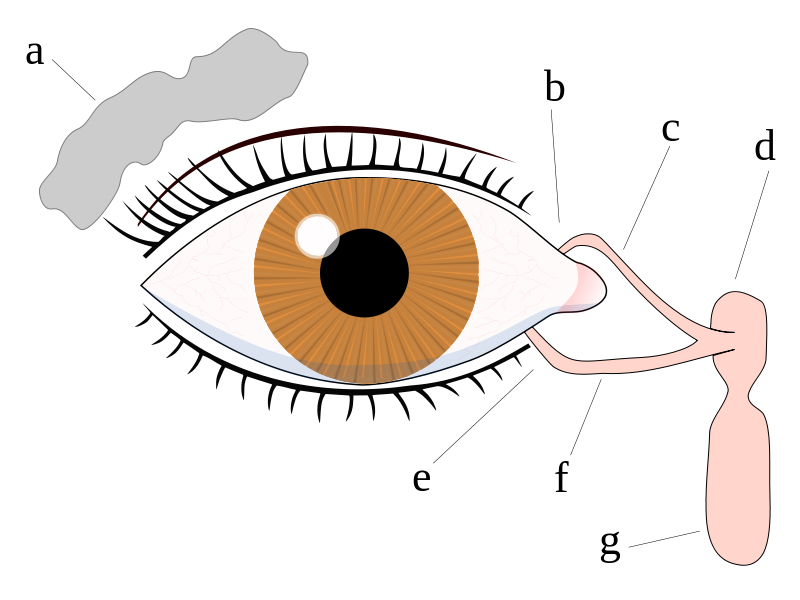
a = lacrimal gland, b = superior lacrimal punctum, c = superior lacrimal canal, d = lacrimal sac, e = inferior lacrimal punctum, f = inferior lacrimal canal, g = nasolacrimal canal
Brain
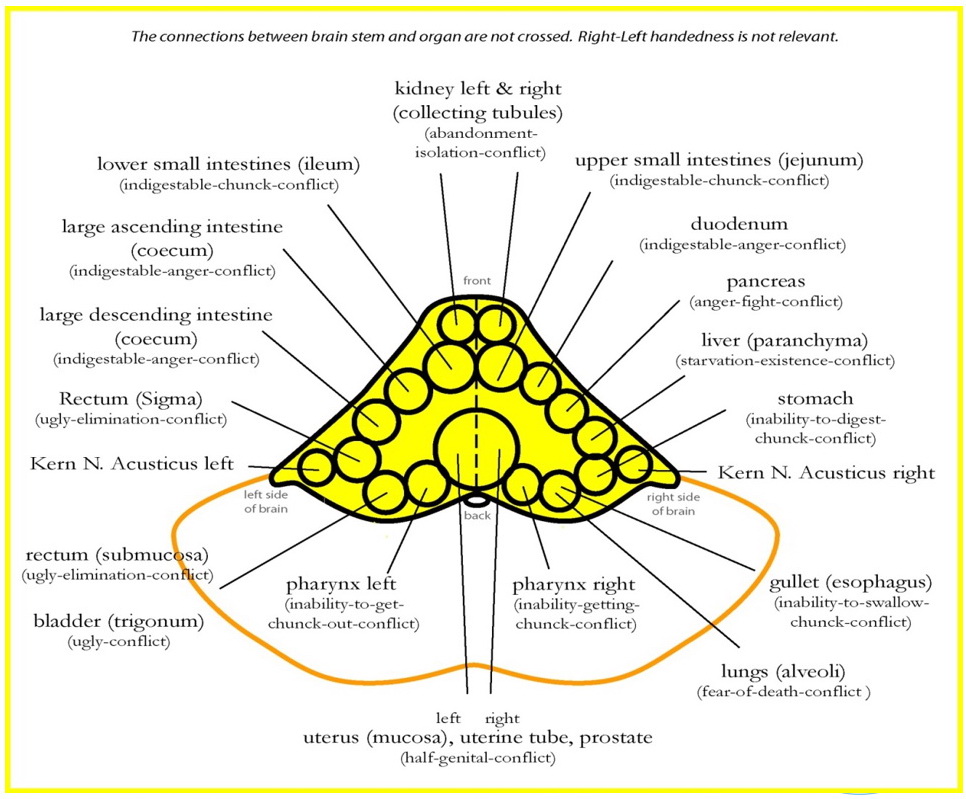
In the Brain Stem, the primeval ring structure is reflected: organ tissue relays with assimilative and digestive functions from oesophagus to small intestines are situated in the right brain stem, while excretory organs from caecum to rectum are relayed in the left brain stem. Medial on both sides are the relays of mouth/pharynx, middle ears and lacrimal glands, as well as the pineal and pituitary glands and the thyroid.
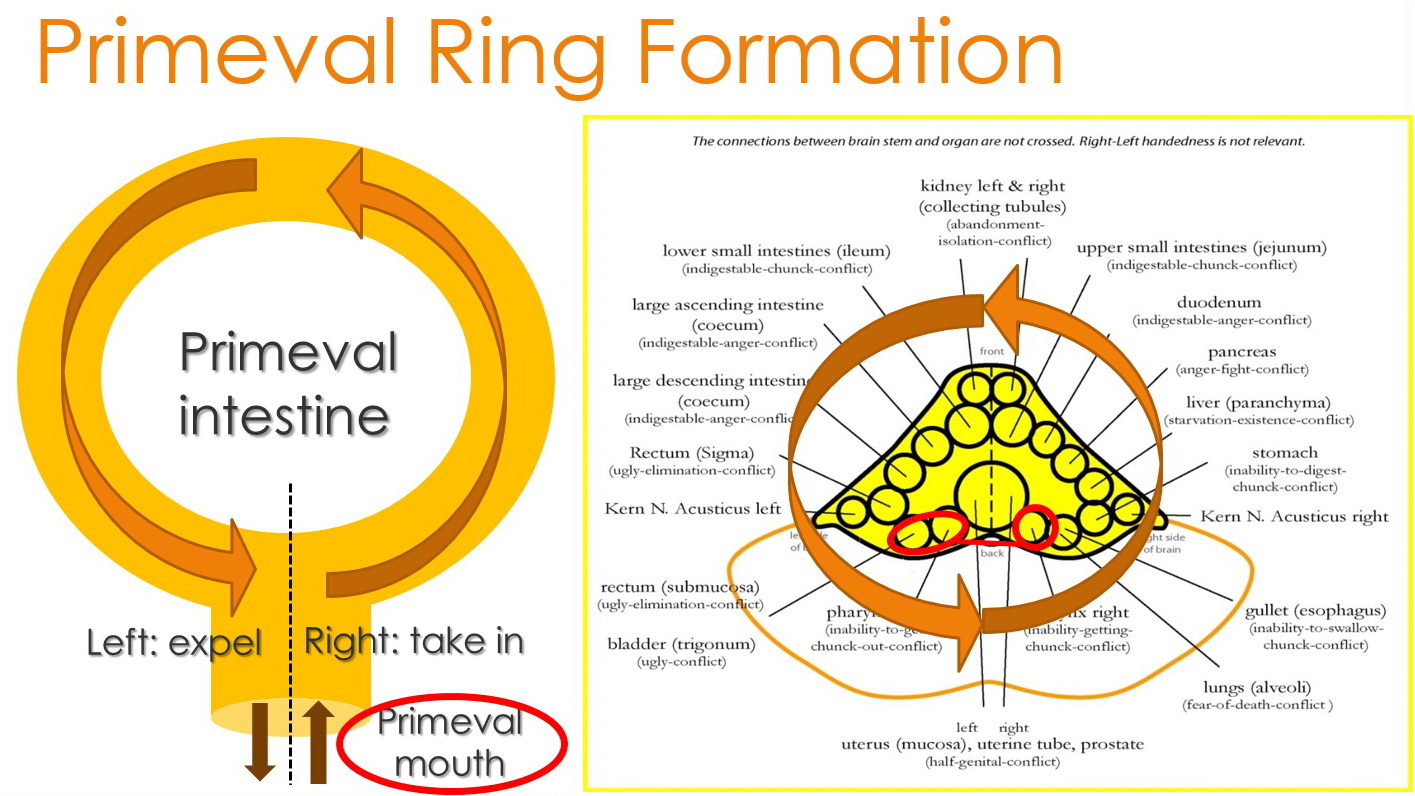
Relay:
Brain Stem ( + / – ) posterior medial
Mind
Theme:
1. Right: Need to acquire and assimilate a “Visual Chunk” or value
2. Left: Need to avoid or get rid of a “Visual Chunk”, poison or threat
Emotions, Thoughts:
1. Longing, need, greed
- I must have that!
- I need to see that sharply!
- I need to see that to believe it.
2. Disgust, protection - I mustn’t look at this!
- The sight is haunting me.
- It hurts my eye.
- I must wipe the sight off.
META-Meaning:
My eyes perceive everything that is of importance to me now, and release the rest.
Organ
Stress Phase Symptoms:
First there is a functional increase of the lacrimal glands, experienced as watery eyes (epiphora). Later possibly a development of pleomorph adenoma or adenoid cystic carcinoma of the lacrimal glands, which can be felt as swelling in the lid area and can create vision impairment through deformation of the eye.
Regeneration Phase Symptoms:
Function normalisation, but inflammation (dakryoadenitis, keratoconjunctivitis sicca) can lead to dry eyes.
Decomposition of the excessive tissue (lacrimal gland atrophy) often with fungi or mycobacteria – then we see purulent tears. Encapsulation of the tumor is also possible. After many relapses the lacrimal glands can dry out.
Biological Meaning:
The stress phase changes increase the production of lacrimal fluid to nourish and clean the eyes.
Social
Examples:
- An elderly man living alone doesn´t cope well and feels ashamed how he and his property looks. He wants to wash or blink the sight away.
- A child doesn´t like to sit in the classroom and spends time looking out and dreaming of what she would like to see instead. Her eyes get wet. She also has a strong urge to move, and is diagnosed with ADHD.
Additional Information
Constellations:
Brain Stem Constellation possible: perplexity, lethargy, passiveness, reduced movement. Purpose: new orientation
Differential Diagnosis:
Lacrimal ducts(Cerebral Cortex, -/+): first widening, later trophic decrease (but functional increase) in stress phase (lack of attention), inflammation and swelling (possibly dry eyes because of obstruction) in regeneration phase.
Conjunctiva (Cerebral Cortex -/+) Regeneration phase after loss of visual contact: itch and hyperesthesia, inflammation, weeping.
Other possible reasons for dry eyes include: - Staring, too little blinking (eye muscles, eyelid muscles) e g due to work behind a computer screen
- Blepharitis
- Dry air through air conditioning
- Low testosterone level (also due to medication)
- Eye surgery
