
Tympanic cavity & Eustachian Tube
Anatomy
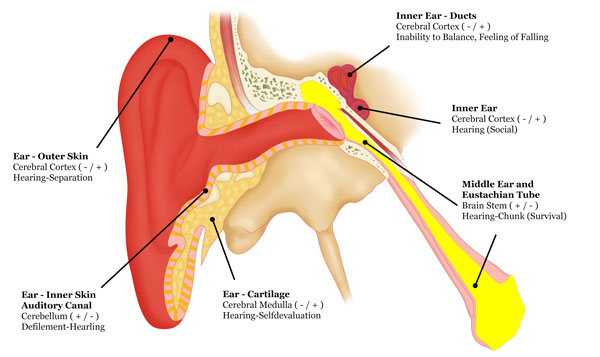
The middle ear is situated behind the eardrum and before the oval window of the cochlea. The tympanic cavity contains 3 ossicles that transform the vibrations of the eardrum into pressure waves and transfer them to the inner ear via liquid. The mastoid (processus mastoideus) at the temporal bone is filled with air. This air is transported through the middle ear.
The Eustachian tube (or auditory tube, pharyngotympanic tube) links the pharynx to the middle ear. Thereby it is drainage path for secrete and lymph from the middle ear. It also makes pressure equalization betwen the middle ear and the external pressure: by gulping, yawning or the Valsalva maneuvre.
Brain
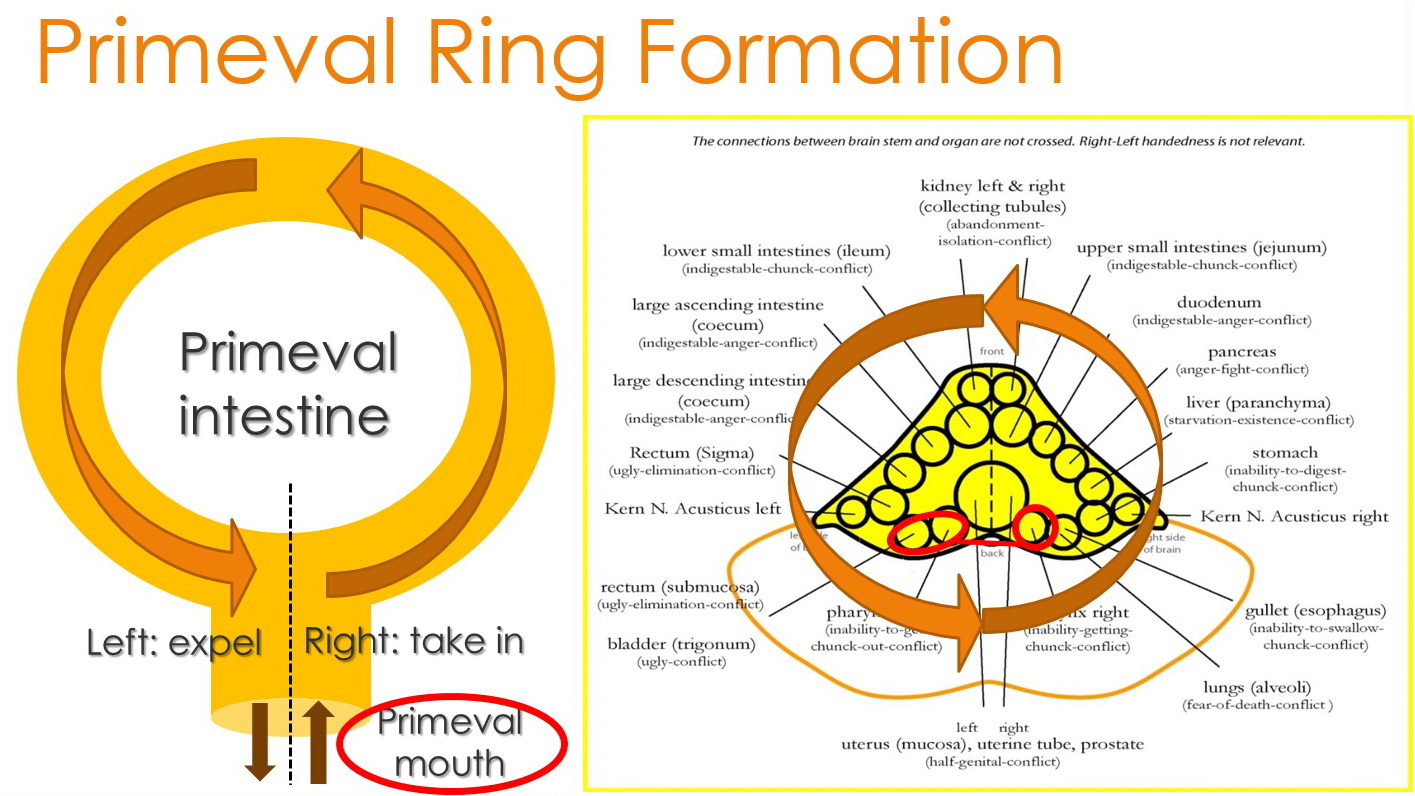
In the Brain Stem, the primeval ring structure is reflected: organ tissue relays with assimilative and digestive functions from oesophagus to small intestines are situated in the right brain stem, while excretory organs from caecum to rectum are relayed in the left brain stem. Medial on both sides are the relays of mouth/pharynx, middle ears and lacrimal glands, as well as the pineal and pituitary glands and the thyroid.
Relay:
Brain stem ( + / – )
1. lateral left & right (for inner lining of the middle ear)
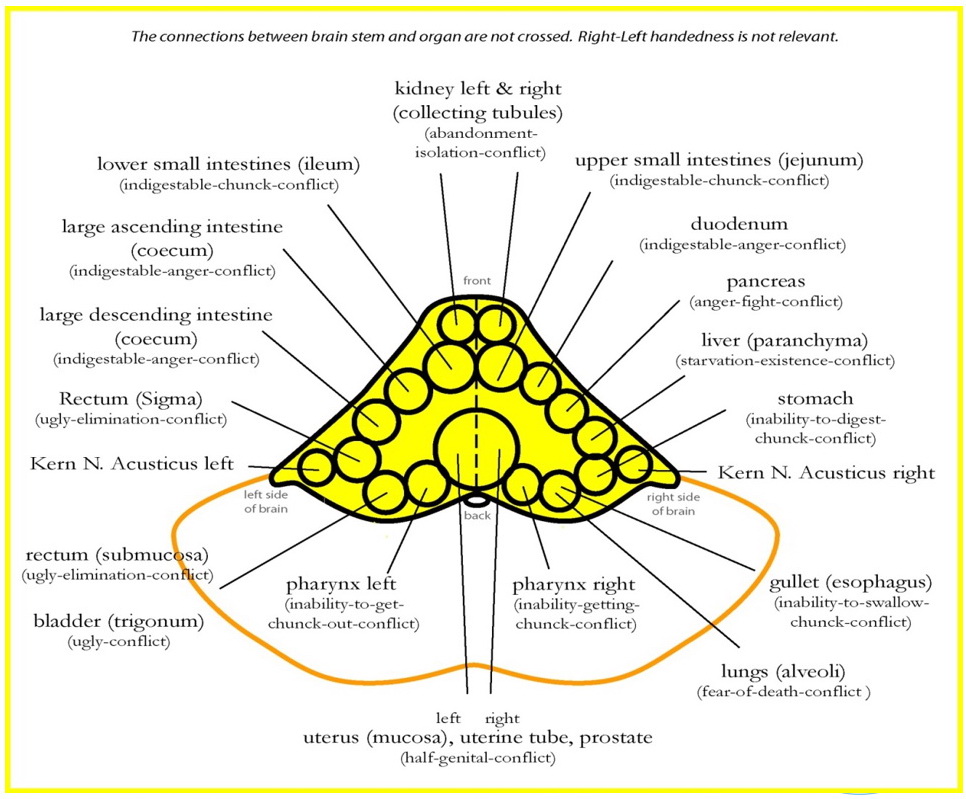
2. dorso-medial left & right (for inner lining of the Eustachian tube)
Mind
Theme:
“Auditory Chunk” or “prey-hearing”: the need to get or get rid of auditory information
The right ear reacts rather upon needing to catch the information, while the left ear attempts to avoid or get rid of information.
Emotions, Thoughts:
Attention, impatience
- I need to hear that!
- Be silent!
- I couldn’t accept or trust what I was hearing.
- I didn’t get that!
META-Meaning:
My ears catch all the information that I need, and release the others. I have all I need!
Organ
Stress Phase Symptoms:
The auditory function increases immediately (hyperacusis). Later, cell growth like ear polyp or adenoma (which has an absorptive or secretory function) which can cause an obstruction in the Eustachian tube and an indentation on the tympanic membrane. Due to insufficient ventilation it may result in hearing impairments.
Regeneration Phase Symptoms:
The surplus tissue is incapsulated or degraded in presence of mycobacteria or fungi. This purulent discharge can drain through the mouth (in case of an inflammation of the Eustachian tube) or the middle ear, with the diagnosis of otitis media (occasionally accompanied with the perforation of the tympanic membrane in order to drain the pus). Otitis media can cause hearing impairment or deafness.
Healing Peak
Chills and auditory hyperacuity during several hours
Biological Meaning:
The functional increase in stress phase makes the information easier to catch. The tissue reinforcement is meant to enhance the function if the conflict is not timely resolved. Unlike the “social-cortex” hearing of voices, this function is an improvement in the primeval perception of noises (e.g. being able to hear the approaching prey).
Social
Examples:
- A baby can´t hear her mother’s voice.
- A dog is trained to hear the car of his master. When the family makes a journey without the dog, another person is sitting him. On return, the dog gets an otitis media.
- An elderly lady has nobody to speak about the things she hears on TV.
- The Mamma-Rapport many women have causes hyperacusis for sounds of (survival-)stress from the baby.
Additional Information
The middle ear is hollow. If one moves to a high-altitude environment, or dives into the water, there will be a pressure difference between the middle ear and the outside environment. This pressure will pose a risk of bursting or otherwise damaging the tympanum if it is not relieved. If middle ear pressure remains low, the ear drum may become retracted into the middle ear. One of the functions of the Eustachian tubes that connect the middle ear to the nasopharynx is to help keep middle ear pressure the same as air pressure.
The Eustachian tubes are normally pinched off at the nose end, to prevent being clogged with mucus, but they may be opened by lowering and protruding the jaw; this is why yawning or chewing helps relieve the pressure felt in the ears when on board an aircraft.
Constellations:
Brain Stem Constellation possible: perplexity, lethargy, passiveness, reduced movement. Purpose: new orientation
Differential Diagnosis:
Middle Ear, Ossicles & Muscles(Cerebral Medulla, -/+) Stress (self-doubt): functional loss; reinforcement and possibly otosclerosis after completed regeneration phase.
Inner Ear, Hearing(Cerebral Cortex, -/+, non-organic functional change) Tinnitus in stress phase (unwanted sound), temporary hearing loss in regeneration phase. Possibly hearing constellation (voices, paranoia, can be manic/depressive if territorial theme).
Inner Ear, Vestibulum(Cerebral Cortex, -/+) Structural loss in stress phase (loss of control); reinforcement and possibly otosclerosis after completed regeneration phase.
