Uterus Mucosa – Endometrium
Anatomy
The endometrium is the inner lining for the uterus, preventing adhesions between the opposed walls of the myometrium. During the menstrual cycle or estrous cycle, the endometrium grows to a thick, blood vessel-rich, glandular tissue layer, which represents an optimal environment for the implantation of a blastocyst (fertilized egg cell) upon its arrival in the uterus.
The endometrium consists of a single layer of columnar epithelium rich with glands resting on the stroma, a layer of connective tissue that varies in thickness according to hormonal influences. In a woman of reproductive age, two layers of endometrium can be distinguished. These two layers occur only in endometrium lining the cavity of the uterus, not in the lining of the uterine Fallopian) tubes:
- The functional layer is adjacent to the uterine cavity. This layer is built up after the end of menstruation during the first part of the previous menstrual cycle. Proliferation is induced by estrogen (follicular phase of menstrual cycle), and later changes in this layer are engendered by progestrone from the corpus luteum (luteal phase). It is adapted to provide an optimum environment for the implantation and growth of the embryo. This layer is completely shed during menstruation.
- The basal layer, adjacent to the myometrium and below the functional layer, is not shed at any time during the menstrual cycle, and from it the functional layer develops.
In the absence of progesterone, the arteries supplying blood to the functional layer constrict, so that cells in that layer become ischaemic and die, leading to menstruation.
During pregnancy, the glands and blood vessels in the endometrium further increase in size and number. Vascular spaces fuse and become interconnected, forming the placenta, which supplies oxygen and nutrition to the embryo and fetus.
Brain
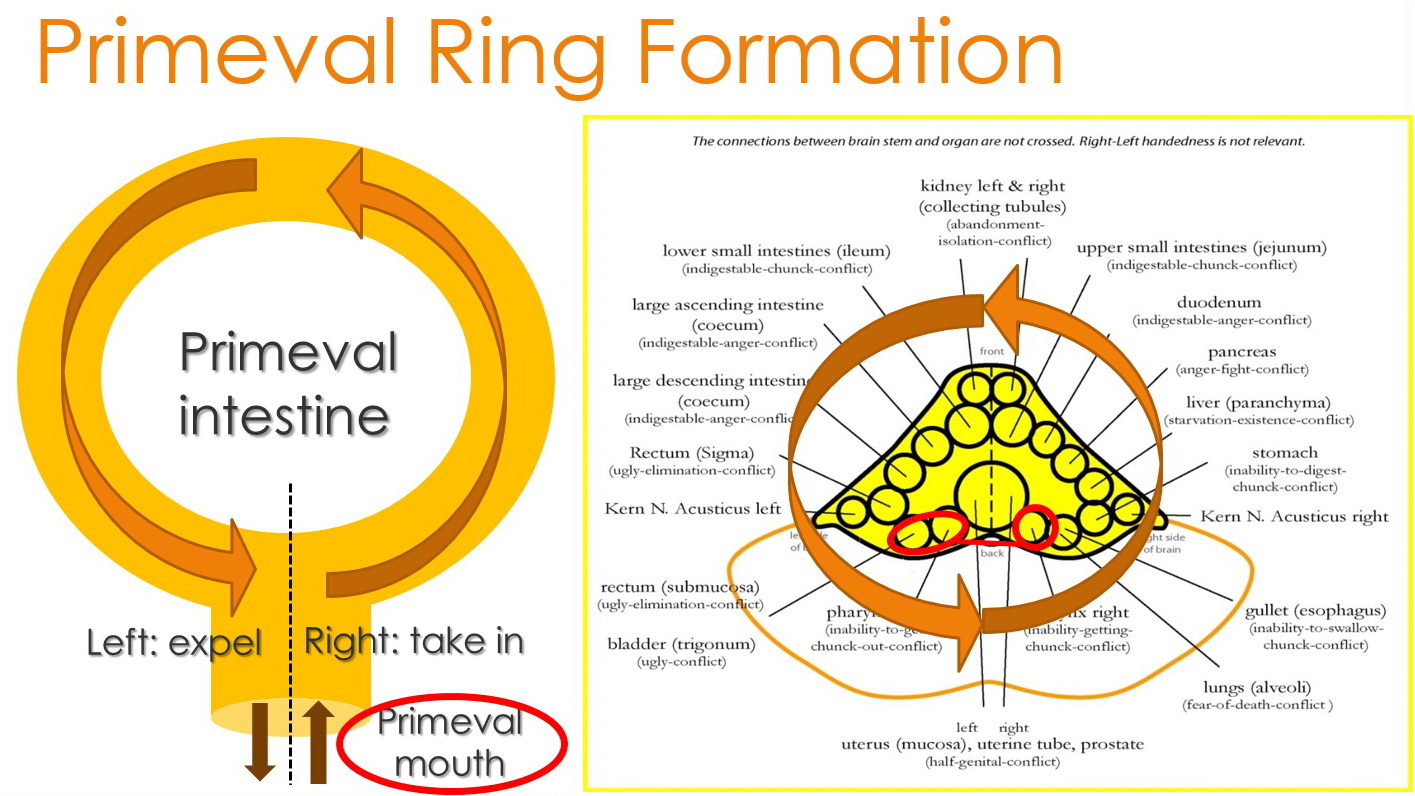
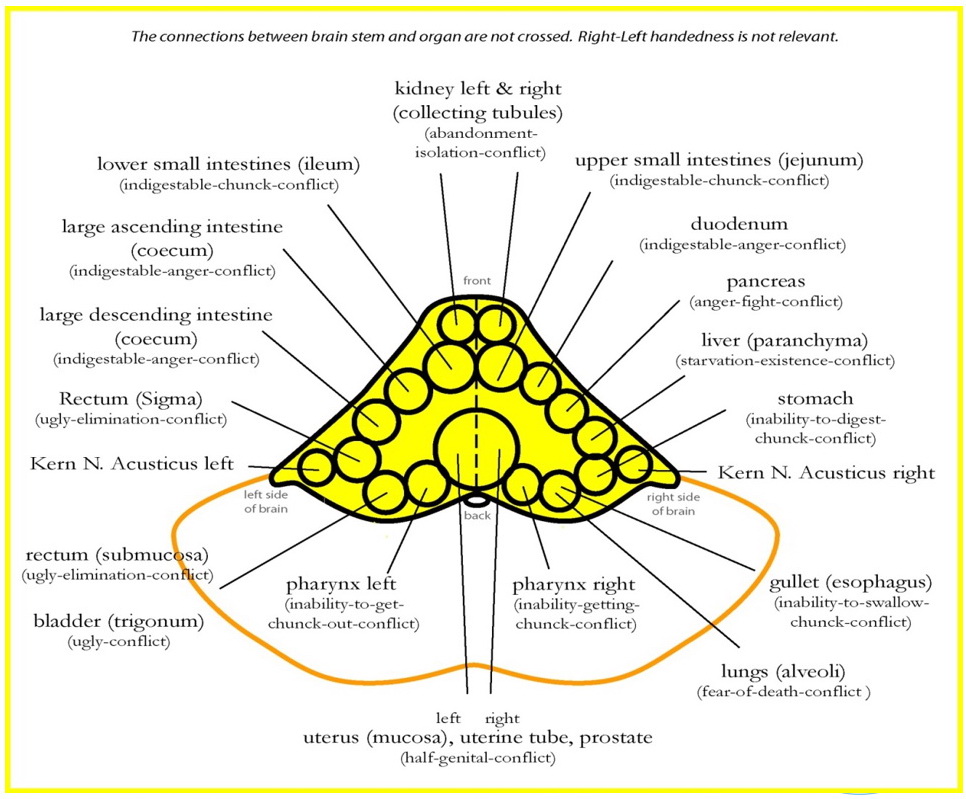
In the Brain Stem, the primeval ring structure is reflected: organ tissue relays with assimilative and digestive functions from oesophagus to small intestines are situated in the right brain stem, while excretory organs from caecum to rectum are relayed in the left brain stem. Medial on both sides are the relays of mouth/pharynx, middle ears and lacrimal glands, as well as the pineal and pituitary glands and the thyroid.
Relay:
Brain Stem ( + / – ) dorso-medial
Mind
Theme:
1. Loss of a Person (children, grandchildren, partner)
2. Ugly Conflict with Sexual nuance
Emotions and Thoughts:
1. Grief, despair
- I lost my baby!
- Where is my child?
- How could this gap ever be filled?
2. Rage, hate - No you won´t!
- How could he do this to me?
META-Meaning:
- Me and my family are complete.
- The universe and life provide all the means to heal and to perceive perfection.
Organ
Stress Phase Symptoms:
Enhanced function by reabsorption or secretion. Eventually, a compact secretory adenocarcinoma or a flat-growing reabsorptive adenocarcinoma grows in the uterine cavity, mostly accompanied by high oestrogen levels.
Possible diagnoses: endometrial hyperplasia, myometrial (the myometrium supports the reaction of the endometrium) or endometrial cancer.
Regeneration Phase Symptoms:
There are different ways of healing reaction: Among fertile women the tumor is eliminated with the decidua through heavy bleedings. In case of postmenopausic women the tumor degrades through an inflammatory process, possibly fungal or bacterial infection accompanied by nighty sweating and a purulent, yellowish-greenish vaginal discharge and light bleedings.
Possible diagnoses: endometritis, endometrial tuberculosis
When the basal layer gets damaged in the process, it may lead to adhesions inside the uterus.
Healing Peak
Chills and possibly spasms of the muscle layer.
Biological meaning
When the endometrial layer gets thickened through the increased cell proliferation in stress phase, the fertilized ovum can be implanted and nourished easier.
Social
Examples:
- The client’s husband cheated on her while she was pregnant. She felt it but kept silent. After birth her menstrual period begins abruptly with strong bleedings and pain.
- The client grieves for her second son who died at 19. She has high expectations of herself supporting her first son. When he moves again to live in her home, she gets constant strong bleedings. When she accepts and transforms her emotions, the bleedings stop after 8 weeks. (Hansen, MHU archive)
- An accountant suffers from sexual harassment in her workplace but fears to lose her job. In a routine examination, uterine hyperplasia is detected.
Additional Information
Endometriosis means growth of endometrial tissue outside the uterus in the abdominal cavity. There, cyclic proliferation is taking place, often accompanied by pain and infertility. The cells can escape the uterus e g by means of injury or surgery. The emotional background also is loss with a sexual nuance, possibly fight or unaccepted femininity.
Constellations:
Brain Stem Constellation possible: perplexity, lethargy, passiveness, reduced movement. Purpose: new orientation
Differential Diagnosis:
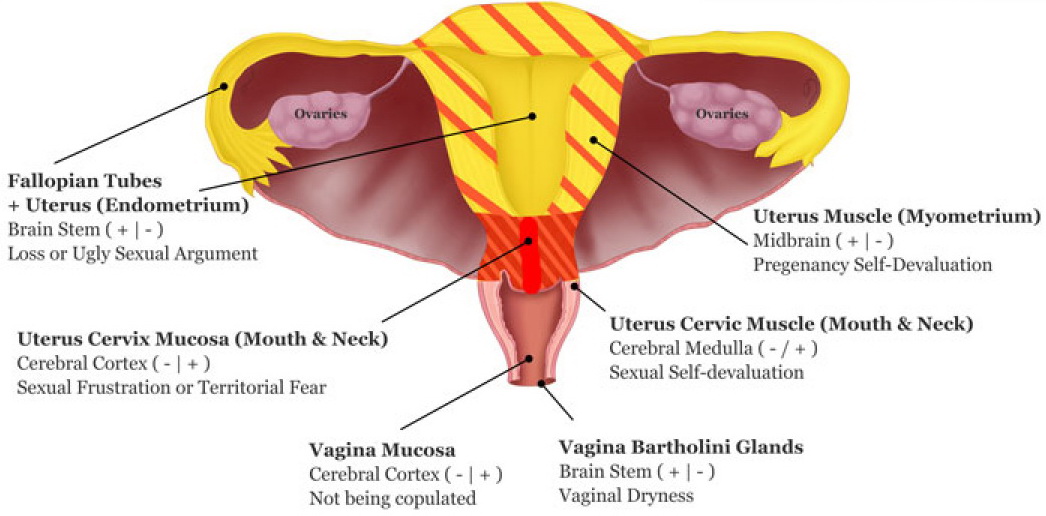
Uterus – Myometrium (Midbrain, +/-) stress (wish to bear a child): reinforcement of the smooth muscle which can remain after conflict resolution, myoma
Uterus – Cervix and Mouth (Cerebral Cortex, -/+): widening and ulceration in stress phase (loss of love), exceeding replenishment in regeneration phase.
Ovaries – interstitium oestrogen production (Cerebral Medulla, -/+): underproduction, infertility in stress phase (loss of a person), cysts in regeneration phase, at the end increased hormone levels.
Ovaries – germ cells (Brain Stem, +/-): hyperplasia in stress phase (loss of a close person)
Fallopian Tubes (Brain Stem, +/-) Stress (sexual fight or loss): enhanced secretion & fertility, possibly adenoma growth; Regeneration phase: salpingitis chronic processes can lead to infertility.