
Testicles/Ovaries Germ Cells
Anatomy
Primordial germ cells that still have to reach the gonads, also known as precursor germ cells or gonocytes, divide repeatedly on their migratory route through the gut and into the developing gonads. They are pluripotent stem cells from which rise tissues from all 3 germ layers.
After migration to the ovary, primordial germ cells become oogonia which differentiate into primary oocytes (egg cells).
Germ cells make the majority of the gonads’ tissue.
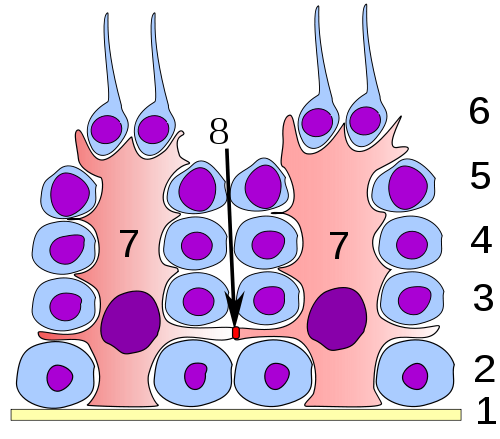
Germinal epithelium of the testicle.
1 basal lamina,
2 spermatogonia,
3 spermatocyte 1st order,
4 spermatocyte 2nd order,
5 spermatid,
6 mature spermatid,
7 Sertoli cell,
8 occlusive junctions
Brain
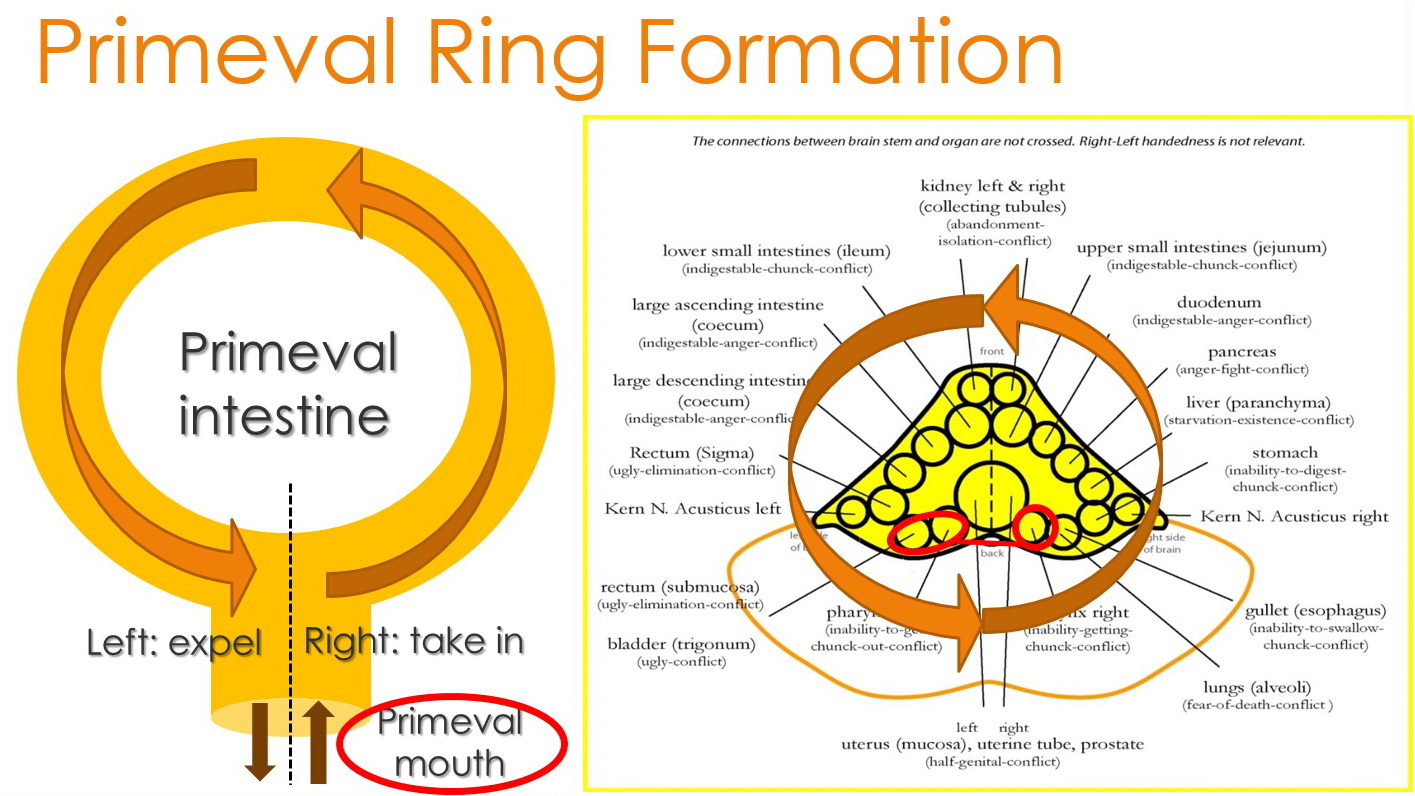
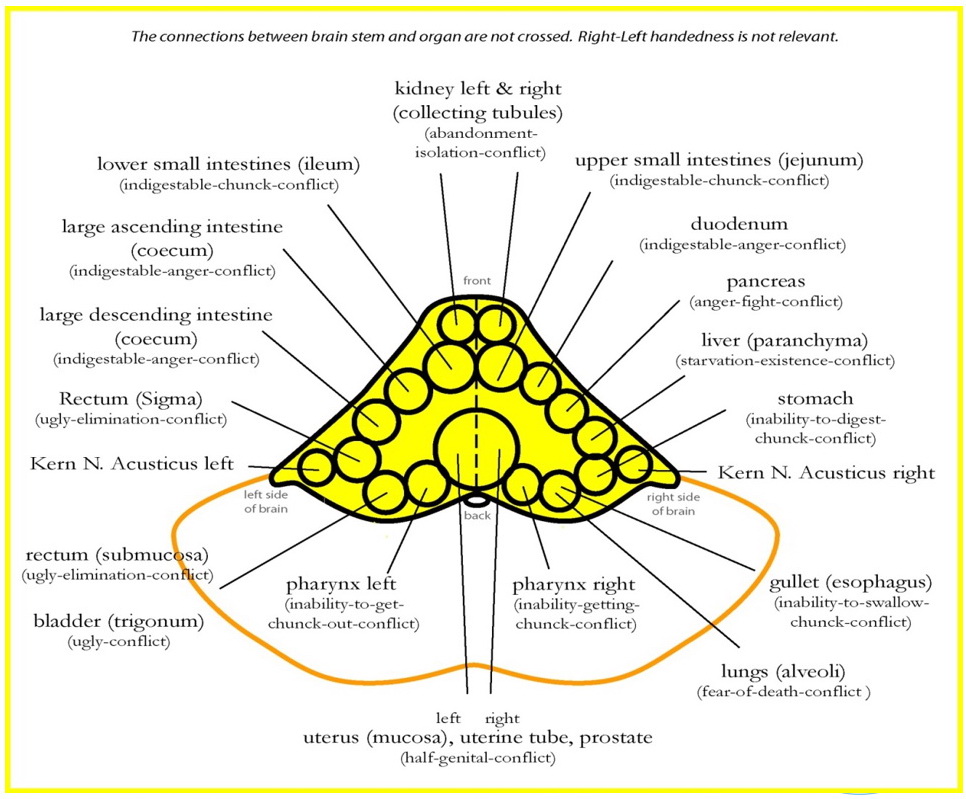
In the Brain Stem, the primeval ring structure is reflected: organ tissue relays with assimilative and digestive functions from oesophagus to small intestines are situated in the right brain stem, while excretory organs from caecum to rectum are relayed in the left brain stem. Medial on both sides are the relays of mouth/pharynx, middle ears and lacrimal glands, as well as the pineal and pituitary glands and the thyroid.
Relay:
Brain Stem ( + / – ) dorso-medial
Mind
Theme:
Profound loss of a beloved one
Emotions and Thoughts:
Grief, despair
Loss of child, partner, parent or friend.
- How can I get on living without her?
- How could she ever be replaced?
- Our family/group must survive.
META-Meaning:
- I can feel and perceive my connection to all loved ones.
- All the universe is filled with love.
- We are there and connected for all time.
Organ
Stress Phase Symptoms:
Increased production of germ cells, hyperplasia. The majority of testicle cancers are derived from this tissue.
Teratoma growth in the testicle, ovary (or even in other places of the body), maturing during several months as an ancient biological program to replace the experienced or feared loss of offspring or partner.
Teratomas derived from germ cells occur in the testes in men and ovaries in women. Testicular teratomas present as a palpable mass in the testis.
Regeneration Phase Symptoms:
Successive (!) stop of growth (because of the tissue´s embryonic origin) but remaining in place. This tumor is generally considered benign.
Biological Meaning:
Ancient program of fast replacement of lost offspring or partner.
Social
Examples:
- A homeless man misses his dog that was shot in a police raid.
- A father loses his son in a dramatic mountain-climbing accident
- After a car accident, the daughter of the patient lies in coma.
Additional Information
A teratoma is a tumor with tissue or organ components resembling normal derivatives of more than one germ layer. Although the teratoma may be monodermal or polydermal (originating from one or more germ layers), its cells may differentiate in ways suggesting other germ layers. The tissues of a teratoma, although normal in themselves, may be quite different from surrounding tissues and may be highly disparate; teratomas have been reported to contain hair, teeth, bone and, very rarely, more complex organs or processes such as eyes ,torso, and hands, feet, or other limbs.
Usually, however, a teratoma will contain no organs but rather one or more tissues normally found in organs such as the brain, thyroid, liver, and lung. Sometimes, the teratoma has within its capsule one or more fluid-filled cysts; when a large cyst occurs, there is a potential for the teratoma to produce a structure within the cyst that resembles a fetus. Because they are encapsulated, teratomas are usually considered benign.
Teratomas are also classified by their content: a solid teratoma contains only tissues (perhaps including more complex structures); a cystic teratoma contains only pockets of fluid or semi-fluid such as cerebrospinal fluid, sebum, or fat; a mixed teratoma contains both solid and cystic parts. Mature teratomas are highly variable in form and histology, and may be solid, cystic, or a combination of solid and cystic. A mature teratoma often contains several different types of tissue such as skin, muscle, and bone. Skin may surround a cyst and grow abundant hair.
Teratoma are found also in other organs than the testicles and ovaries, and they seem to be present in fetuses already, so that we consider the probability of their presence to reflect an inherited/passed on trauma.
Constellations:
Brain Stem Constellation possible: perplexity, lethargy, passiveness, reduced movement. Purpose: new orientation
Differential Diagnosis:
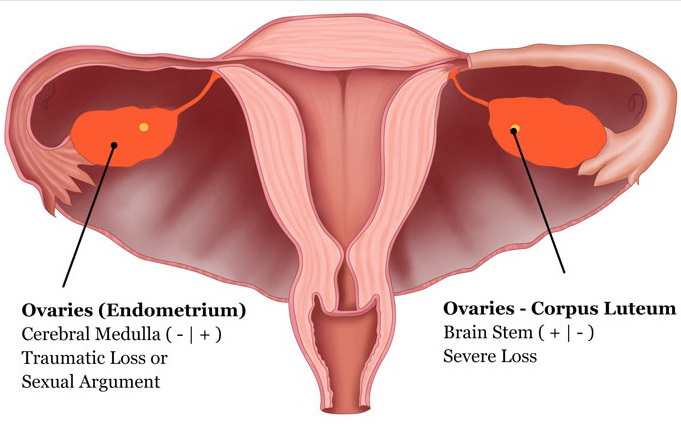
Ovaries & testes – interstitium sex steroid production (Cerebral Medulla, -/+): underproduction, infertility in stress phase (loss of a person), cysts in regeneration phase, at the end increased hormone levels.
Pituitary anterior lobe – production of growth hormone (Brain Stem, +/-) Stress phase (not big enough): increased production of growth hormone, in adults acromegaly
Pituitary anterior lobe – production of gestagen (Brain Stem, +/-) Stress phase (priority, pregnancy): increased production of gestagen, inhibition of ovulation, infertility
Pituitary anterior lobe – production of FSH (Brain Stem, +/-) Stress phase (wish to get pregnant): increased production, maturing of germ cells, increased fertility
Endometriosis means growth of endometrial tissue outside the uterus in the abdominal cavity. There, cyclic proliferation is taking place, often accompanied by pain and infertility. The cells can escape the uterus e g by means of injury or surgery. The emotional background also is loss with a sexual nuance, possibly fight or unaccepted femininity.
