Stomach – Gastric Mucosa (Fundus & Great Curvature)
Anatomy
The gastric mucosa is the mucous membrane layer of the stomach which contains the glands and the gastric pits.There are three types of gastric glands, distinguished from one another by location and type of secretion:
- The cardiac gastric glands are located at the very beginning of the stomach. They produce mucus to coat and protect the stomach wall from self-digestion.
- The intermediate, or true, gastric glands in the central stomach areas are tubular glands which produce the enzymes rennin (for breakdown of milk) and pepsin (for protein digestion), as well as hydrochloric acid to activate the enzymes.
- The pyloric glands in the terminal stomach portion produce gastrin, a peptic hormone helping gastric motility .
There is usually a small, constant production of gastric juices, but their secretion can be stimulated by numerous means. Tasting, smelling, or thinking of food tends to increase enzyme secretions. The production of gastric juices is limited while a person is asleep, but production resumes upon awakening. Consumed food provides additional stimulation necessary for mucus secretion. Some foods also contain chemicals that activate enzyme production. Psychological states of fear, sadness, or withdrawal may reduce gastric secretion.
The greater curvature of the stomach is directed mainly forward and is four or five times as long as the lesser curvature. Here we find a different mucosa from that in the lesser curvature and the pylorus.
Brain
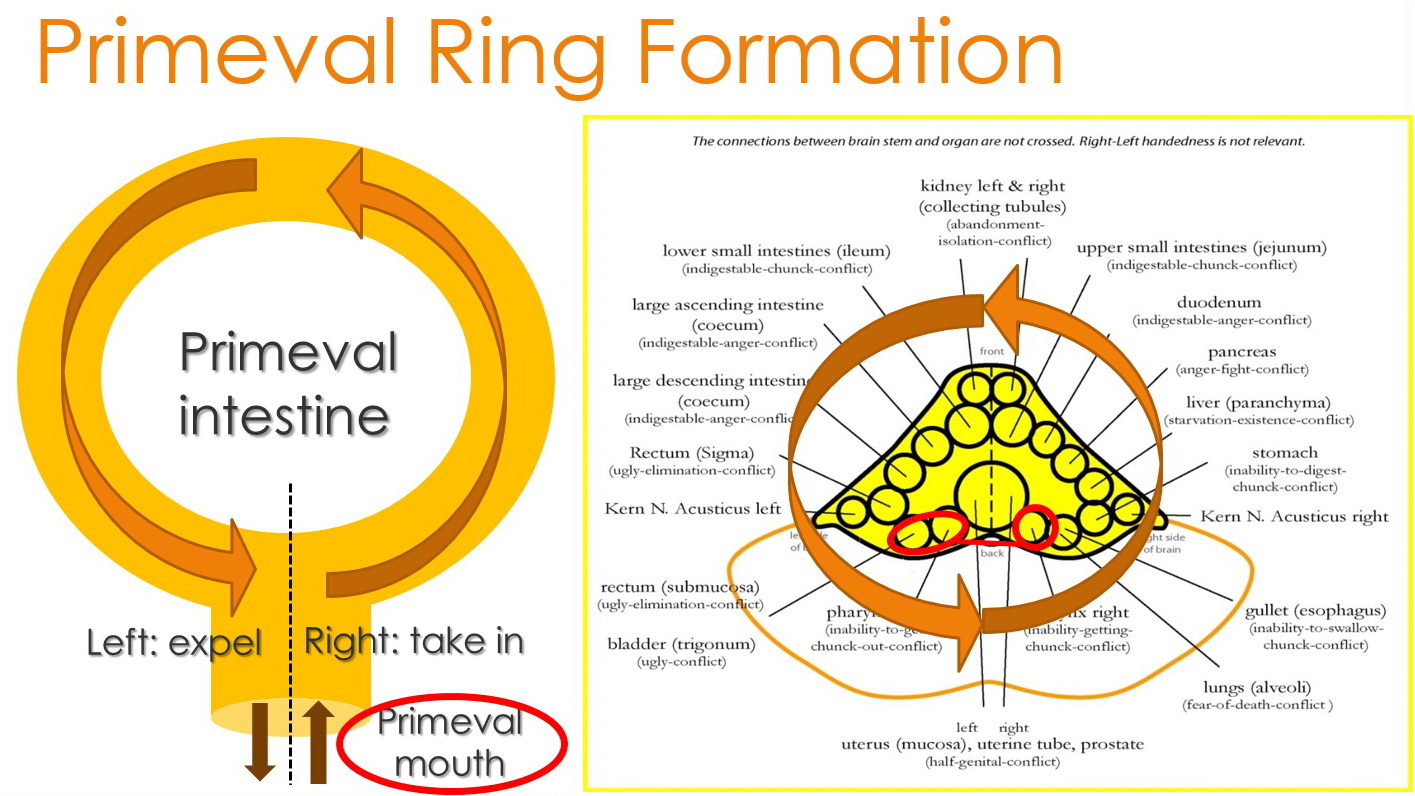
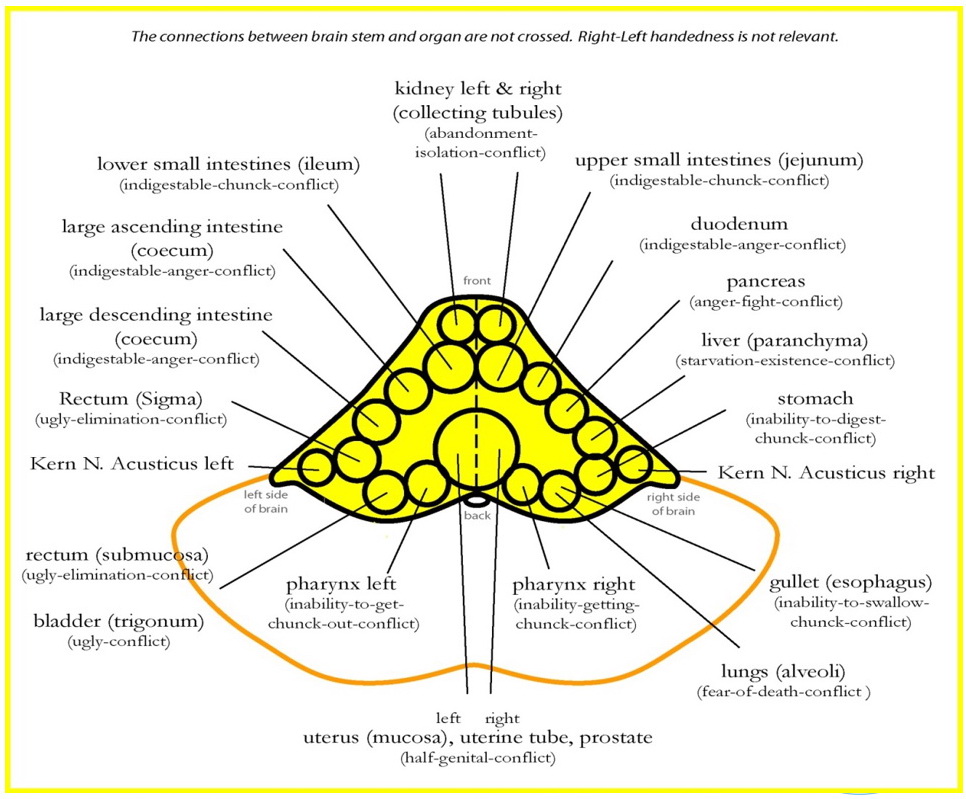
In the Brain Stem, the primeval ring structure is reflected: organ tissue relays with assimilative and digestive functions from oesophagus to small intestines are situated in the right brain stem, while excretory organs from caecum to rectum are relayed in the left brain stem. Medial on both sides are the relays of mouth/pharynx, middle ears and lacrimal glands, as well as the pineal and pituitary glands and the thyroid.
Relay:
Brain Stem (+/-) dorso-lateral right
Mind
Theme:
Inability to break down a big chunk, either physically or emotionally
Handedness is irrelevant in this relay.
Emotions and Thoughts:
Overload, anger
Often related to job, family, money, property, relationships, legal issues, etc. - I can’t digest this.
- This is too big for me.
- It overwhelms me.
- I can´t break it down.
META-Meaning:
All that seems to be too big to digest, I can easily and effectively break down into manageable parts.
Organ
Stress Phase Symptoms:
Functional secretory increase in the glands, later cell proliferation coupled with an increased production of stomach acid, eventually this can produce heartburn (a stress reaction of the cardiac sphincter) and compact tumors of different sizes that are either diagnosed as benign tumors, i.e. fundic gland polyps or adenoma, or malignant tumors, i.e. Adenocarcinoma, of the stomach. These stomach tumors are either compact, up to the size of a child’s head, cauliflower-shaped growing secretory adenocarcinomas or flat-growing adenocarcinomas with absorptive quality, so called tumorous swellings of the stomach wall. The tumor is painless unless pressing or obstructing other structures with sensitive innervation.
Additional typical symptoms are digestive disorders such as bloating, nausea, or food intolerances as aversion to fish, coffee, fruits and alcohol.
Regeneration Phase Symptoms:
Normalization of juice production and degradation of excess tissue, often in presence of acid-resistant fungi or mycobacteria (in this case nightly sweating). Occasional bleedings are digested and detected as dark “tar stools”. Possible diagnoses: gastritis type A, gastric tuberculosis, gastric thrush or candidosis.
Tumors can also become incapsulated and remain as benign inactive tumors.
Healing Peak
Chills, spasms of the stomach muscles
Social
The conflict is usually not sexually or territorially perceived, but as a morsel or survival issue.
Examples:
- A business shareholder was deprived of his share, so that he cannot use it anymore (financially). He suffers from nausea and heartburn.
- A person got money by fraud and all the money was taken away by the court, so they didn’t receive their ’chunk of the money’. He develops stomach cancer.
- The client leaves her partner and needs to take on a job which is draining her energy. She feels bloated and fights with fungal infections in the stomach.
- The client was not allowed to attend higher education as a child. As learning is a core value for her, she never could get over that. She constantly suffered from bloating and digestion problems, and had intolerances to many foods, which got better when she built her own family. (Klapp)
Biological Meaning:
The enhanced secretory function of the glands and the tumor help to break down and digest the swallowed morsel.
Additional Information:
Constellations
Brain Stem Constellation possible: perplexity, lethargy, passiveness, reduced movement. Purpose: new orientation
Interactions
Cardiac or Lower Esophagus Sphincter (Brain Stem +/-): opens in stress phase and creates acid reflux/heartburn.
Smooth Muscle (Midbrain +/-): smooth muscle often co-reacts with mucosa, theme being to forward the bolus by peristalsis. In stress phase we see a functional increase and possibly leiomyoma.
Differential Diagnosis:
Stomach Mucosa (Ectodermal) of lesser curvature and pylorus (Cerebral Cortex -/+): ulceration in stress phase (social anger, identity), swelling and repair and possibly proliferation/tumor in the regeneration phase.
Submucosa/ Lymphatic tissue (Cerebral Medulla -/+) Symptoms in regeneration phase (after self-definition, choice, acceptance): Inflammatory and edematous in the first phase. Diagnoses may be lymphoma, inflammatory fibroid polyps, perineurioma and leiomyoma