
Large Intestine – Sigmoid Colon
Anatomy
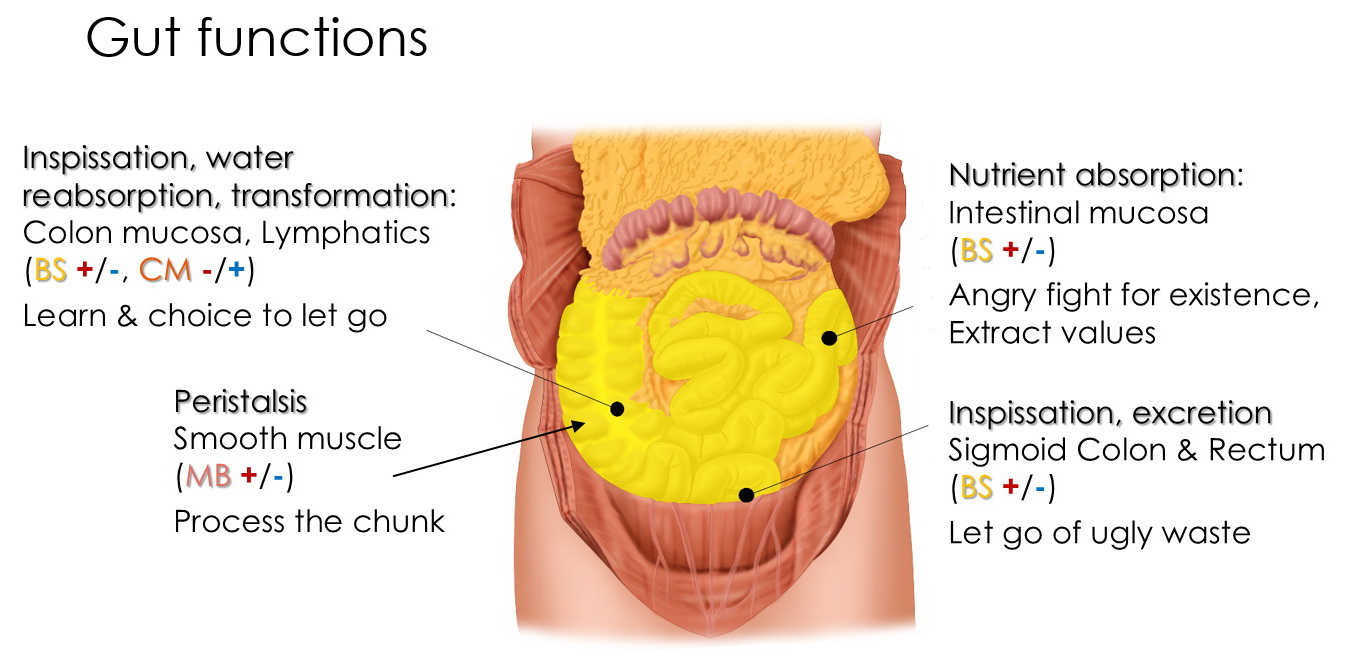
The sigmoid colon is the part of the large intestine after the descending colon and before the rectum in the digestive tract. It’s S-shaped form makes the separation of gases and compact waste possible. The walls of the sigmoid colon are muscular, and contract to increase the pressure inside the colon, causing the stool to move into the rectum.
Brain
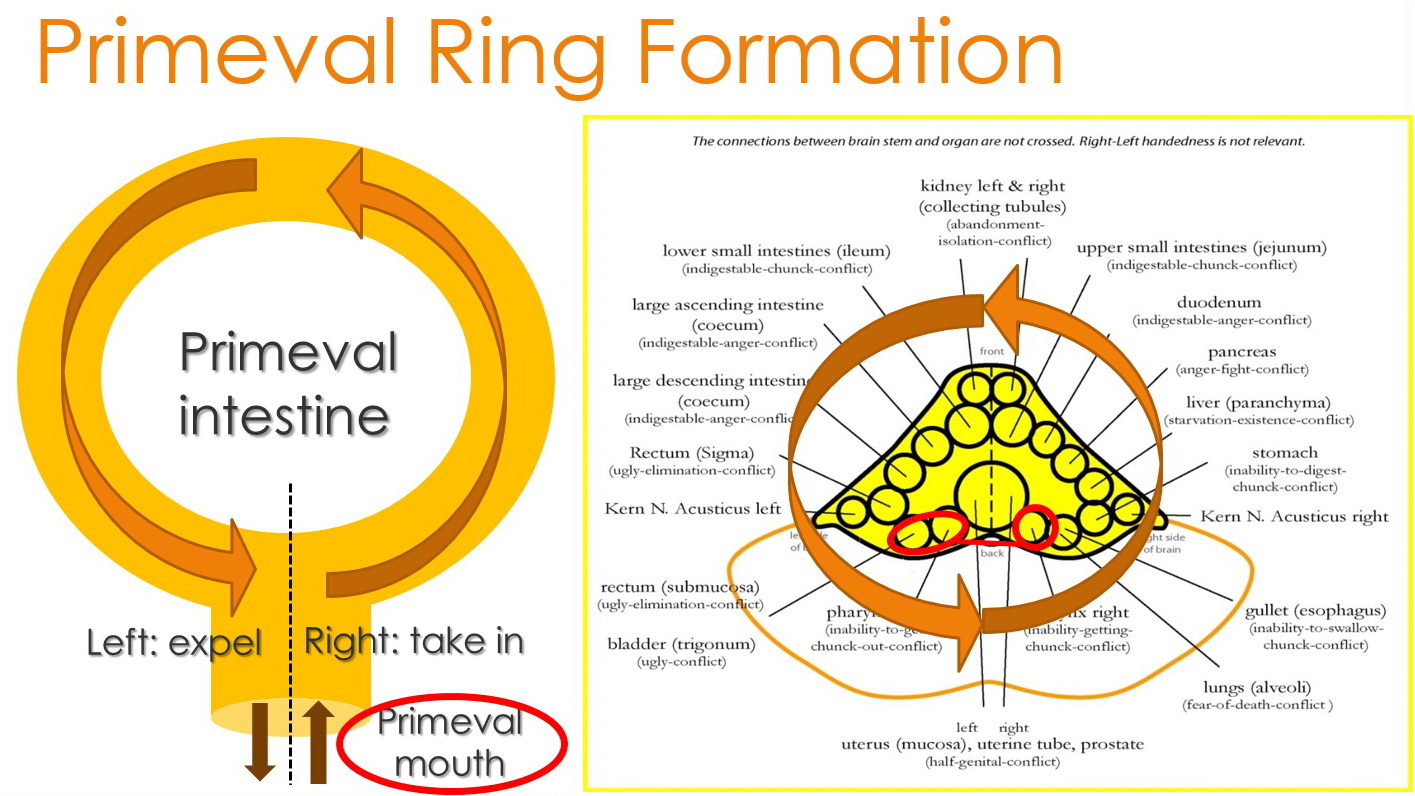
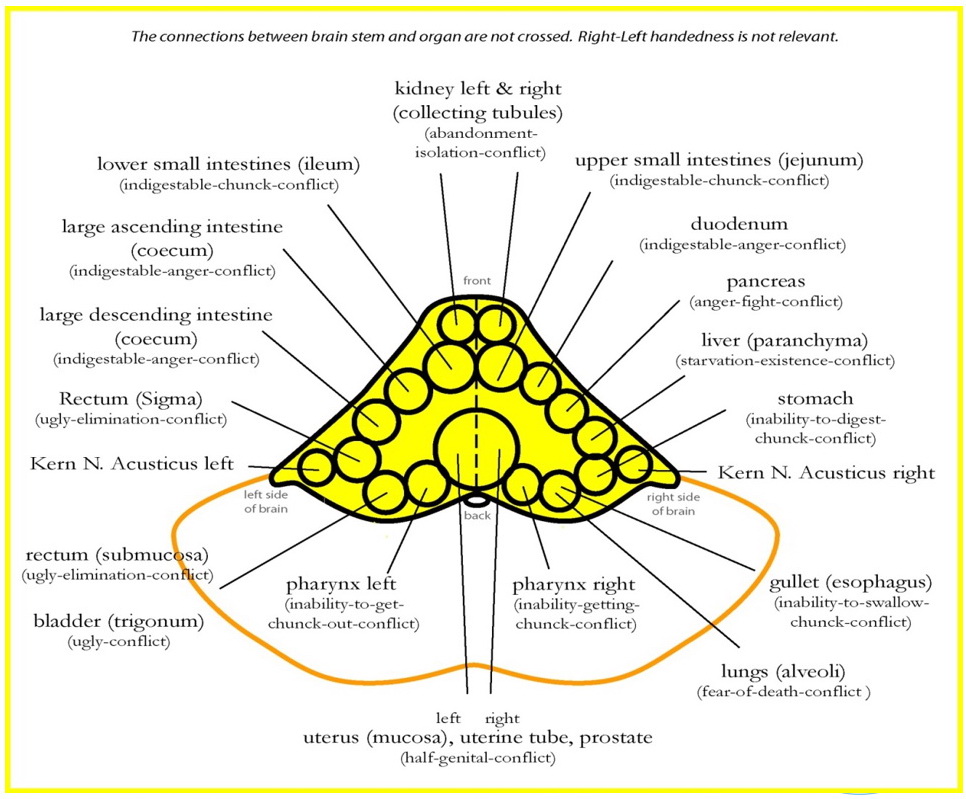
In the Brain Stem, the primeval ring structure is reflected: organ tissue relays with assimilative and digestive functions from oesophagus to small intestines are situated in the right brain stem, while excretory organs from caecum to rectum are relayed in the left brain stem. Medial on both sides are the relays of mouth/pharynx, middle ears and lacrimal glands, as well as the pineal and pituitary glands and the thyroid.
Relay:
Brain Stem ( + / – ) dorso-central left, between decending colon & left pharynx relays, medial to acoustic kernel, for Mucosa, and
Midbrain (+/-) dorso-central left, for smooth muscle
Mind
Theme:
Reabsorption, secretion, separation of waste
Associated: Ugly Elimination Conflict (The further down the gut, the less useful and more dirty the situation was experienced, thus the stress on elimination.) Side dominance is irrelevant here.
Emotions and Thoughts:
Grudge, not being able or willing to let go of the ugly emotion, situation, stress or other subjective association.
- Why have they done this to me.
- I have to get rid of this!
- I wish I could leave that behind.
META-Meaning:
- I have now processed that and can let it go.
- There is nothing more to do. I am free!
Organ
Stress Phase Symptoms:
In the stress phase the secretory or reabsorptive functions are enhanced, and the smooth muscle compresses the waste to prepare it’s expelling. In long stress phases, a hyperplasia grows (either a polyp, a diverticle, a compact or flat-growing tumor, depending on secretory or absorptive quality). Diverticulosis is in most cases symptomless. In case of big tumors there is a danger of intestinal obstruction. Defecation disorders commonly occur at this phase.
Possible diagnoses: diverticulosis, colorectal polyps, colon carcinoma, sigmoid carcinoma, colorectal carcinoma
Regeneration Phase Symptoms:
Tumor is decomposed by lymphatic cells, usually in presence of microbes (fungi or mykobacteria). Typical symptoms are pain in the lower left abdomen, defecation disorders, light bleedings and an intense night sweat especially in the morning.
The possible diagnoses are diverticulitis or ulcerative colitis.
Biological Meaning:
The reabsorptive function serves for saving water and condensing the waste. The secretory function serves for smoothing the expelling action.
Social
Examples:
- A friend spreads nasty rumours about the client.
- Husband is dating other women behind wife’s back.
- Someone has been wrongly convicted in court.
- Deeply insulting and emotionally charge accusations.
All of the above go along with the thought “I will never be able to let go or forgive this” - A young nurse feels highly stressed when she recognizes an emergency case on her first day of work. She can’t express the need for action clear enough. She does her best to help the patient, but it takes several hours until appropriate measurements are taken. This situation haunts her 20 years, during which she develops flatulence, irritable colon, and repeating spasms of the rectal muscles. (Hansen)
Additional Information
Expansion of the mucosa as in diverticulosis is also connected to a weakening of the supporting connective tissue. Therefore we can be aware of self-devaluation in regard to the ability to discriminate, evaluate and to let go.
Constellations:
Brain Stem Constellation possible: perplexity, lethargy, passiveness, reduced movement. Purpose: new orientation
Differential Diagnosis:
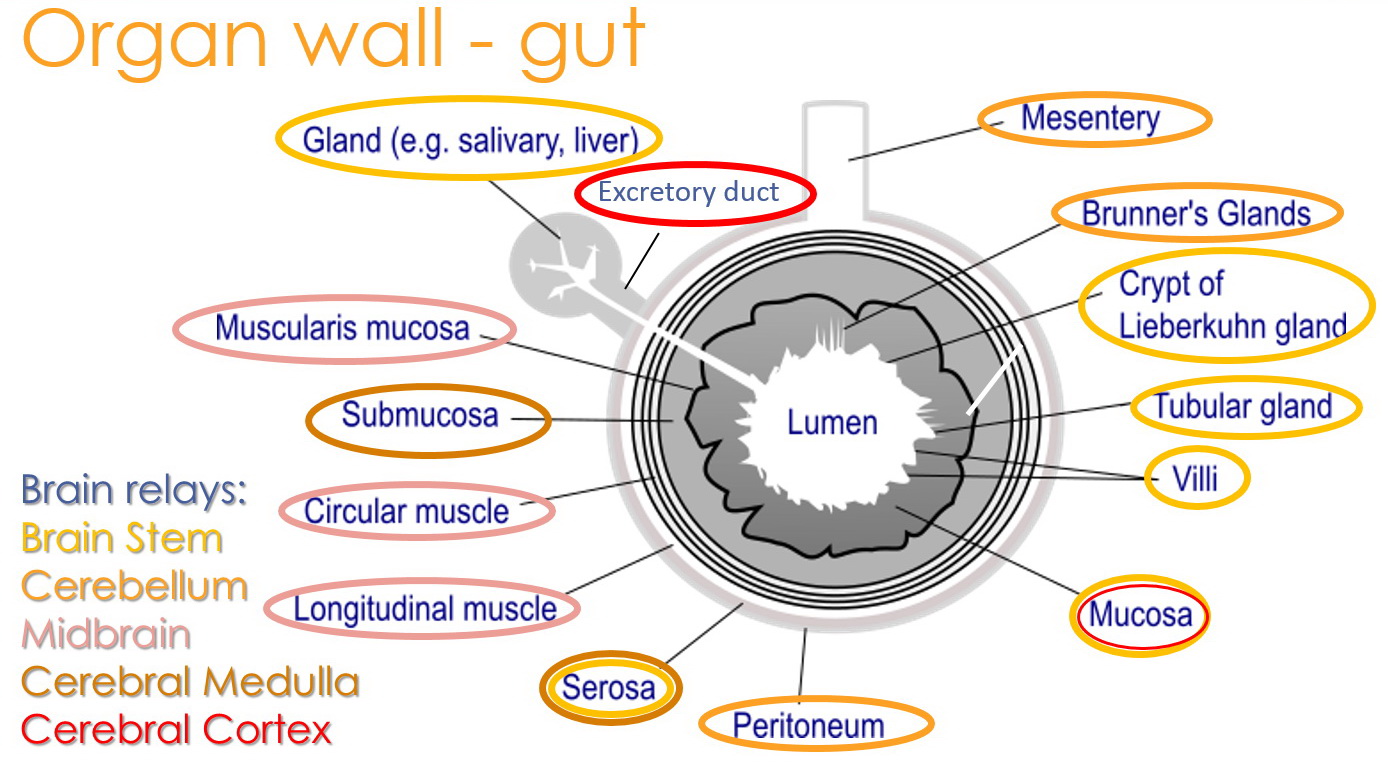
Submucosa / connective tissue and gastro-intestinal lymphatic tissue (Cerebral Medulla -/+) stress (choice, decision): immune insufficiency, leaky gut; regeneration phase: Inflammatory and edematous in the first phase. Diagnoses may be lymphoma, inflammatory fibroid polyps, perineurioma and leiomyoma.
Smooth Muscle Layer (Midbrain +/-): smooth muscle often co-reacts with mucosa, theme being to forward the chyme by peristalsis. In stress phase (processing anger) we see a functional increase and possibly leiomyoma.
Peritoneum & Greater Omentum (Cerebellum +/-), stress phase (protection of the gut) possibly with adenoidal mesothelioma, and tuberculous decomposition in regeneration phase, possibly ascites.
Adipose and Lymphatic Tissues of the Greater Omentum (Cerebral Medulla -/+), with necrosis in stress phase (Resources to protect Self) and possibly lipoma, lipoedema or lymphoma in regeneration phase.
