
Salivary Glands
Anatomy
The salivary glands have important functions in the digestive system. They are found mainly in the oral cavity and produce a mucous liquid containing enzymes. Saliva is important to lubricate your mouth, help with swallowing, protect the teeth and predigest food. The three major pairs of salivary glands are parotid glands on the insides of the cheeks, submandibular glands at the floor of the mouth, sublingual glands under the tongue. There are also several hundred minor salivary glands throughout the mouth and throat, embedded in the mucosa. Saliva drains into the mouth through small tubular ducts The largest duct (the sublingual duct of Bartholini) joins the submandibular duct to drain through the sublingual caruncle.
The parotid glandis the largest of the salivary glands. It is found wrapped around the ramus of the mandible and it secretes saliva through Stensen's duct into the oral cavity to facilitate mastication and swallowing.
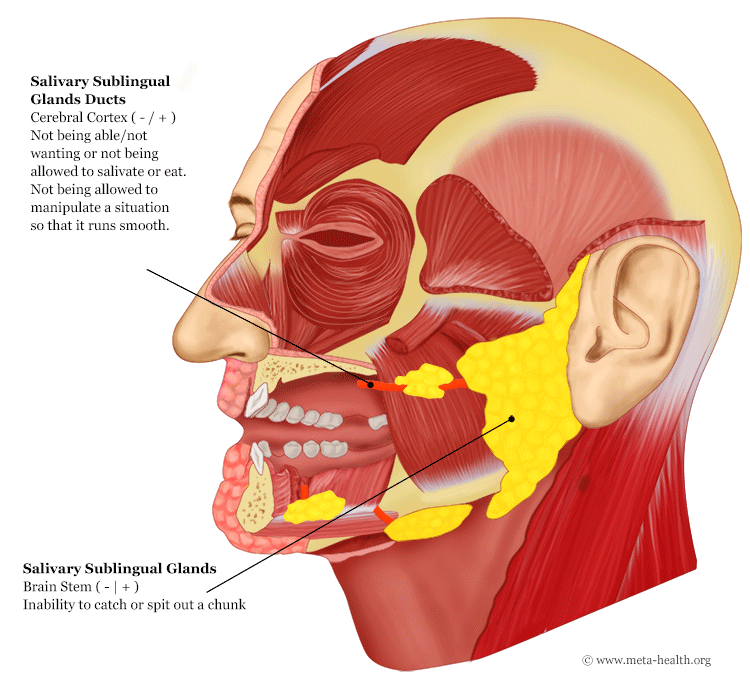
Brain:
In the Brain Stem, the primeval ring structure is reflected: organ tissue relays with assimilative and digestive functions from oesophagus to small intestines are situated in the right brain stem, while excretory organs from caecum to rectum are relayed in the left brain stem. Medial on both sides are the relays of mouth/pharynx, middle ears and lacrimal glands, as well as the pineal and pituitary glands and the thyroid.
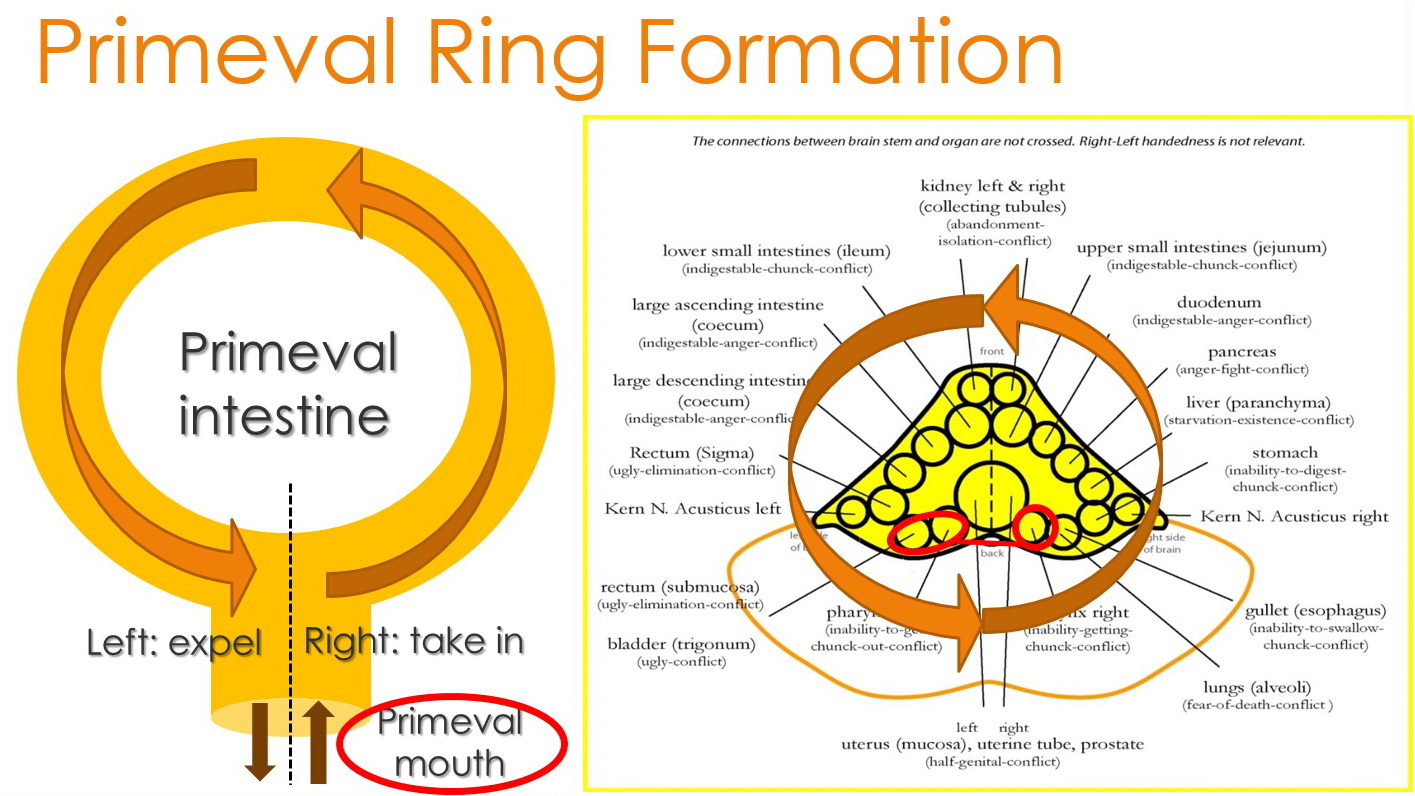
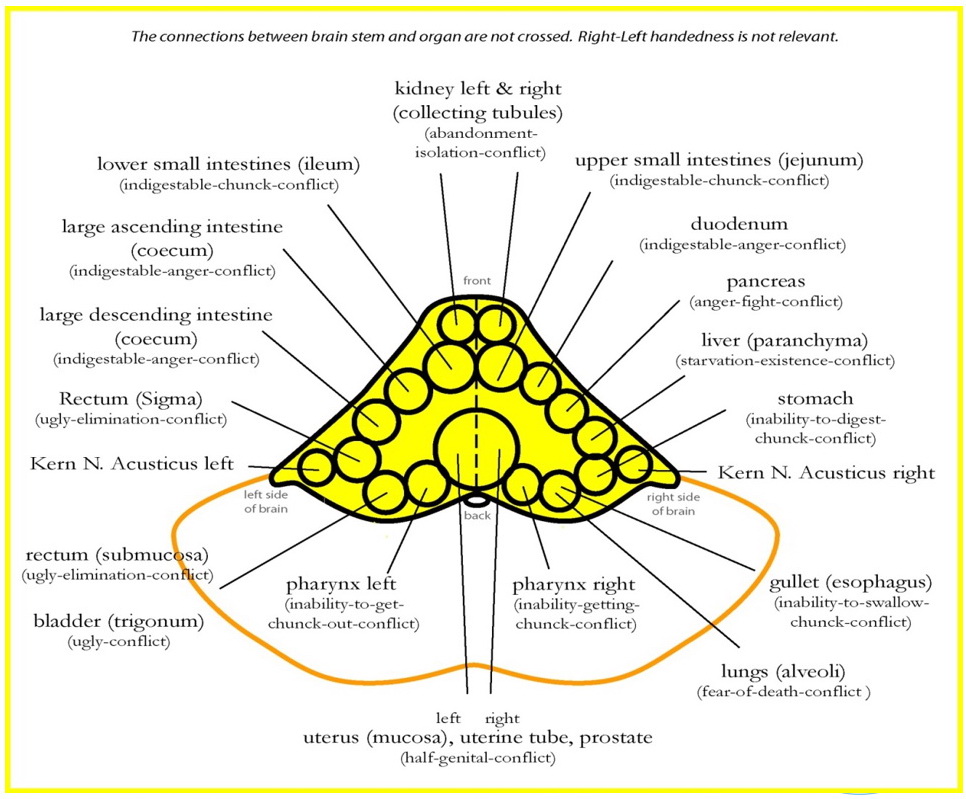
Relay:
Brain Stem ( + / – ) dorso-central, next to uterus endometrium relay
Mind
Theme:
Inability to catch or spit out a chunk
1.Right salivary glands: Not being able to catch/get or reach a chunk (due to insufficient salivation)
2.Left salivary glands: Not being able to salivate and spit out a chunk; not being able to get rid or let go of a chunk
Emotions and Thoughts:
Hunger, greed, overwhelm, disgust
- I so need to have this!
- It makes my mouth water.
- I cannot get hold of the situation.
- I can’t swallow the situation.
- This feels too much/big for me.
- I need to spit this out as fast as possible!
- This is poison to me!
META-Meaning:
- I take my time to analyse and to chew before swallowing.
- Everything I take in, I can easily process and digest.
Organ
Endodermal tissue itself has no sensitive innervation and processes do not create pain unless they affect mouth or tongue mucosa tissue.
Stress Phase Symptoms:
Increased salivation and cell proliferation in salivary glands. Characteristic symptoms include the enlargement (hyperplasia) of salivary glands and salivary gland tumors (pleomorph adenoma, Warthin tumor, salivary adenocarcinoma).
Regeneration Phase Symptoms:
Function normalization; inflammatory, purulent degradation of salivary tumors by fungi (mycoses) or mycobacteria accompanied by mouth odor and night sweat. Pain occurs if the sensitive oral mucosa (CC, Inner Skin Sensitivity) is triggered by the “mouth conflict”.
Possible diagnoses: salivary abscess, sialadenitis, candidosis, thrush.
In case of long lasting conflicts with many relapses there is a danger of a complete destruction and desiccation of the salivary glands, like in Sjögren-Syndrome.
Healing Peak:
Chills, salivation; Pain occurs if the sensitive oral mucosa (CC, Inner Skin Sensitivity) is triggered by the “mouth conflict”.
Biological Meaning:
Increased saliva production in stress phase to be able to bring in the food chunk (right side) or to release or excrement the chunk better (left side).
Social
Examples:
- Pavlov’s dog!
- Cat goes on holiday with its owner and it isn’t allowed him to hunt. He cannot get out as there is another cat in the holiday resort that has already taken his territory.
- A woman buys a home in the holiday destination together with her partner. This is a “big chunk” which they have to fight for many years. Gradually, her mouth becomes dry and the salivary glands stop working.
- A baby gets thrush in the mouth when it is weaned from breast milk.
Additional Information
Constellations:
Brain Stem Constellation possible: perplexity, lethargy, passiveness, reduced movement. Purpose: new orientation
Differential Diagnosis:
Mouth – sensitive Mucosa (Cerebral Cortex -/+) stress phase (mouth contact): painful and sensitive aphthea and canker sores.
Salivary Gland Ducts (Cerebral Cortex -/+) Stress (assimilation/spitting prevented): enhanced release of saliva, later ulceration; Regeneration phase: swelling, obstruction, possibly tumor formation
Lymphoid tissue in tonsils, sublingual tonsils (Cerebral Medulla -/+) Stress (self-definition, choice): weakened detox & immune responses; Regeneration phase: swelling, enhanced immune response; chronic: autoimmune reactions possible
