
Bones
Anatomy
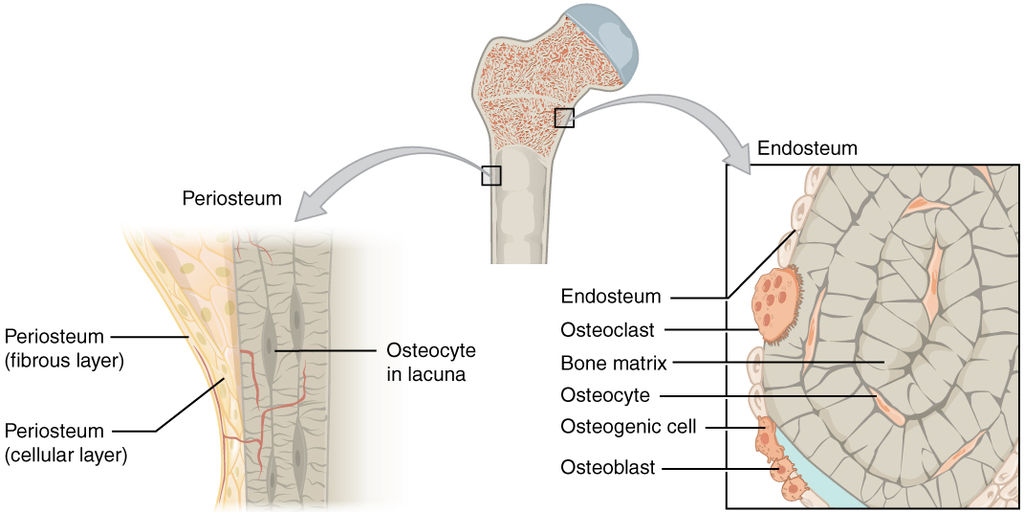
Bones are rigid structures in the skeleton. They give structure and stability to torso and limbs, and support and protect various organs of the body. They have a complex internal and external structure they makes them lightweight yet strong and hard.
The hard outer layer of bones is composed of compact or dense bone tissue, with osteocytes and minerals. Filling the interior of the bone is the trabecular bone tissue (an open cell porous network also called cancellous or spongy bone), which is composed of a network of rod- and plate-like elements that make the overall organ lighter and allow room for blood vessels and marrow. The trabeculae arrange according to the strain and pressure the cancellous is subjected to,
The shafts of long bones are hollow. In children, the space is filled with red bone marrow containing blood-composing cells. Later in life, it transforms into yellow fatty marrow, an energy deposit. The supply of bone tissue is via the blood vessels in the periosteum and by minuscule capillaries to the bone marrow. https://www.nature.com/articles/s42255-018-0016-5
The longitudinal growth of long bones happens in the metaphyses between epiphysis and shaft in adolescence.
Bones are continuously renewed. During 25 years, all bone cells have exchanged. The composition is done by osteoblasts, the destruction by osteoclasts.
Bones have no sensory innervation of their own, but their sensitivity is mediated by the periosteum, a fibrous layer which gives form to the bone and steers it’s supply by influencing the dilation of local blood vessels.
On articular surfaces, the bone is covered with cartilage that produces synovia for lubrication.
Interestingly, bone tissue takes part in regulation of hormones: Osteocalcin which is produced in osteocytes and regulates blood sugar by stimulating the Beta-cells in the pancreas, and promoting lipolysis (fat dissolution). It also influences the testosterone production in the Leydig cells of the testicles.
Brain
Relay:
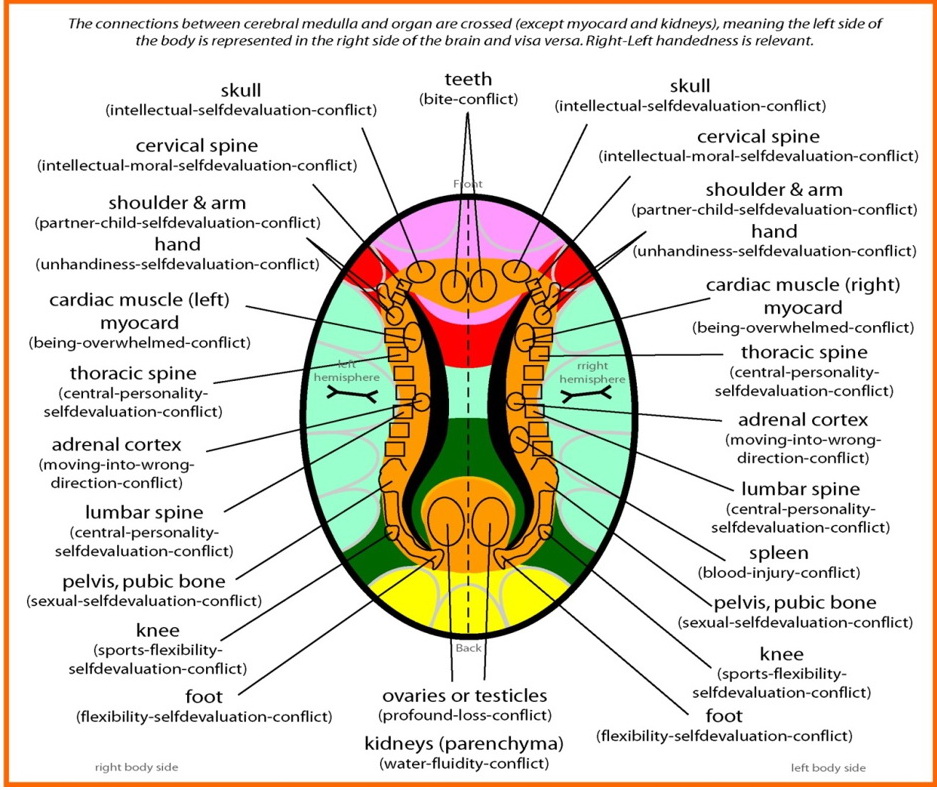
Cerebral Medulla ( – / + )
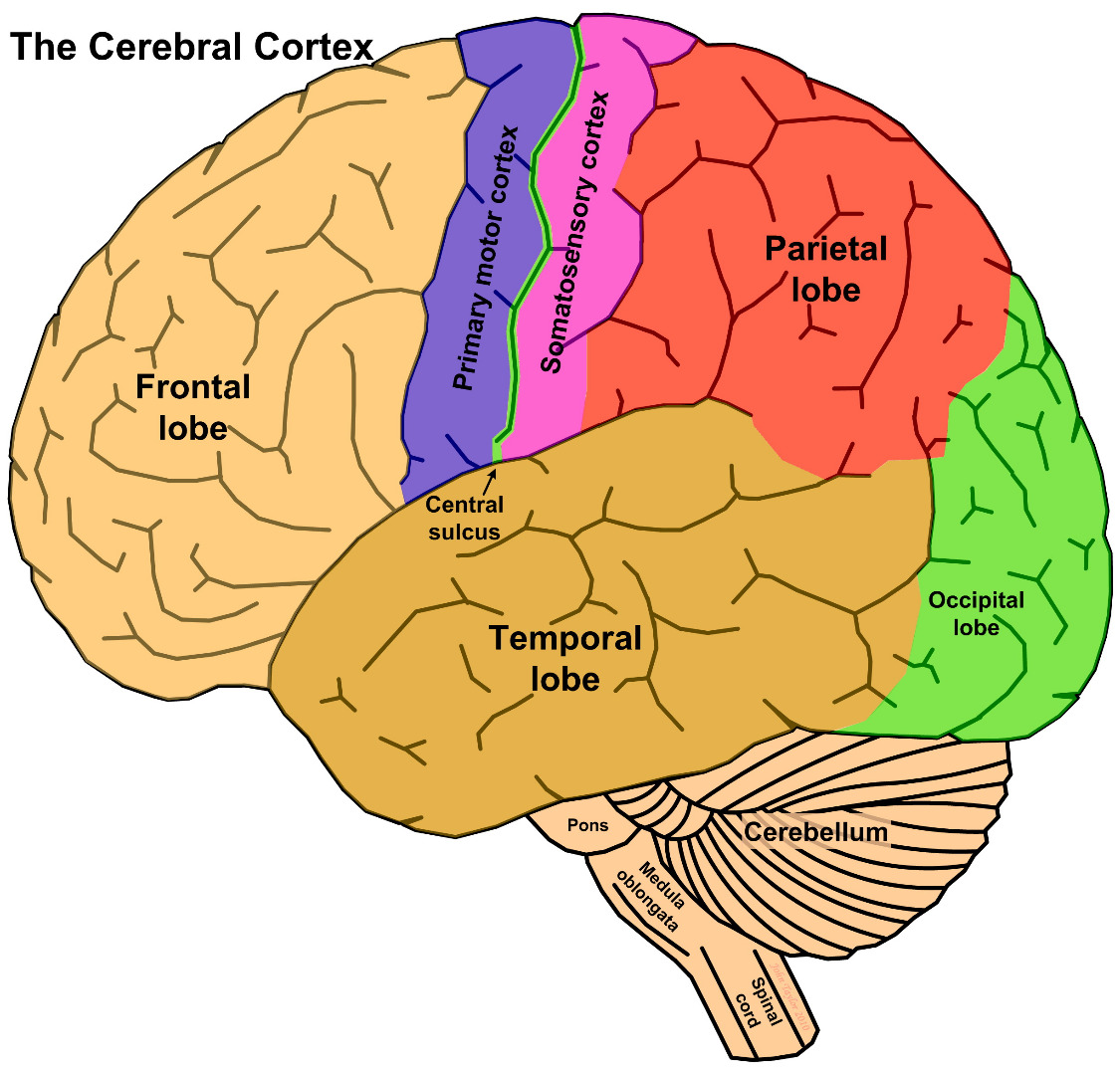
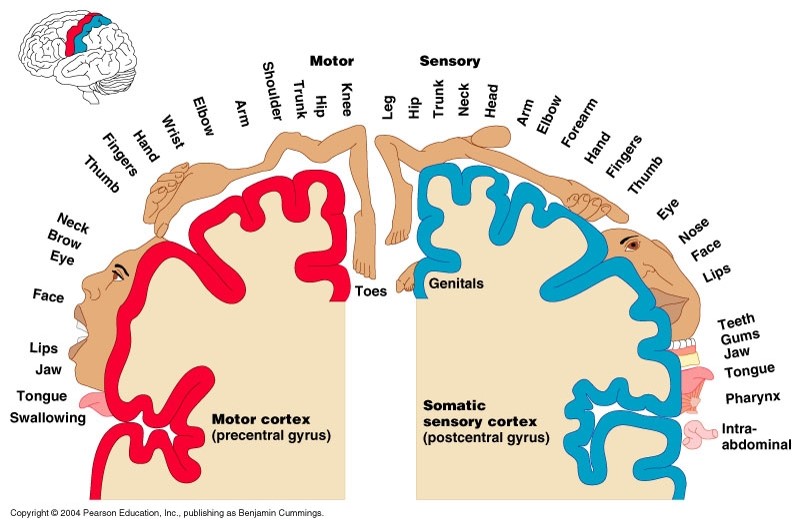
Cerebral Cortex (-/+) postsensory area, for periosteum sensitivity
Mind
Theme:
Self-devaluation trauma, Lack of stability and inner strength
Association to locality:
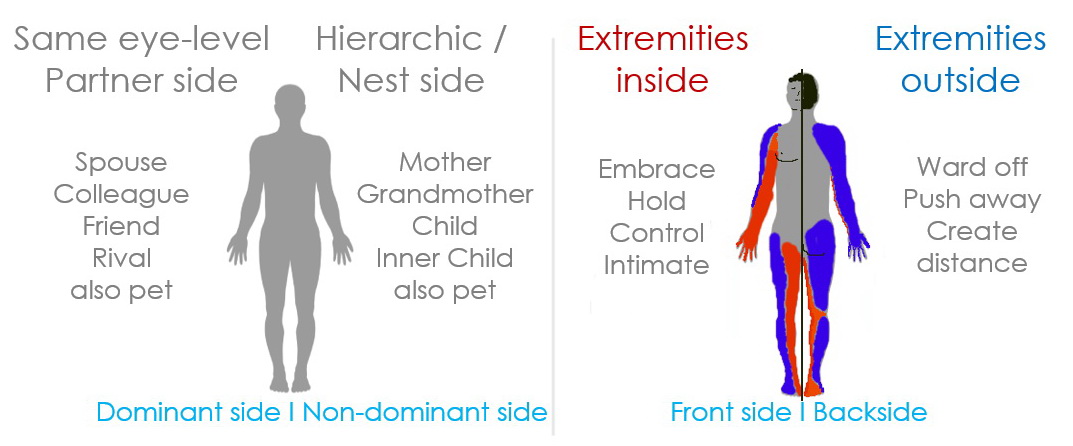
For special associations according to locality see “Musculoskeletal System – Overview“!
Emotions and Thoughts:
Inferiority, frustration
- I can´t endure that.
- I am worthless.
- This pressure is too much.
- I am not strong and good enough.
- They are better than me.
- I can’t live up to my own expectations.
Content according to the skeletal part’s biological and associated function.
META-Meaning:
I value myself. I feel strong inside and confident about myself and my abilities.
Organ
Stress Phase Symptoms:
Weakening of bone tissue and osteolysis (deficiency or degradation of bone substance). During the osteolytic process, pain and fractures are rare, due to the stabilizing effect of the periosteum. Stress phases may remain unnoticed due to absence of symptoms in shorter durations.
Possible diagnoses: osteoporosis, osteomalacia, plasmacytoma (skull), decalcification, necrosis.
If it’s a deep emotional conflict and the bone marrow is involved, the conflict will affect blood-formation by depression of hematopoiesis, Possible diagnoses: bone marrow depression, leukopenia, anemia, panmyelophtise (true anemia).
Regeneration Phase A
Inflammatory process and recomposition of bone substance with help of bacteria. During the oedematous stage the periosteum is stretched and parted from the bone, which is very painful and makes the bone susceptible to fracture. The blood can have elevated calcium levels.
As in healing of fractures, new tissue is built in excess. Under unfavourable conditions, bone tumors can appear.
Possible diagnoses: osteoma, osteosarcoma, osteoblastoma
When the bone marrow is affected, the regeneration first leads to an anaemic state because of the previously reduced blood cell production and dilution by the oedema. This is accompanied by severe fatigue. When bacteria are present in this process, osteomyelitis or bone abscess can be diagnosed.
Healing Peak:
Mostly inconspicious, possibly pale skin with cold sweat and short-termed absence. Especially after the healing peak, erythrocytes count rises.
.
Regeneration Phase B
The blood cell count rises, and imbalances at this stage can lead to leukaemia (leukemia) or erythrocytaemia. Excessive buildup of bone marrow is called myeloma, plasmacytoma or Ewing-sarcoma.
“Warm” rheumatic pain is a sign of recurring or prolonged regeneration of bone tissue, while “cold” bone rheumatism with constriction of arterioles and capillaries is created by the periosteum in recurring stress with feelings of indignation. Stress-active renal tubuli increase oedema and pain.
Possible residual organ symptoms, after finished regeneration:
*
Ganglion
*
Calcification in bones and joints
*
Residual pain can occur through scar tissue and nerve compression.
Biological Meaning:
Processes governed by the Cerebral Medulla show their biological meaning first after finished regeneration, when the tissue will be stronger (if more rigid) than before the start. This may refer to a biological meta-meaning of “survival of the strong” for the kind.
Social
Possible causes for self-devaluations are
*
Inferiority: The person feels himself worthless, inferior to others, because he isn’t able to manage the required situation.
*
Functional self-devaluation:
*
lack of ability to perform an activity (the patient’s performance doesn’t meet the requirements)
*
limited function of a body part
*
lack of ability to perform a certain activity
*
disfunctionality or reduced capability of an organ (for instance, rib pain by renal failure)
Examples:
*
After having an accident with bone fracture, the concerned person feels no longer powerful, functional and valuable at the location of the fracture. Due to that he suffers a local self-devaluation conflict at the affected place and it causes a bone necrosis.
*
A young man has been diagnosed with heart valve disease. Thus, he suffers a local self-devaluation conflict with the feeling that he’s no longer efficient, functional and valuable in that location of his heart. Thereby, he develops a bone necrosis in the ribs above the heart. It begins to ache after the resolution of the conflict by conflict- and trauma therapy. After a week, he is symptom-free with respect to the ribs.
*
A child who was born prematurely and who is constantly questioning herself, develops a scoliosis during school years.
*
A man who’s position at work is unstable and who doesn´t feel backed up by his boss, suffers a disc hernia in the lumbar spine after years and recurring conflicts.
Additional Information
Bones can be affected by processes of adjacent structures of connective tissues, inserting tendons and cartilage, like in arthritis, deformation of the spine and their consequences like disc hernia and nerve compression.
Possible diagnoses: scoliosis, kyphosis, lordosis, lumbalgia, sciatica
Constellations:
Megalomania, Motivational Constellation (both hemispheres affected in Cerebral Medulla): the turnaround of self-devaluation, belief in one’s abilities and achievements in spite of handicaps. This constellation remains through the whole cycle until regeneration is finished in one of the hemispheres.
- Skull: Intellectual megalomania
- Cervical spine: Justice (rebel-)megalomania
- Thoracic spine: Honesty megalomania
- Lumbar spine: Passion megalomania
- Shoulder: Responsibility megalomania
- Arms: Manager megalomania
- Hands: Dexterity megalomania
- Pelvis: Sexual megalomania
- Hip: Patience megalomania
- Legs: Stability megalomania
- Feet, knees: Stability or mobility megalomania
Differential Diagnosis:
Periosteum (Cerebral Cortex -/+) Indignation stress creates pain reaction and vasoconstriction with local reduction of blood supply. Regeneration phase: periostitis; Chronic: Bone rheumatism.
Skeletal Muscles(Cerebral Medulla, -/+) and Fascia (Cerebellum, Midbrain +/-) Skeletal muscles usually are involved in processes concerning joints. Even if the process of degrading bone tissue or swelling in regeneration phase doesn´t directly affect muscles, the pain felt will let them contract for protection, and possibly later weaken because uncomfortable movements are avoided.
Connective Tissue (Cerebral Medulla, -/+) While cartilage is covering joint surfaces, and other types of connective tissue structures like joint capsule and ligaments surround and guide the joint. These structures tend to shrink successively when the mobility of the joint is impeded by pain.
Spleen (Cerebral Medulla, -/+) (for blood-related symptoms) While bone marrow reacts with variation of the found leukocytes and erythrocytes in the blood stream, we see a thrombocytopenia in the stress phase of the spleen.
