Seminal Duct, Prostate Ducts, Seminal Vesicle
Anatomy
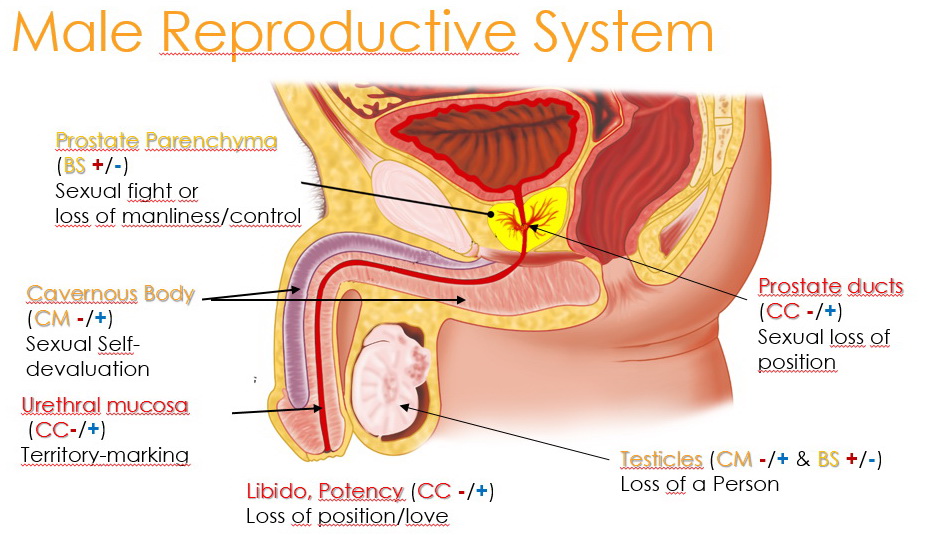
The seminal vesicles (spermatocysts) close to the prostate secrete about 70% of the semen. Their excretory ducts lead, together with the seminal ducts (vas deferens) and the ductules of the prostatic glands into the ”Sinus prostaticus ”beside the” Colliculus seminalis ”of the urethra.
The seminal ducts run from the epididymis, where sperm is matured and stored, through the inguinal canal and prostate to the urethra. They transport the sperm into the ejaculate.
Brain
Relay:
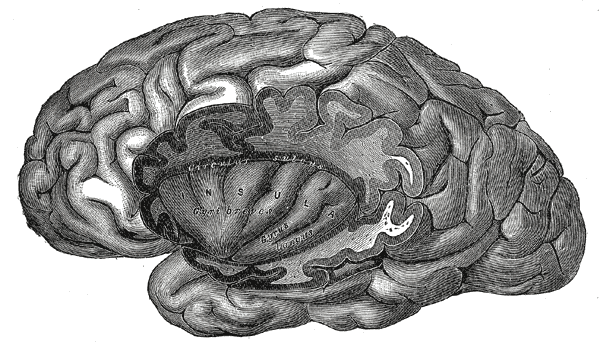
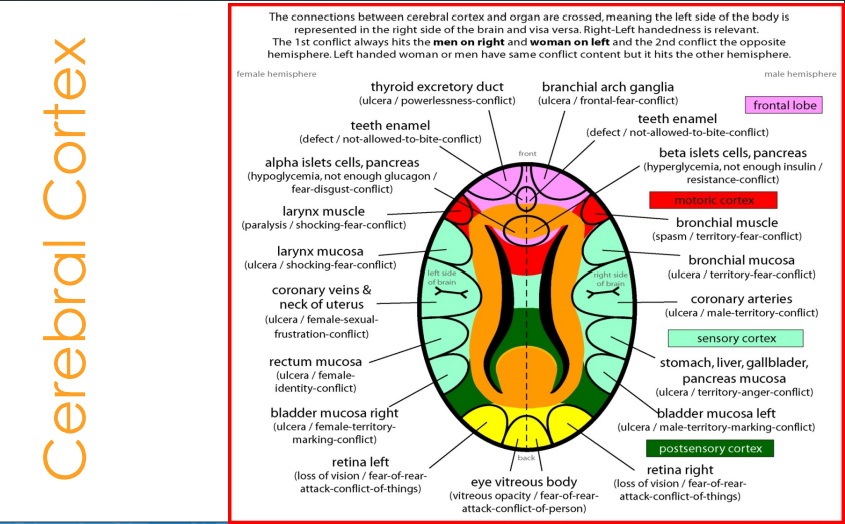
Cerebral Cortex ( – / + ) dorsal insular area right, for intima/inner layer
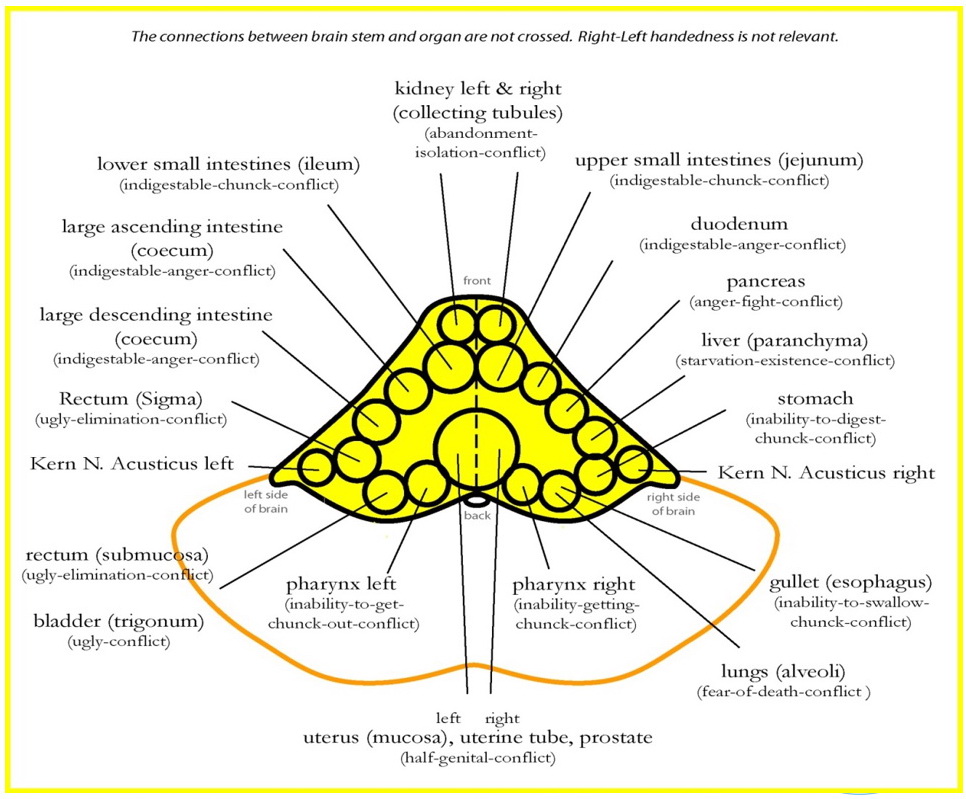
Midbrain (+/-) central, for smooth muscle layer
compare Brain Stem
Mind
Theme:
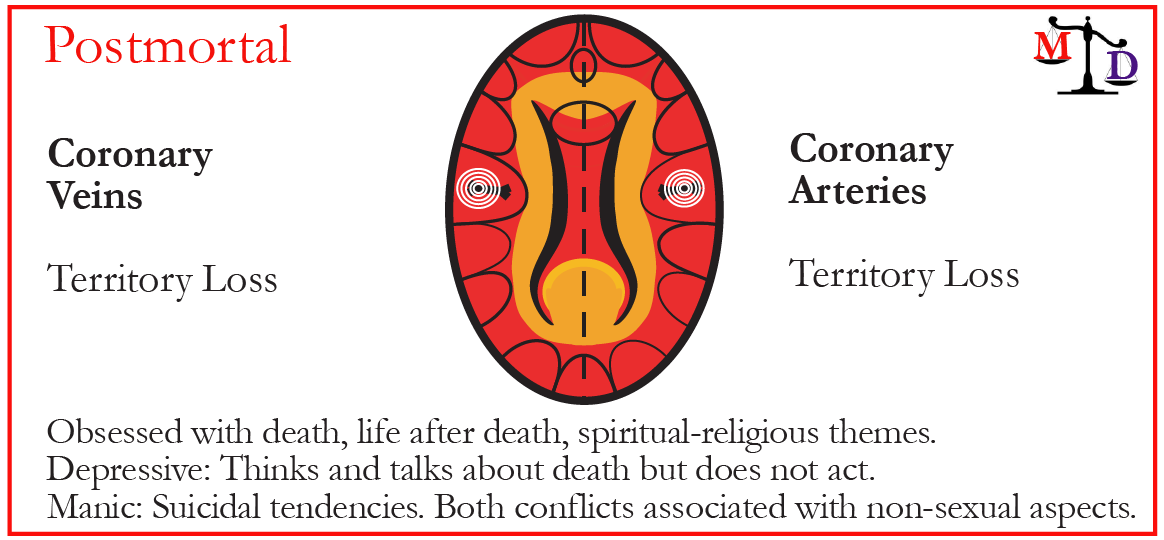
1. Loss of territory (a territory conflict can be a family-related, a sexually-related or a profession-related conflict).
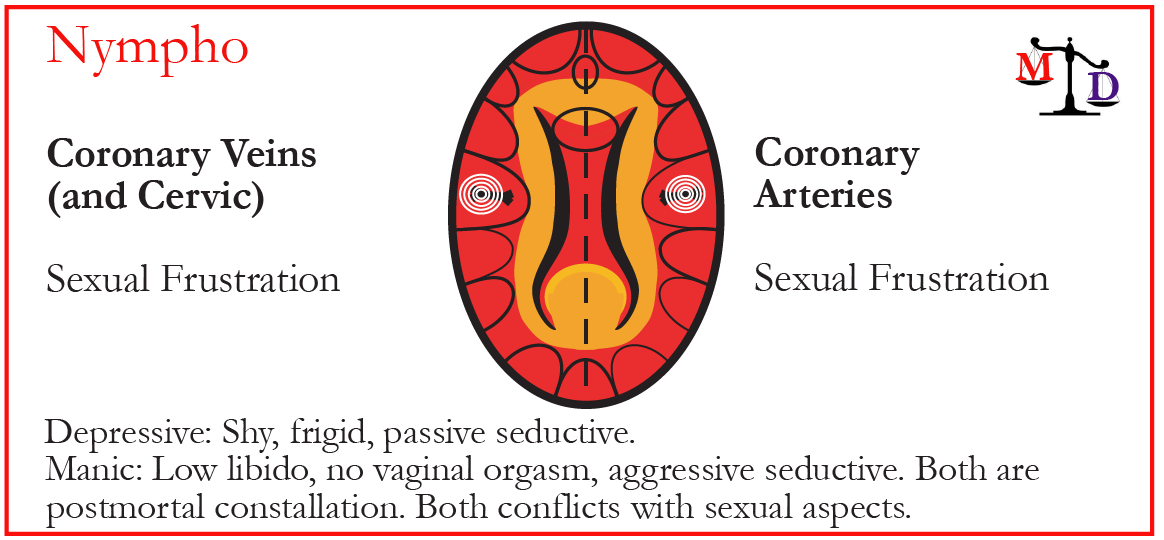
2. Not feeling loved (female perception in territorial constellations) or sexual conflict.
Emotions and Thoughts:
1. Rage
- She’s gone!
- They have taken my place!
- I have lost my rank!
- I’ve got to win!
- He stole my woman!
- My life has lost it’s meaning.
2. Sadness, self-abandonment - I feel like I lost my heart.
- Sex is awful!
- Why don´t you want me?
- Why don´t you love me anymore?
- The essence of who I am is shattered.
- My life has lost it’s meaning.
META-Meaning:
- Now I can decide to open up for feeling the true meaning of love.
- Now I can decide to open up for being free.
- I totally love and accept myself as I am.
Organ
Sensitivity changes according to Outer Skin /Epidermis pattern with hyperesthesia in regeneration phase
Stress Phase Symptoms:
The ducts widen, leading to temporarily enhanced secretion, and their sensitivity is reduced. Later, the ductules may ulcerate.
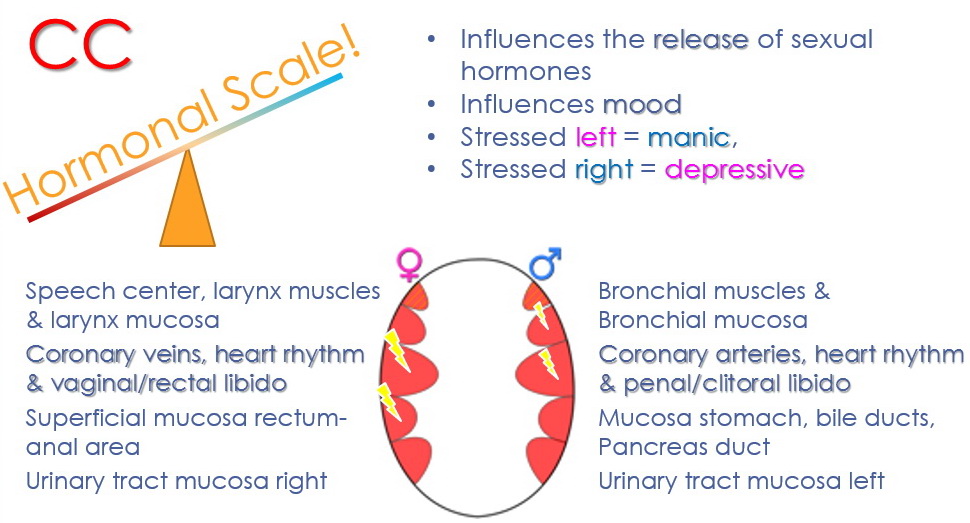
During stress phase the testosterone level falls which influences fertility and potence. The concerned may experience erectile dysfunction and depressive states. The penile arousal is reduced.
Simultaneously, interaction with coronary arteries possible (bradycardia, extrasystoles, angina pectoris)
Regeneration Phase A:
Painful inflammatory swelling of the epididymis or prostate ducts causes obstruction, possibly even oliguria and residual urine. High fever can occur. The urothelium proliferates without changing PSA levels. Possible diagnoses: prostatitis, epididymitis, prostatic intraepithelial neoplasia (PIN), prostate cancer, prostate carcinoma.
Healing Peak:
Short blackout/absence. Unvoluntary ejaculation. Interaction with coronary arteries is possible (coronary infarction)
Regeneration Phase B:
Normalization and scarring. The urothelium may proliferate without changing PSA levels. Possible diagnoses: prostatic intraepithelial neoplasia (PIN), prostate cancer, prostate carcinoma.
Biological Meaning:
Due to widening in stress phase, there is an enlargement in the excretory capacity of the ductules.Thereby, more prostatic secretion can be supplied for ejaculation.
Social
Examples:
- A retired man experiences that he lost his territory (at work) and has to establish a new one at home. His partner becomes a “rival” for him.
- The client, president of a company, fights with business partners who seem to take his position. He develops prostatic cancer. (Maggi, MHU archive)
Additional Information
The seminal vesicle´s and prostate’s functions are greatly influenced by sexual hormones. Any territorial constellation, as well as processes of testicles and epididynis, influence the sexual hormone balance, and thereby the function of the accessory glands.
Possible Constellations
Death-Seeking: together with Coronary Veins relay. Interest in death and afterlife. Fearlessness, giving oneself up for a greater purpose. Suicidal thoughts and risk of suicide in mania. Positive: Unconditional love
If together with aggressive constellation, possibly suicidal assassin.
Casanova: together with Coronary Veins relay, if both conflicts had a sexual theme. Flirting and constant attraction of transitory lovers but restricted sexual arousal and often reduced potency.Positive: Unconditional love.
Differential Diagnosis:
Prostate Gland (Brain Stem, +/-) stress phase (male control/worry): lasting increase of secretion & PSA level, tissue proliferation; regeneration phase: prostatitis, gonorrhea, nightly sweating, light fever
Testicles (Cerebral Medulla, -/+): reduced testosterone production in stress phase (loss of a person), increased production from the end of regeneration phase.