Gallbladder, Intrahepatic and Common Bile Ducts
Anatomy
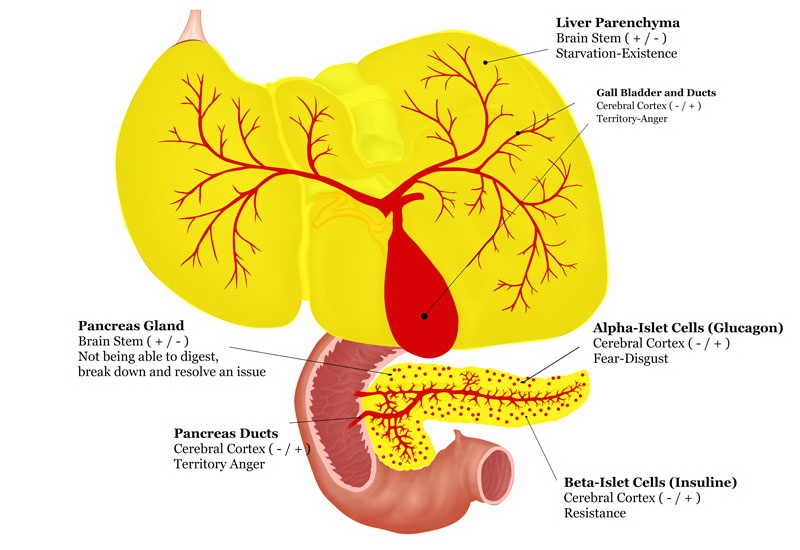
Bile is a yellow-green digestive fluid that is made by the liver, stored in the gallbladder and passes through the common bile duct into the duodenum where it helps to digest fat. After the fat is absorbed, the bile is also absorbed and transported back to the liver for reuse. The principal component of bile is cholesterol. The gallbladder stores the bile, thickens it and empties when required.
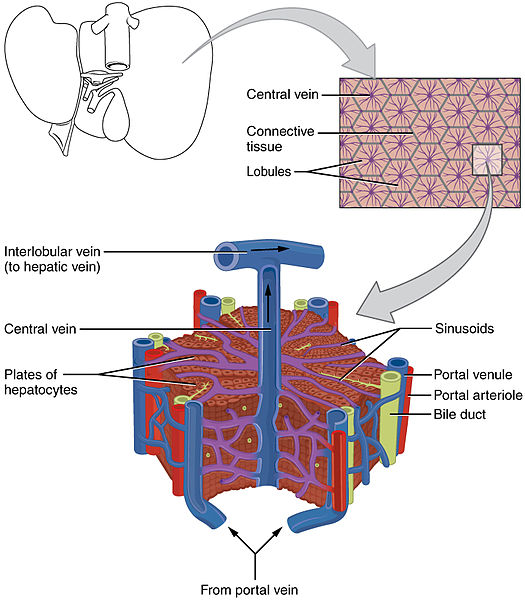
The intrahepatic bile capillaries – gaps between hepatocytes – converge into an interlobular duct, which runs together with a branch of the hepatic artery and the portal vein as Glisson-Trias to the periphery of the hepatic lobe.
The common hepatic duct is the duct formed by the convergence of the right hepatic duct, which drains bile from the right functional lobe of the liver, and the left hepatic duct, which drains bile from the left functional lobe of the liver. From their common hepatic duct the cystic duct separates to run to the gallbladder.
The gallbladder is situated just beneath the liver. It is divided into three sections: fundus, body and neck, and it’s wall contains smooth muscle. The neck tapers and connects to the biliary tree via the cystic duct, which then joins the common hepatic duct to become the common bile duct. At the neck of the gallbladder is a mucosal fold as a functional sphincter.
Brain
Relay:
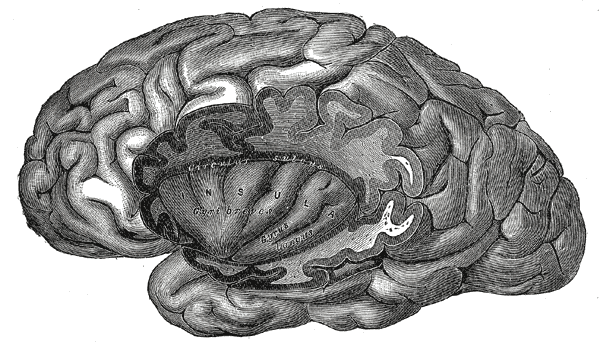
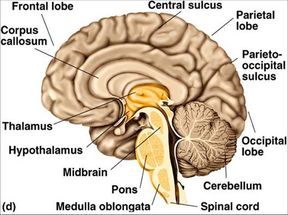
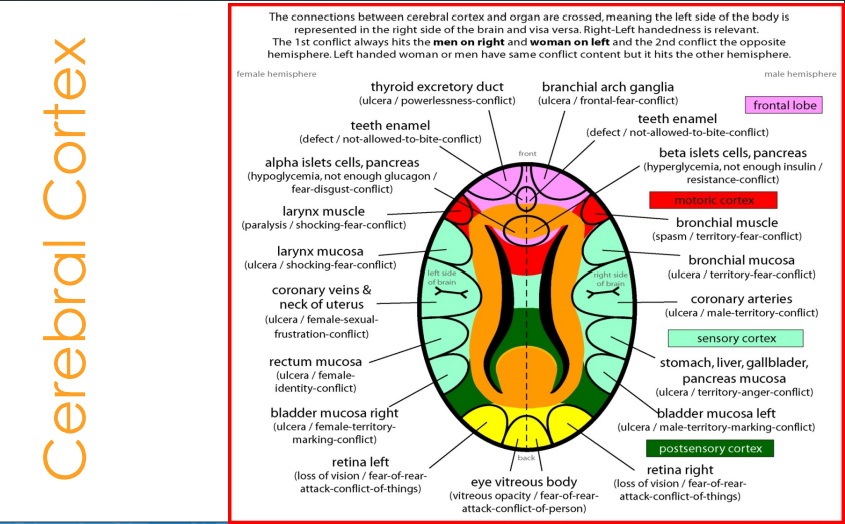
Cerebral Cortex ( – / + ) insular region medio-lateral right hemisphere, territorial “4 o’clock relay”
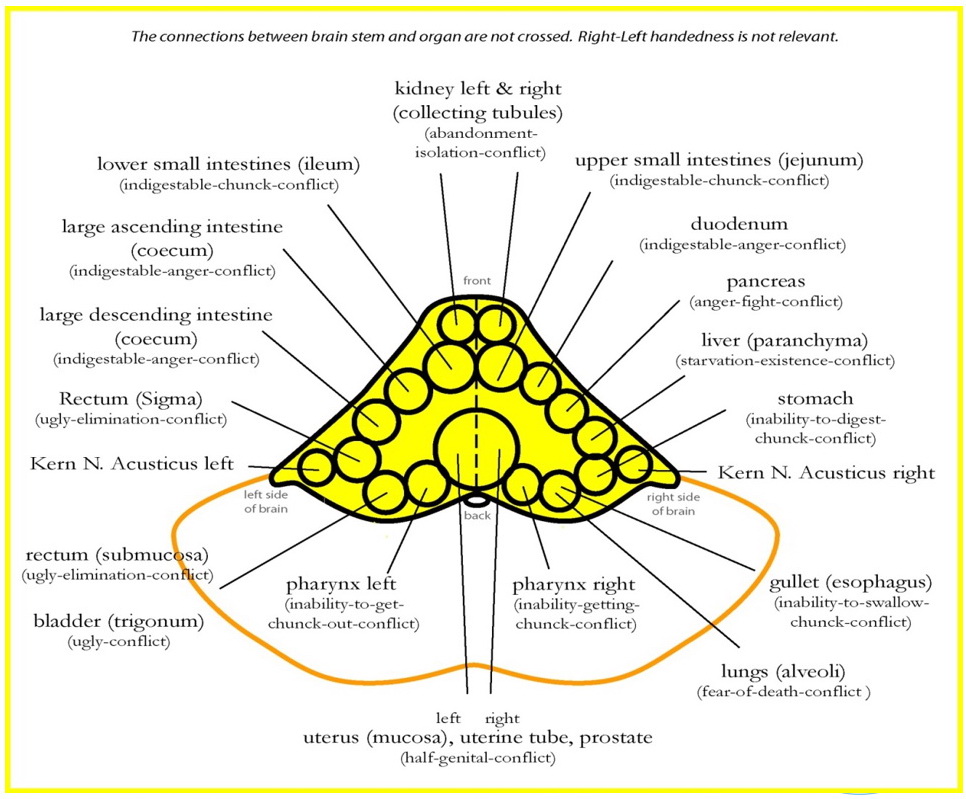
Midbrain (+/-) medio-lateral right, for smooth muscle layer
compare Brain Stem
Mind
Theme:
1. Territorial Anger, Competitiveness (male perception)
Often about border disputes with siblings, neighbours, work colleagues or because of the possession of a girlfriend/partner or money
2. Identity (female perception)
Does not know where she belongs or where she is going or what decisions to make (decision-conflict). This conflict belongs to the territorial area of the left cerebral cortex in women and it may have a sexual aspect, similar to sexual frustration conflicts.
Emotions and Thoughts:
1. Anger, rage about somebody who invades our territory, our own space or domain:
- They are encroaching into my space.
- This is my emotional/physical space, this is me.
- How can he do that!
- Don’t you dare!
2. Indecisiveness: - What is my position here?
- Should I follow him?
- What am I doing here?
- Who am I really?
META-Meaning:
- I always know how to find the right solution.
- Now, I respect and I am being respected.
- I find the answer in my heart.
Organ
Sensitivity change according to Inner-Skin-pattern with hyperesthesia in stress phase.
Stress-activity inhibits release of testosterone
Stress Phase Symptoms:
In the first phase the ducts widen to release more bile. In this phase cells slough off and mix with bile. Peristalsis presses the cells together. This agglutination leads to the development of gallstones. The bile gets thickened.
Later, ulcerations of the intrahepatic and the extrahepatic bile ducts and the gall bladder develop, mostly accompanied by spasms, pain and a biliary colic. Typical symptoms are abdominal tension, vomiting of bile, and chills.
In long-lasting conflicts the liver can shrink, which may be diagnosed as liver cirrhosis.
Even pancreas, stomach, and duodenum can be affected. Herbs, liver cleanse and other supportive therapies are useful here.
Regeneration Phase A
Cell proliferation to repair ulcerations, often accompanied by virus infection, inflammation, high fever.Typical symptoms are swelling of the biliary ducts which can lead to a temporary adhesive closure, cholestasis. It can result in the accumulation of bilirubin in the bloodstream and in the tissues, which can be seen as an icterus of the skin and sclerae. The blood test results shows increased levels of gamma GT, AP and bilirubin.
Hepatic enlargement which is accompanied by a pulling pain in the liver capsule can appear when kidney tubules are stress-active simultaneously.
The elevated cell proliferation can be diagnosed as a malignant tumor by conventional medicine under unfavourable circumstances.
Diagnoses include: - Hepatitis A and B
- Hepatitis C, that is a non-A non-B virus hepatitis
- Carcinoma of the biliary ducts (cholangiocellular carcinoma)
- Gallbladder carcinoma
An interesting fact: More than 80% of the patients with gallbladder carcinoma have gallstones.
Healing Peak:
A/B: During the period of the increased level of gamma GT and AP test results. This can lead to a serious hypoglycemia, as the liver does not release more glucose.
C: Biliary colics with or without the passage of gall bladder stones:
Regeneration Phase B
A fibrous repair after the inflammatory reaction may be diagnosed as liver cirrhosis which develops from the partly connective tissue-, partly squamous epithelium- originated tissue structures. The most frequent causes increasing the risk of cirrhosis include alcohol consumption, drug intake, intoxications and different metabolic disorders.
Primary sclerosing cholangitis which can be caused by intensive conflict relapses, by which we see the sclerotization of the biliary ducts may also appear after the healing peak.
Chronic hepatitis can often be developed by further or repeated territorial anger conflict relapses. Typical symptoms are reduced performance, fatigue, anorexia, pressure pain in the liver region, slightly enlarged liver, 33% enlargement of the spleen, possibly leuko- and thrombopenia, skin changes including, but not limited to, smooth red tongue, palmar erythema, vascular spiders, itching with scratching, white nails. In female patients; dysmenorrhea or secondary amenorrhea, absence of menstruation and in male patients: loss of male hairiness. The main complications of chronic hepatitis are liver cirrhosis and hepatocellular carcinoma.
Fatty liver: Besides the stress-related increase of fat storage, the main factor of the development of a fatty liver is the excessive intake of alcohol. However, there are many factors such as diabetes mellitus, overweight, hyperlipoproteinemia, parenteral feeding, protein malnutrition, different kinds of drugs, e.g. Tetracycline and hypoxia, but civilisation-related malnutrition and the disorders of lipid metabolism that also contribute to the development.
Biological Meaning:
The expansion of biliary ducts, through ulceration, results in an improved bile flow rate, which provides better digestion of fats, thereby more energy can be saved in order to deal with territorial anger conflicts.
Social
Examples:
1. Territorial anger/Competitiveness:
This is often about border disputes with siblings, neighbours, work colleagues or because of the ’possession’ of a girlfriend, partner or money - An employee gets repeatedly accused and aggressively addressed by colleagues because they made an error during the performance of their duties.
- The landlord enters a tenant’s apartment unannounced in the company of the new tenant, disregarding the resident tenant’s private sector. Both of them speak in an unpleasant and rude way, thereby the causing the resident tenant to feel disturbed and insecure.
- An adult son argues with his father about technical issues. The father knows everything better.
- A stepfather was sneakily accused of sexually abusing his stepdaughter.
2. Identity/Indecisiveness
The affected person doesn’t know where she belongs or where she’s going and what decisions to make. This theme reflects in the territorial area of left cerebral cortex, and it may have a sexual aspect.
*
A woman is constantly criticized and disparaged by her partner. She is very uncertain and no longer knows what to think about herself. She doesn’t even know how to behave with her partner. - A couple talk about moving to another country. While the man is focused on making plans, his wife feels ambiguity because she doesn’t want to leave her position and relations.
Both conflicts often lead to aggressive behaviour or depression (see constellations).
Additional Information
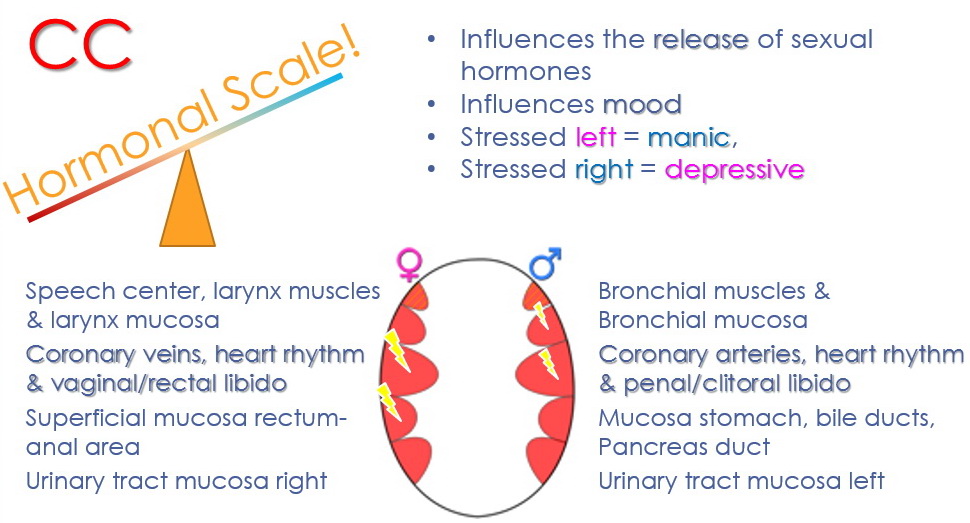
This relay belongs to the “territorial relays” in the peri-insular cerebral cortex, with the theme of social position and affiliation. Special rules apply for the meaning of side dominance. Conflicts affect the sexual and social “hormonal scale” and can promote manic or depressive episodes (see “territorial constellations” related to the function of the neurohypophysis).
Lab Parameters for Liver:
GGT: Normal range by men: up to 28, by women: up to 19;
With territorial anger conflict, there is an increase in the GGT-level in the regeneration phase, when the biliary duct cells are also involved and because of the regeneration phase, there is an elevated cell proliferation rate as well.
Up to 200 uncritical;
Up to 400 critical;
Above 400, in the healing crisis, quite severe and dangerous
GOT and GPT: Elevate in the case of a hepatobiliary occlusion, when there are elevated bilirubin levels in the bloodstream.
AP: Differential diagnostically: it can be also changed by a bone ‘process’…
Cholesterase: A statement about the synthetic performance of the liver;
Normal range: between 2000-3700 U/L;
Under 1500: extremely critical
Possible Constellations:
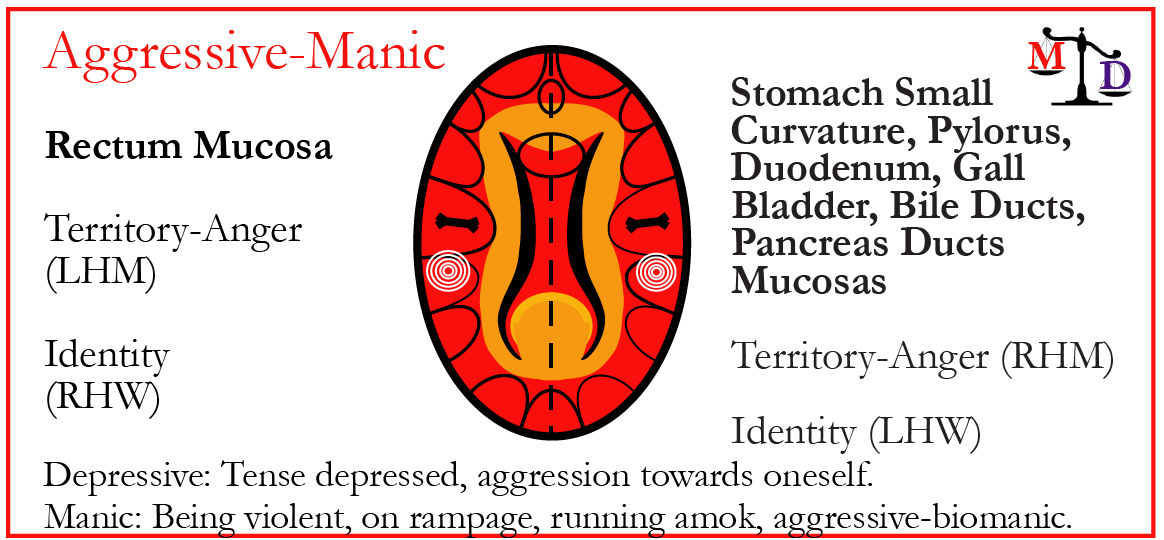
Aggressive: Together with Rectum/Anal Mucosa relay. The person is aggressive and possibly violent against himself or others. Positive: courage and will to resolve the conflict.
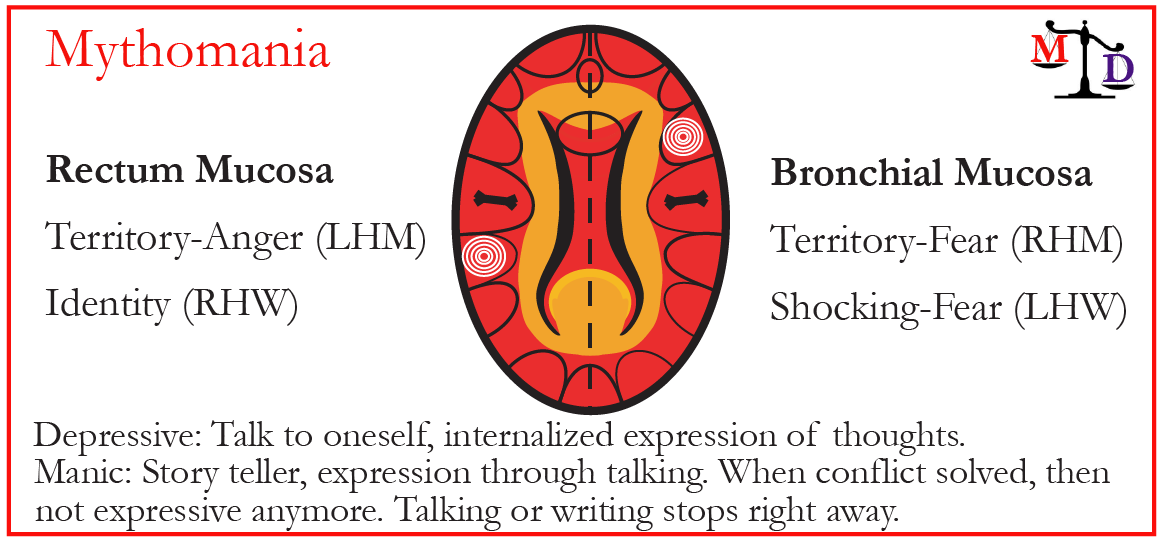
When together with Bronchial Mucosa activation, aggressive mythomania leads to “Paparazzi”- or “Führer” behaviour.
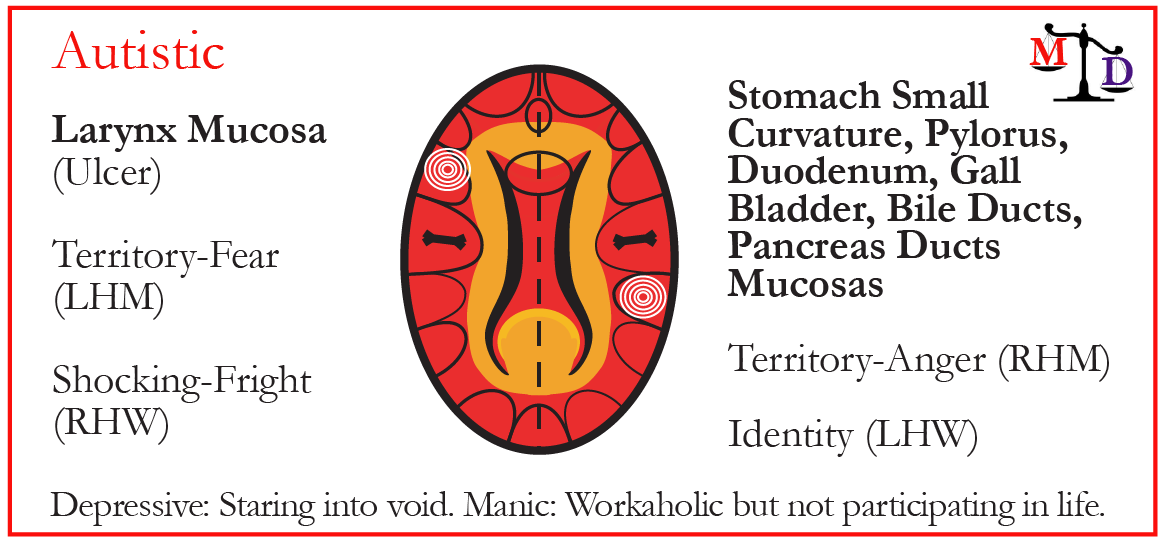
Autistic or Introvert constellation: Together with Larynx Mucosa relay. The person shows an introvert and self-centered personality, distracted and living in their own world. Positive: focus!
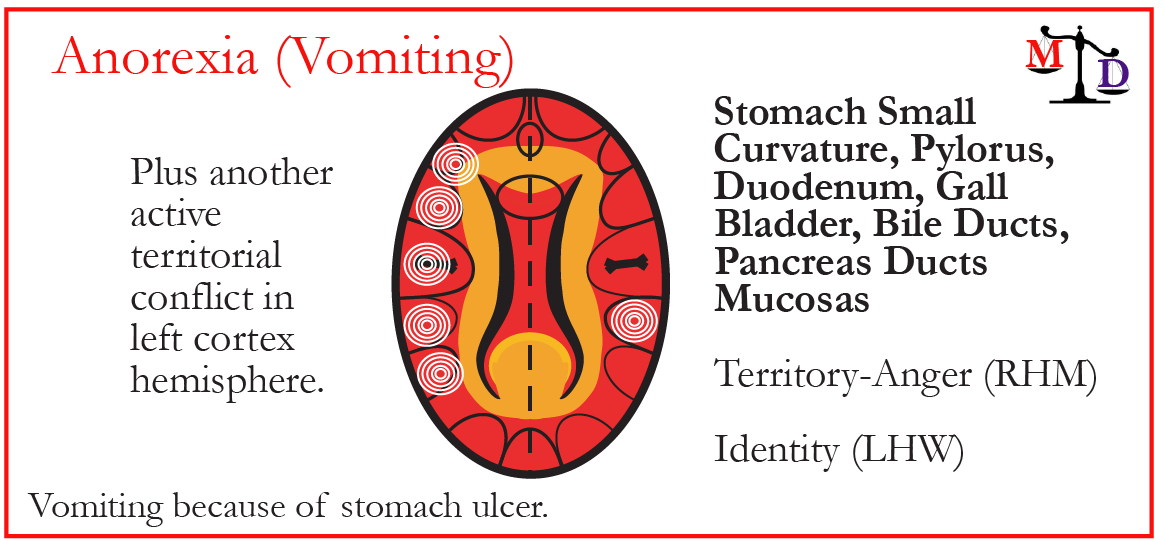
Anorexia: Together with another active periinsular relay in the left hemisphere. The person is unwilling to eat, or throws food up again.
With these 3 constellations mania and/or depression will be present depending on hormonal status and conflict impact.
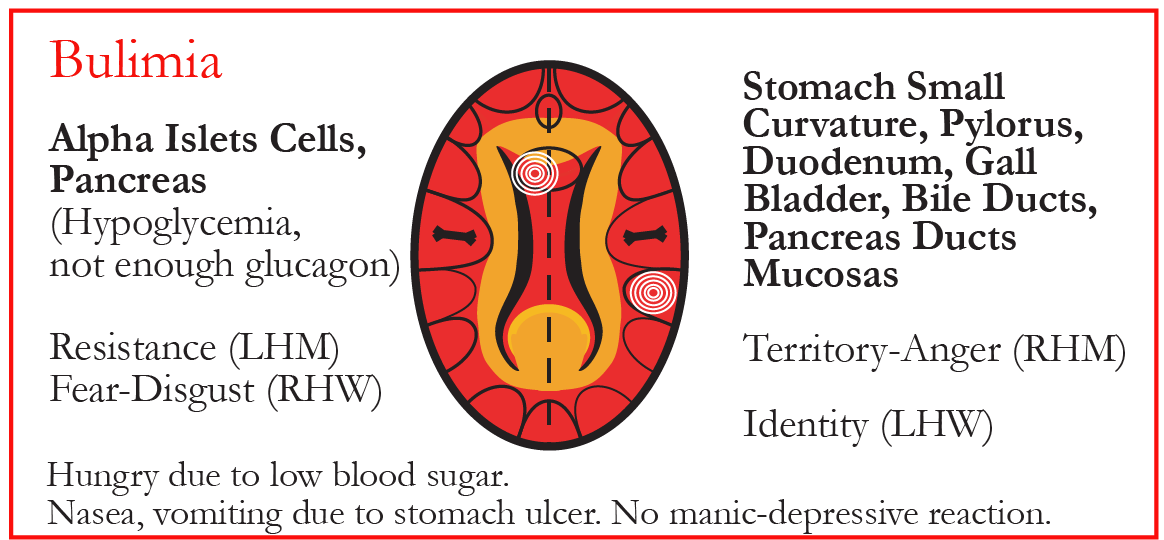
Bulimia: Together with Pancreas Alpha Islet Cells relay. The person is binge-eating (reflects hypoglykemia) and throwing up (reflects painful gallbladder).
Differential Diagnosis:
Liver Parenchyma(Brain Stem +/-): with adenoma in stress phase (starvation), tuberculous decomposition in the regeneration phase and possible cirrhosis after recurring processes.