Eyes – Vitreous Body
Anatomy
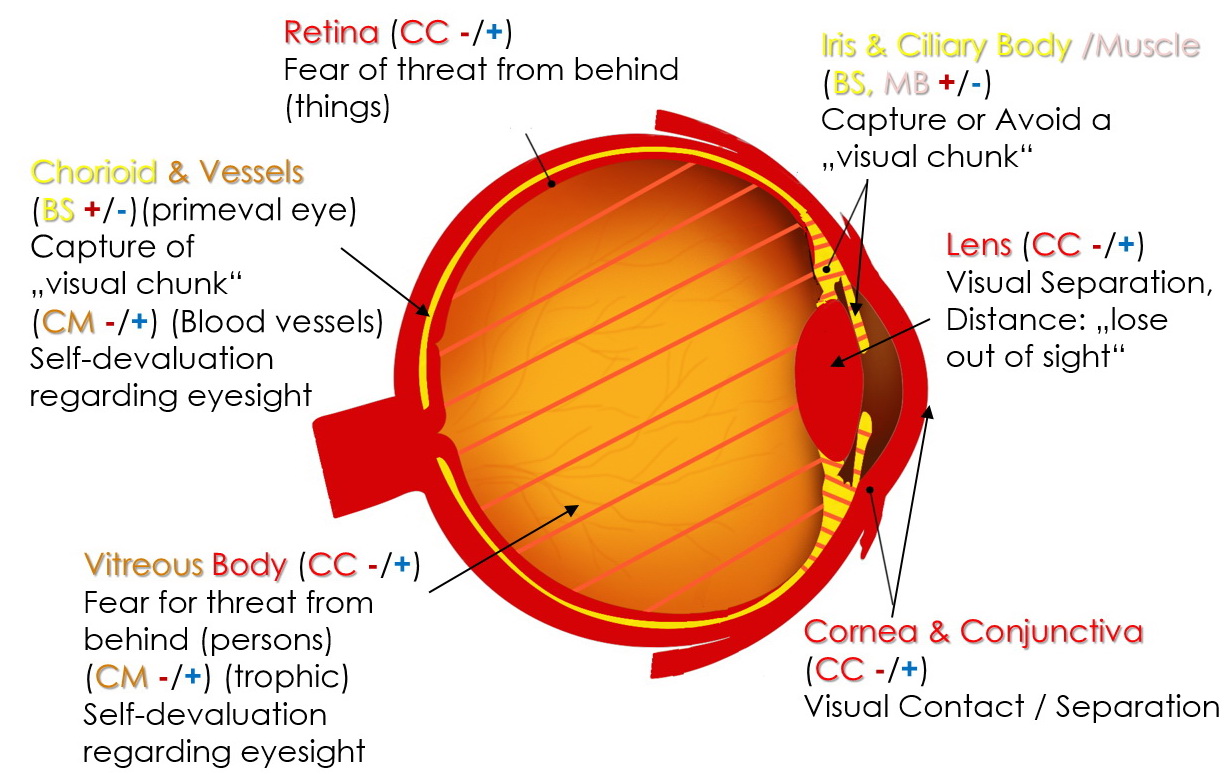
The vitreous is the transparent, colourless, gelatinous mass that fills the space between the lens of the eye and the retina lining the back of the eye. It is present at birth and does not change much over the course of aging. It is produced by cells in the non-pigmented portion of the ciliary body deriven from embryonic mesenchyme cells which then degenerate after birth. Its composition is similar to the cornea, but contains very few cells (mostly phagocytes which remove unwanted cellular debris in the visual field).
Although the vitreous is in contact with the retina and helps to keep it in place by pressing it against the chorioid, it does not adhere to the retina, except at the optic nerve disc,where the retina sends about 1.2 million nerve fibres to the brain.
Brain
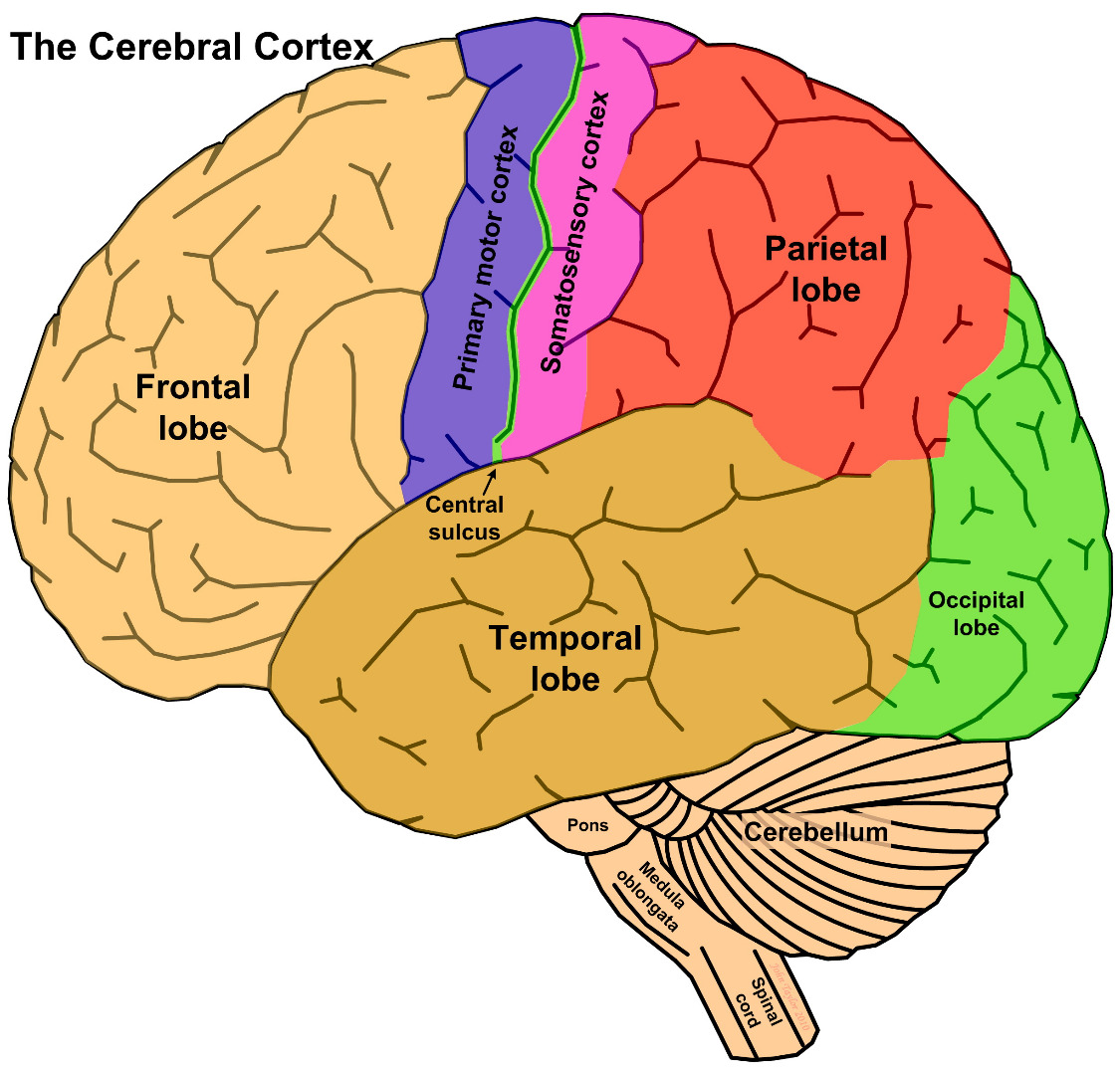
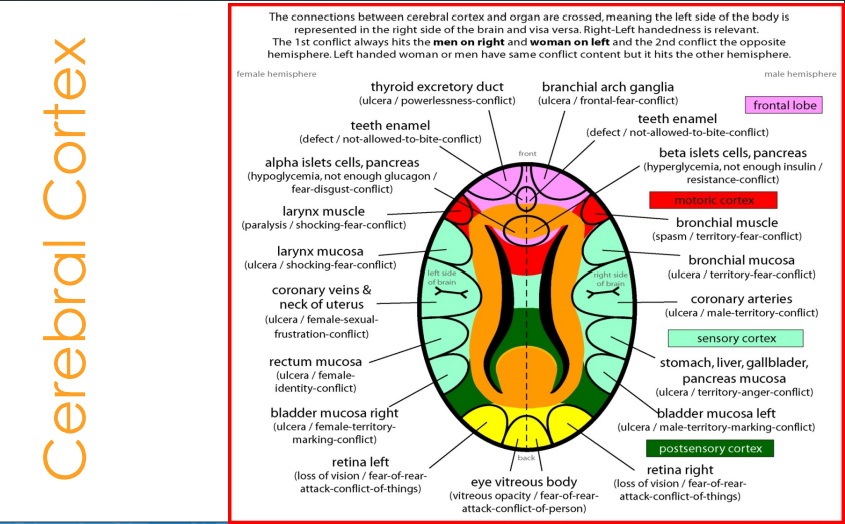
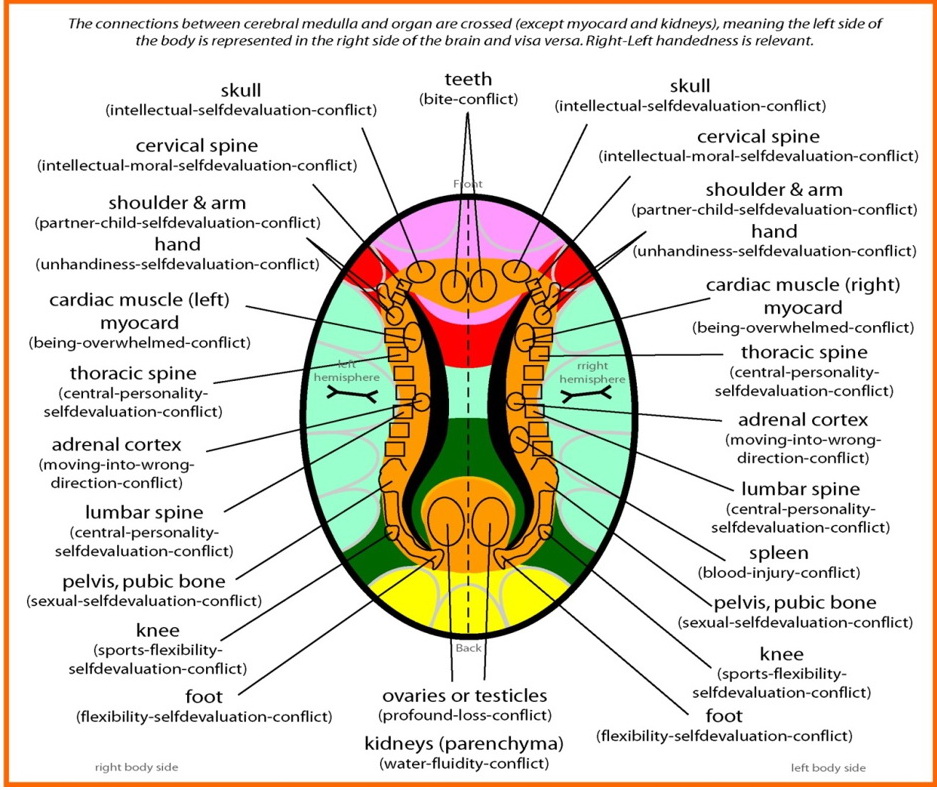
Occipital region in Cortex & Medulla:
Relay:
Cerebral Cortex ( – / + ) visual area
Cerebral Medulla ( – / + ) occipital for trophic
Mind
Theme:
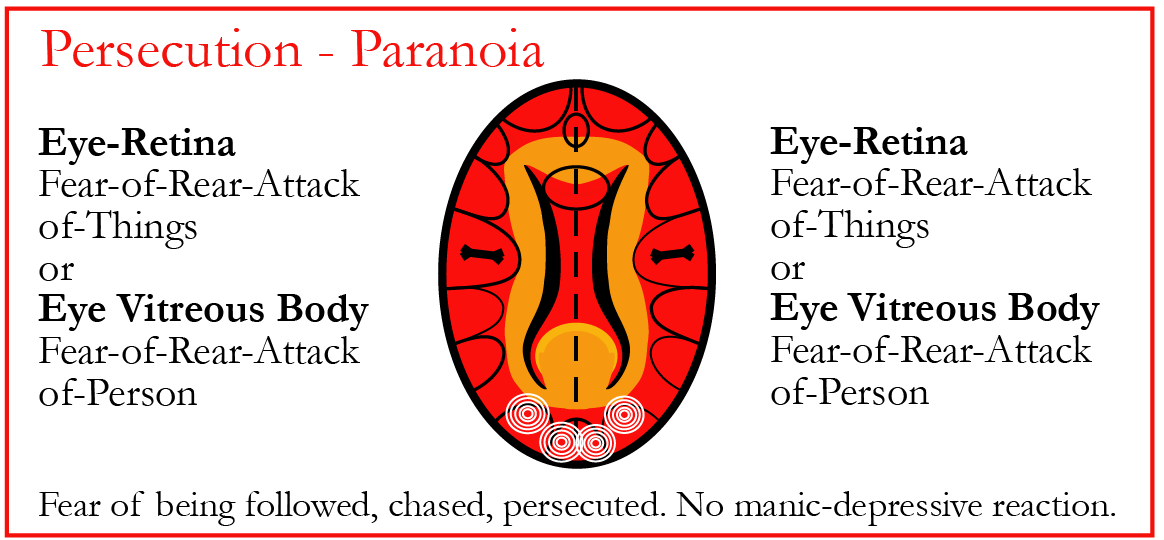
Fear of threat/attack from behind (persons)
Emotions, Thoughts:
Fear, worry
- Somebody or something is threatening us unexpectedly and frightening us.
- A danger, fear or something that we might see but cannot let go.
- Something we actually have seen or imagine visually and believe to be true.
- There is somebody!
- I can’t get rid of him!
- This was totally unanticipated.
- The danger is looming over me.
- They are pursuing me.
META-Meaning:
- Now, I am safe and secure.
- Everything I need to see is within my reach.
- Now, I can look around fearlessly.
- I perceive everything important with all my senses.
Organ
Stress Phase Symptoms:
Reduced intraocular pressure, glaucoma. The most typical symptoms are the reduction iof the visual field like tunnel vision, and sudden vitreous opacities. Possible diagnoses scotoma, glaucoma.
Regeneration Phase A:
Normalization of the vitreous opacity accompanied by a glaucoma (increased intraocular pressure). The edema might press on the entry hole of the optic nerve (especially with active water retention syndrome). Laser operations in this state can be critical.
Healing Peak:
Strong decrease of intraocular pressure.
Regeneration Phase B:
After the healing peak the pressure normalizes slowly.
Remnant: Floaters by scarring/agglutination of collagen fibrils in the vitreous; also sparks (Synchisis scintillans) through cholesterol crystals in the vitreous body.
Biological Meaning:
Loss of function or partial clouding of the vitreous body in the stress phase disguises the danger that lurks behind.
Social
Examples:
- A school pupil lives in constant fear for the teacher looking him over the shoulder. He seems to hunch over his books and develops short-sightedness.
- A woman feels mobbed at work, thinking her colleagues and boss are observing her waiting for an opportunity to find faults in her work. This is connected to her social status, so she gets both depressed and a persecution constellation.
- A violent rape movie triggered a long repressed memory for a woman, who developed a persecution constellation. She sees many floaters.
Additional Information
Unlike the fluid in the frontal parts of the eye (aqueous humour) which is continuously replenished, the gel in the vitreous chamber is stagnant. Therefore, if blood, cells or other byproducts of inflammation get into the vitreous, they will remain there unless removed surgically (see floaters). If the vitreous pulls away from the retina, it is known as a vitreous detachment. As we age, the vitreous often liquefies and may collapse. This is more likely to occur, and occurs much earlier, in eyes that are nearsighted (myopia). It can also occur after injuries to the eye or inflammation in the eye (uveitis).
Possible constellations:
Optical hallucination: relays in both hemispheres are involved. which results in seeing pictures, also visual channeling
Persecution: relays in both hemispheres are involved. which results in paranoia, suspecting threats behind every corner. If the conflicts have a sexual/territorial theme, mania and depression can occur.
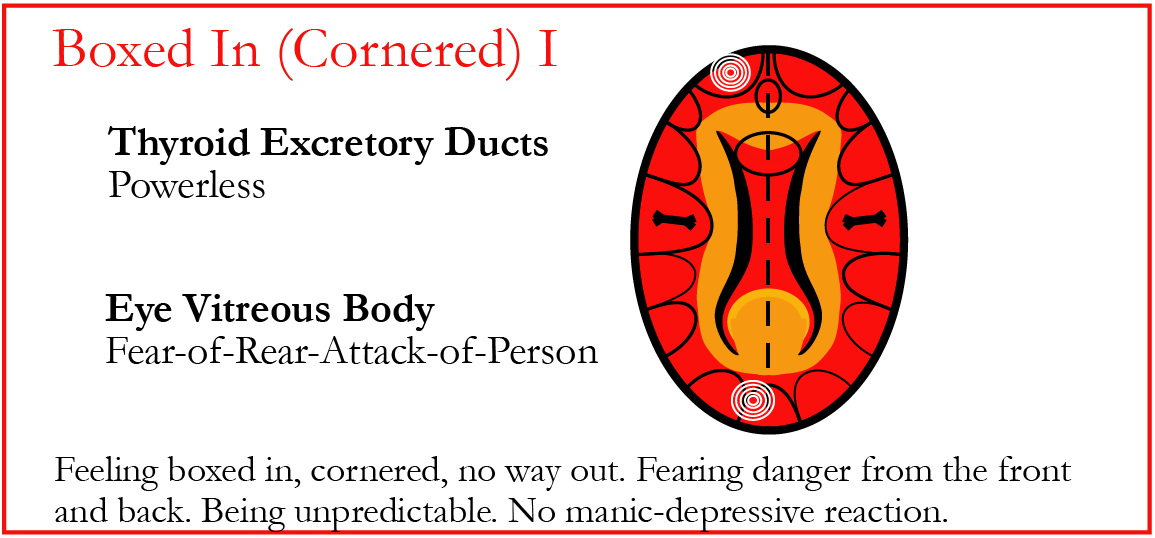
Cornered/Boxed in: One occipital relay and one frontal relay are concerned primeval thyroid duct/primeval pharyngeal ducts). This can be mono- or bilateral. Freeze response or unpredictable spontaneous behaviour to survive the perceived threats.
Differential Diagnosis:
Retina(Cerebral Cortex -/+) stress phase (persecution fear, guilt): Function reduction (colour/contrast vision) and retina degeneration; retina detachment in regeneration phase A, retinitis pigmentosa can be mistaken for uveitis. Short- or far-sightedness can be residual states after recurring processes with scarring & deformation.
Crystalline Lens(Cerebral Cortex -/+)stress phase (loss of meaning in life): Decrease in trophic, thinning of the lense; temporary cataract (opacity), late reinforcement and possibly loss of elasticity in regeneration phase, leading to presbyopia, astigmatism or myopia.
Cornea(Cerebral Cortex -/+): Chronic processes lead to deformation of the cornea and to astigmatism.
Chorioid(Brain Stem +/-) stress phase (light conflict): neovascularization, proliferation of pigment layer leads to reduced contrast vision, possibly macula degeneration; Regeneration phase: chorioiditis, uveitis, normalization