Eyes – Cornea
Anatomy
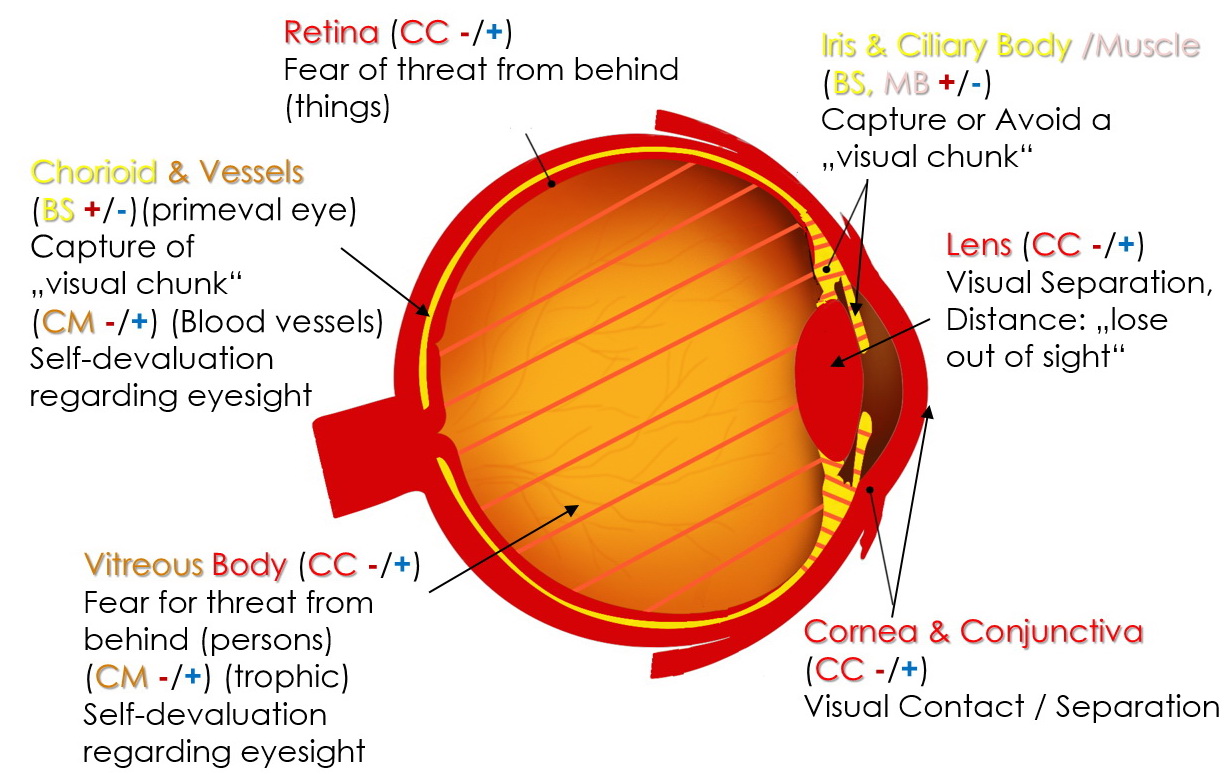
The cornea is the protective transparent front part of the eye that covers the iris, pupil, and anterior chamber. Together with the lens the cornea refracts light and helps the eye to focus. While the lens is flexible, the form of the cornea is fixed. Because transparency is of prime importance the cornea does not have blood vessels; it receives nutrients via diffusion from the tear fluid at the outside, and the aqueous humor at the inside, and also from neurotrophins supplied by nerve fibers that innervate it. The cornea has unmyelinated nerve endings sensitive to touch, temperature and chemicals. A touch of the cornea causes an involuntary reflex to close the eyelid.
The cornea consists of 6 layers with different functions:
- The epithelium stabilizes the tear film and contains lymphatic Langerhans cells (not to confuse with Islets of Langerhans)
- Bowman’s membrane maintains the structure of the epithelium
- The corneal stroma (main part of connective tissue with keratocytes and fibrocytes)
- The dua layer is thin and tear-resistant
- The descemet-membrane (elastic membrane of collagen fibres)
- The Endothelium maintains the transparence and regulates metabolic processes
graphic:Von Bomber62, CC BY-SA 3.0
Brain
cerebral cortex areas
Relay
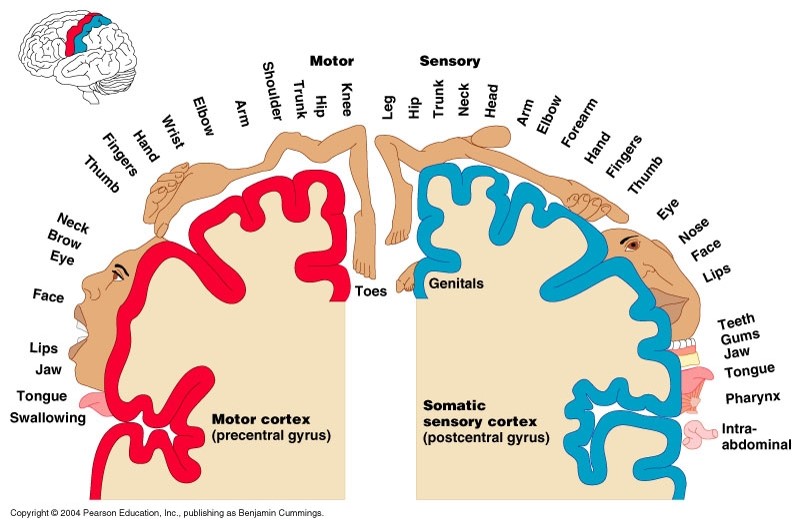
Cerebral Cortex ( – / + ) sensory area lateral left & right, brain-organ-relation crossed
Mind
Theme
Visual loss of touch: Losing out of eyesight because of being separated
Emotions, Thoughts
Fear, Grief
- Where is she gone?
- You mustn’t go away!
- They took her away from me.
- I am afraid of losing you!
- It is my fault that I don’t see him anymore.
META-Meaning
- I am emotionally independent and feel a deep connection with my loved ones.
- Nothing can part our inner connection.
- I can look forward into life!
Organ
Sensitivity Reaction according to Outer Skin/Epidermis Pattern with hyperesthesia during the regeneration phase.
Stress Phase Symptoms
Thinning of the stroma. Cell loss can be diagnosed as an ulcer of the cornea, as corneal dystrophy, or in long stress phases as Keratoconus, by which the thinned cornea changes shape. This creates a form of myopia.
Regeneration Phase Symptoms
Enhanced trophic and water absorption and refilling of the ulcer. Typical symptoms: temporary opacity of the cornea, or keratitis (common name of corneal inflammations, frequently accompanied by edema and pain). Chronic: shape changes through scarring lead to astigmatism, inclusions can also appear.
Biological Meaning
By the changed and distorted vision in stress phase, the visual separation is meant to be perceived differently and easier to handle.
Social
Examples
- A baby is separated from her twin sister and her mother while being in the incubator. Already as toddler she is diagnosed with astigmatism.
- A boy loses sight of his beloved cat when he gets into school. It disappears and doesn’t return. The boy blames himself and gets progredient astigmatism.
Additional Information
As the only supply to the cornea happens through tear fluid, the processes of lacrimal glands (+/-) and -ducts (-/+) have an influence on the trophic of the cornea as well.
Corneal neovascularization (excessive ingrowth of blood vessels into the cornea) is a chronic process.
In trachoma lymph follicles (-/+) grow in the conjunctiva, which damage the cornea and lead to progredient scarring.
Differential Diagnosis
Conjunctiva (Cerebral Cortex-/+): decreased sensitivity and possibly ulceration in stress phase (visual separation), hypersensitivity and conjunctivitis in regeneration phase.
Crystalline lens (Cerebral Cortex-/+): Thinning and trophic decrease in stress phase (loss of meaning in life); Regeneration phase: temporary opacity (cataract). Loss of elasticity in recurring processes, which results in a form of astigmatism.
Eye muscles (Cerebral Cortex & Medulla -/+): hypo- or hypertension of the extraocular muscles creates a squint.