
Penis – Cavernous Bodies
Anatomy
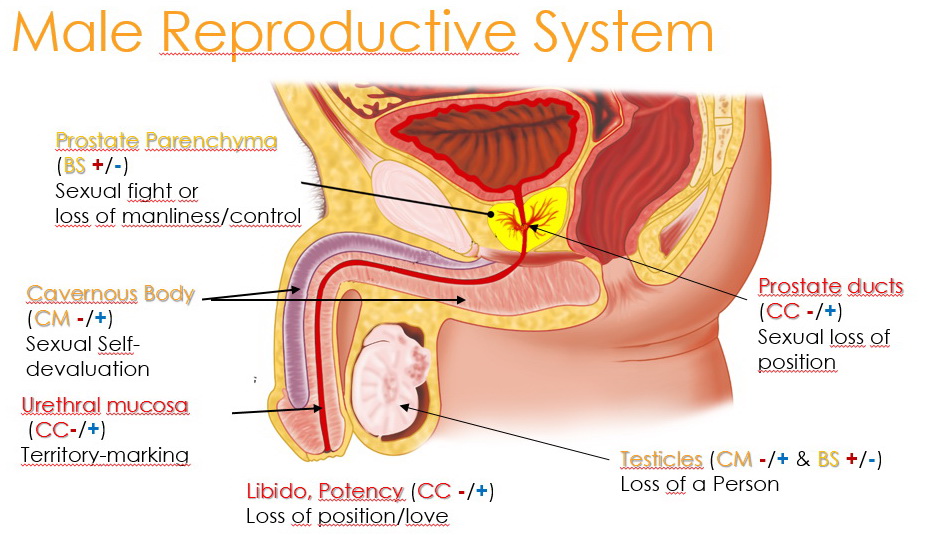
The two corpora cavernosa and corpus spongiosum are three expandable erectile tissues along the length of the penis which fill with blood during penile erection. The two corpora cavernosa lie along the penis shaft, from the pubic bones to the head of the penis, where they join. These formations are made of a sponge-like tissue containing irregular blood-filled spaces which have an inner lining of endothelium.
The arterial cavernous bodies are covered by a layer of strong connective tissue, from which the septa extend into the inner part, separating different vascular spaces. This provides the structure for erection of the penis when drainage of the arterial blood is throtteled. In unaroused state they are exsanguinated. The female equivalent is the corpus cavernosum clitoridis.
The venous corpus spongiosum surrounds the urethra and secures it’s patency during erection by elastic fibres. It continues in the bulbous glans, the tip of the penis, where it is covered by a sensitive mucosa.
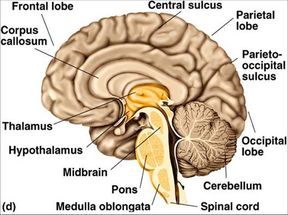
Brain
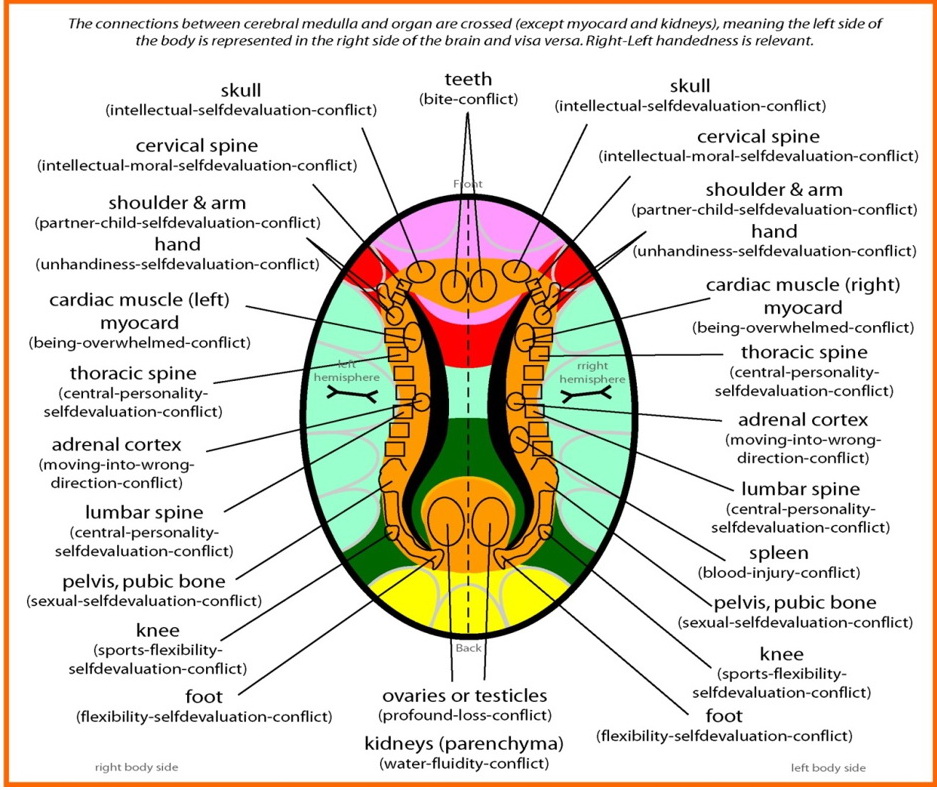
Relay:
Cerebral Medulla (-/+) central left & right in pelvic area
Mind
Theme:
Sexual Self-Worth
Emotions and Thoughts:
Frustration, self-doubt, self-hate
- I can´t get/hold him up!
- I can´t make her lucky.
- I can´t satisfy her.
- I´m not worthy as a man.
META-Meaning:
- I totally love and accept myself.
- I´m feeling confident and at ease with my love.
- Enjoying soft love makes me feel good.
Organ
Stress Phase Symptoms:
Inhibition of the erectile function, later decreased trophic of the cavernous bodies, necrosis. Possible diagnoses: erectile dysfunction, impotence, penis atrophy. Micropenis can be caused by inherited patterns and beliefs.
Regeneration Phase A:
Inflammatory swelling & oedema; in combination with water retention, priapism is possible.
Regeneration Phase B:
Replenishment, often excessive. fibrous knots can cause pain with erection. Possible diagnoses: Penis deviation, La Peyronie´s disease (Induratio penis plastica) especially in chronic cycles.
Biological Meaning:
The fibrous reinforcement of the tissue in regeneration phase could be meant to enhance and solidify erection.
Social
Examples:
- An adolescent wishes to make love but feels disturbed and distracted by memories of his mother telling him about unfaithful men.
- A student living in a commune feels ashamed and afraid of making noises with his sex partner.
- A man meets a sexually active woman in a bar, who touches his private parts. He doesn´t feel turned on but doesn´t want to admit it.
- A young man had an erection in several challenging situations like exams, and became very anxious for this happening. That curbed his potency. After releasing his fears, the reaction normalizes. (Cabral, MHU archive)
Additional Information
Penile erection is the result of a complex interaction of psychological, neural, vascular and endocrine factors, and is often associated with sexual arousal or sexual attraction, although erections can also be spontaneous. The shape, angle and direction of an erection varies considerably in humans.
Physiologically, erection is triggered by the parasympathetic division of the autonomic nervous system (ANS), causing nitric oxide (a vasodilator) levels to rise in the trabecular arteries and smooth muscle of the penis. The arteries dilate causing the corpora cavernosa of the penis (and to a lesser extent the corpora spongiosum) to fill with blood; simultaneously the ischiocavernosus and bulbospongiosus muscles compress the veins of the corpora cavernosa restricting the egress and circulation of this blood. Erection subsides when parasympathetic activity reduces to baseline.
Constellations
Sexual Megalomania in both-sided activation as a coping strategy. Compare Casanova-Constellation of coronary vessels or seminal vesicles.
Differential Diagnosis:
Diabetes is seen as a leading cause of erectile dysfunction. (See Pancreas – Beta Islet Cells)
Lymphangiosclerosis is a hardened lymph vessel (Cerebral Medulla, -/+) in the penis, e g by chronic self-devaluation patterns.
Reduced libido and arousal also happen by neuronal affections, and in stress-activity (loss of love or status) of the coronary arteries / the seminal vesicles
